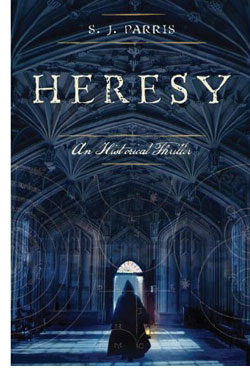
In her debut as a novelist, 'Heresy' (Doubleday / Random House ; February 23, 2010 ; $25.95), she's equally sharp and quite entertaining, even under the pen name S. J. Parris.
Still, one might wonder how she'd review her own book were it to come her way via some sort of amnesia-inducing time travel.
Fortunately, you won't find any amnesia-inducing time travel in 'Heresy.' You will find a well (and occasionally over)-wrought, highly detailed historical thriller about a guy who clearly deserves more attention. Giordano Bruno was born to be the object of not just one, but one hopes, a series of historical novels. Yes, we already know the ending. He was burned at the stake about 410 years ago. An exciting life has its problematic moments.
'Heresy' is not without problematic moments, but they're quite entertainingly overwhelmed by a great lead character and puh-lenty o' research. 'Heresy' begins in 1576, when Bruno is yanked from a two-hour visit to the privy, where he's been reading forbidden knowledge — a copy of Erasmus. And you thought bathroom lit was a recent invention!
Cut to 1583, when Bruno has made his way to what he might have hoped would be the more copacetic setting of London and in particular Oxford. But everywhere is ever a hotbed of intrigue and betrayal and late 16th century England is no exception. Elizabeth I is trying to hold together England and keep Rome at bay, but it's not easy. And Oxford is rife with conspiracies kill Elizabeth and return the England to Rome. Bruno gets recruited by Walsingham, Elizabeth's spymaster, to creep though Oxford and try to scare out the conspiracies. Of course there are deaths. And manuscripts. And, not too soon, murder.
Parris does a great job on the detailed historical aspect of this detailed historical novel. You really do get a feel for the places she describes and the lifestyles of the low and ugly. When it comes to historical thrillers, there are really two ways for a writer to go. One can write in a manner of the period in which one has set the book, or one can turn modern prose and characterizations on the historical period. From the get-go, it's clear that Parris has made the former decision, which results in a book that reads quite easily, but sometimes sacrifices authenticity of voice. And while much of the action is action-oriented, there are passages that will require that readers be as riveted by historical details as they are by mystical conspiracies and horrific murders. I like that sort of stuff and I like the feel of the way Parris has worked it into the novel. It gives the book a sort of richness.
Of course the richest resource here is Bruno, who is quite well-drawn. By picking her central figure carefully, Parris gives her novel a great backbone, a great storyteller, and a figure that modern readers can relate to. Politics and religion have ever been intertwined, and scientists here in the 21st century as still vulnerable to the same powers that decided to burn Giordano Brno at the stake. Oh, we may be setting the whole world aflame, but at least we'll be morally superior to those would prefer to lift a finger. One is forced to wonder if some four hundred years hence, a synfic critic will decide to look back at the time when critics had to set their own novels in the past to make a point in the present. And one wonders what that critic, or Stephanie Merritt herself, might have to say about 'Heresy.' Of course, some thoughts really are forbidden.
02-11-10:Max Watman 'Chasing the White Dog'
Home-Made Hooch and Rebellion
There are worlds you cannot imagine. They're probably not far from where you live.
It was just a smidge less than a year ago when I talked to the Zymurgeeks, home-beer brewers who came to the Capitola Book Café to talk about their craft. Given how huge the home-brewing and micro-brew businesses are today, it seems kind of amazing that it was only through the efforts of California's Alan Cranston that home brewing was made legal in the United States. It was 1978 when Jimmy Carter signed a law that contained the Cranston provision, making beer home-brewing legal. The amount of money that has been generated by that seemingly small decision is mind-boggling. The economic impact is staggering. Thousands of jobs were created.
You see, while they legalized the home brewing of beer, it's still quite illegal to distill your own liquor. There's an arm of the government partially dedicated to chasing you down if you do, The Bureau of Alcohol, Tobacco, Firearms and Explosives. They'll call you a Moonshiner. And maybe put you on stage with Willie Nelson.
Max Watman first encountered modern moonshine while drinking beer in a New York honky-tonk. He tells this story at the beginning of 'Chasing the White Dog: An Amateur Outlaw's Adventures in Moonshine' (Simon & Schuster ; February 16, 2010 ; $25). But what caught my eye was a single phrase — "charred liquor." I didn't know what it was, but it sounded good. And then Watman starts his search for Popcorn Sutton, author of 'Me and My Likker.' From there it's just a hop skip and few bottles of white lightning to the end of this entertaining exploration of all things moonshine.
Watman pursues two tracks in this book; on one hand, he offers a very entertaining history of illegal liquor in America, mapping the journey from the Whiskey Rebellion (1791-1794) to Prohibition and beyond. Here, you'll find a lot of great characters from history and an admirably precise road map of how we got to the state of the nation today, where producing moonshine is still illegal — at least until it gets the micro-brew treatment.
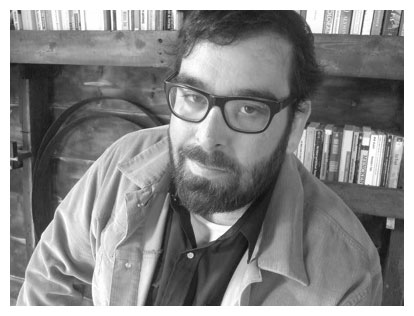
Max Watman
But that history is not over, not by a long shot. Watman visits the modern "nip joints" where a buck won't buy a burger, but it will buy some mighty strong likker that'll just as soon peel your paint as get you drunk. These inner city hidden-worlds are the endpoint of a multi-million dollar underground industry, which Watman explores. And as well, he looks at the lawmen who go after the producers in "Operation Lightning Strike."
But Watman, who was raised in the hinterlands of Virginia, takes the next step and enters the world of the backyard still himself. It's illegal and ill-advised. But it's also a hoot to read about. Here's a non-fiction book where the entertainment value is supposed to supersede the educational value. Because you really wouldn't want to make moonshine would you? No way. But when the moonshine still become the micro-distillery ... there's probably another chapter to this story. Let's just hope it gets the same mix of entertainment and education that atman manages. Here's to the next generation of legal micro-distillers. Cheers!
02-10-10:Anne Lamott Spots 'Imperfect Birds'
The Ties That Unbind
There are lots of different kinds of horror stories out there. To be honest, I prefer the sort that involve supernatural or science fictional monsters pursuing hapless human prey. The best we can do monster-wise in reality is a little toy floating in Loch Ness and a blurry film of Bigfoot on the hoof. And neither of these critters are particularly threatening. So monster-horror stories remain delightfully unreal.
This is not the case with regards to humans. Our horror stories happen every day, all around us. Then, if we're particularly unlucky, they happen to us.
"There are many evils that pull our children."
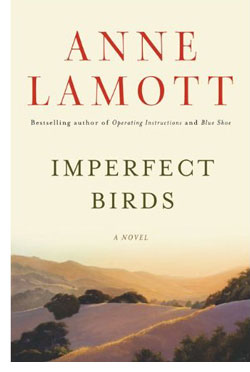
Anne Lamott is utterly upfront in her new novel, 'Imperfect Birds' (Viking / Penguin Putnam ; April 2010 ; $25.95). We know from the first sentence that this is a horror story about real children and actual adults; or at least, a married couple trying to be adults in a world given over to youth. It's a story you have heard, a story you have read in the news; hopefully not a story you have lived, but if that is the case, then you're on familiar ground.
It's a simple family; Elizabeth and James Ferguson, and their daughter Rosie — or rather the girl who used to be Rosie. Once she was the sort of child that parents dream of having, beautiful and accomplished. Now those dreams have given over to nightmares as the Elizabeth discovers Rosie is lying to her. That Rosie is indeed, no longer the sweet child she once was.
If this sounds like the stuff of a thousand "Men Are Pigs" channel movies, it is, so here's where we come to Anne Lamott, who has the narrative power to wrestle this everyday nightmare into a compelling piece of reading, a naturalistic version of Invasion of the Body Snatchers. Lamott's piercing prose enables her to craft characters that seem not just realistic, but, more importantly, entertaining and engaging to read about . This is not the sort of novel that tries to embarrass you to death and carry signs about the hazards of drug abuse. Rather, 'Imperfect Birds' is a novel that creeps into your heart and stays there, leaving fear and wonder and yes, love. The real key to this sort of story is to make the readers really care about the characters and to write a plot that is realistic but puts those characters in jeopardy that threaten souls as well as lives. When you're reading your life is not at risk. But your soul is ever in doubt.
No doubt part of my reaction to this novel is because I've been the parent of teenagers, and I know whereof Lamott speaks. She captures that paradoxical combination of love and anger, of wanting to protect and utter disappointment. As our children grow up we watch them change from within the family. But when they become teenagers, the changes are masked from us. It's actually pretty shocking to learn about changes in your child third-hand. It's inevitable, yes, but inevitability is one of the most powerful aspects of horror fiction.
Lamott's 'Imperfect Birds' takes us out into the lives of people we might know, people we might be. Every thread is connected and pulling on one threatens them all. The shape can change and we only find out about it after the fact. The kinds of monsters we face are most often seen, as it happens not in the woods — but in the mirror.
02-09-10: Douglas Clegg Returns to 'Neverland'
Is 1980's Horror Returning from the Grave?
There was a lot to be excited about then. Great writing, weird writing, over-the-top intensity sometimes burning up the pages. People still talk about the 1980's horror boom, in just that term. David Drake used the phrase in our interview. Frankly, I was happy to hear it.
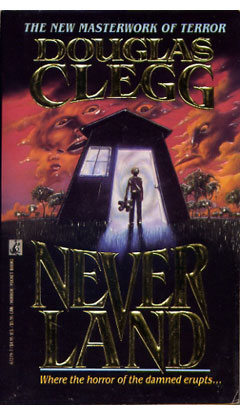
I was equally happy to see Douglas Clegg's 'Neverland' return from the spin-rack hell to whence it had been banished, and "80's horror comeback!" was the first thought that flashed through my mind. But then, pulling my copy of the original trade paperback off the shelves (the inside cover is already a rich, faded brownish-yellow), I realized that it was published, like a fair amount of what I consider "80's horror" in the early 90's — 1991 in this case. That shouldn't surprise me either, really. Horror fiction that doesn't know when to die — and then comes back from the dead. It makes perfect sense.
Douglas Clegg was one of those writers who, to my mind, should have been handed a contract for fat hardcovers that could have hung out with (in a better world) Robert R. McCammon, Bentley Little and Stephen King. These are guys who know America, and know how to literally scare up the best and worst aspects of the American character and slap them into a ripping yarn full of monsters, terror and enough action to keep the pages turning late into the night.
'Neverland' was Clegg's third paperback original for Pocket Books, following 'Goat Dance' and 'Breeder'. It's of the "children of horror" subgenre, that is, it's about children who wander into the path of something quite old and quite sinister. Of course, children can give anything sinister, old or young, a run for its money. Beau Jackson and his cousin Sumter spend their summers on Gull Island, at the decaying family compound. Beau brings along his copy of 'The Martian Chronicles,' just in case readers haven't sensed the Bradbury "sweet evil" vibe when Sumter squeezes his stitches to bring the blood up to the surface. The compound is bad enough, but the shack out there on the bluff. From there it's just one small step for a child, and one giant leap for readerkind, to Neverland.
Clegg has a talent for writing at something of a sweet and detailed fever pitch. Looking at the Pocket Books mass-market paperback now, I can hardly believe how fresh the then new-and-cool raised "foil" letters were. I kept this thing in pristine condition. The yellowed covers and the cheesy paperback look almost ooze evil. But Clegg's work is complex and prickly enough that I wouldn't mind reading it again. But I suspect that attempting to read this almost — can I even believe it? — 20-year-old paperback now would result in its destruction. Perhaps that would be appropriate.
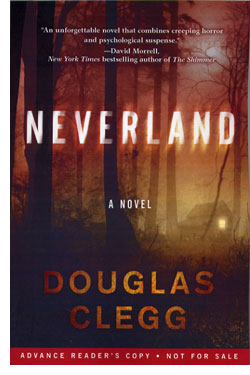
But in any event, I'd certainly welcome the shiny, new trade paperback edition of 'Neverland' (Vanguard Press ; April 2010 ; $15.95). Yes, I still think Clegg deserves hardcover publication, but given that we're resurrecting 80's-Boom/90's Horror, I'm happy to see anyone give Clegg's novel the kind of presentation that it deserves. In this case, that means beautiful alrge print, nice pages and lots of illustrations by Glen Chadbourne. All this at $15.95 seems to be a pretty good deal to me.
But it is, I hope also a harbinger of the resurrection of more 1980's and (80's-style) horror. Certainly, Vanguard should do Clegg's 'Goat Dance' and Breeder,' and give them the deluxe Chadbourne treatment. And if the economy stays in the toilet, maybe we can look forward, not to soul-less, scentless downloadable e-books, but the kind of books that stay on our shelves for 20-something years, ripping yarns in books we love enough to treat like gifts from our children. With sweet sadness .. and a hint of evil.
02-08-10:David Louis Edelman Completes Jump 225
'Geosynchron'
When it comes to reading trilogies that have a three-book story arc (and this is not always the case), I'm gun-shy. Why? Simon & Schuster UK, that's why. I remember picking up Brian Stableford's 'The Werewolves of London' in 1990. It was a wonderfully well-written proto-steampunk novel of supernatural conspiracy, and quickly followed up in 1991 by 'The Angel of Pain.'
The first two novels were issued in lovely hardcovers, with great dust-jacket artwork. The second novel even told us the name of the final volume of the trilogy — 'The Carnival of Destruction.' I could hardly wait for it to come out.
But I waited.
Stableford's a great writer and it was a wonderful series. I don't the circumstances behind the delay, only that I wished I'd waited until the final volume came out to start the first one. Then I could have much better enjoyed the continuity of the story. At least Stableford finished the series, which sadly isn't always the case.
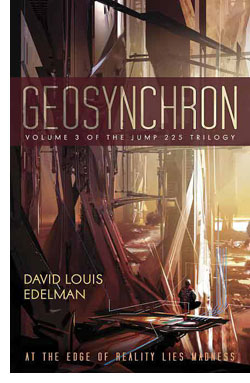
So, if you read my review of 'Infoquake' by David Louis Edelman back in the day, and were both smart and cautious, now you can relax and start reading the book, it's sequel, 'MultiReal' and the final volume in the series, 'Geosynchron' (Pyr / Prometheus ; February 9, 2010 ; $16). The Jump 225 trilogy is a tightly-knit story, told over three novels, and it's an odd duck by any measure. But it's just the right kind of odd duck to please a large segment of readers who like their science fiction equally packed with plot and thought.
Edelman had created an wonderfully detailed vision that harks back to the most classic science fiction series. The best science fiction reaches outside of time, and depicts futures that are not reliant on gadgets, but instead on concepts and thought experiments. Edelman has arguably upped the ante here, since his is a multiple vision of reality, of different timelines spun off by different decisions, all accessible by one person. And for all his unique inventiveness, he still manages to populate his worlds with characters we can understand and sympathize with — even though they're often not particularly likable.
Given the complexity of the series and the plotting in the first two novels, it's pretty handy that Edelman includes a synopsis of them among the many appendices he includes. 'Geosynchron' does have a lot of explaining to do, but happily it does so with plot and not exposition. Yes, Natch is still around, faced with the sort of decisions he deserves. Edelman's got a peculiar and entertaining combination of space opera and cyberpunk, with a feel for deep history that gives both aspects of story and depth and dimension that is unusual, in the best possible way.
The publishing history is equally important here. Pyr has done a good job at bringing readers a meaty series in a readable by inexpensive format. They'll look good lined up on the shelf, and more importantly, they'll stay in your mind. This is what you want from science fiction. You want the vision of the writer to inform your vision of your life. You can feel the alternate timelines and sometimes, achingly, wonder what might have happened had you not sent that email. You may not think you can get to those worlds. But novels offer an opportunity to explore the branches of the decision tree. Now you can decide — safely — to enter the world of Edelman's Jump 225 trilogy. At least in this timeline.
New to the Agony Column
09-18-15: Commentary : William T. Vollman Amidst 'The Dying Grass' : An Epic Exploration of Simultaneity
Agony Column Podcast News Report : A 2015 Interview with William T. Vollman : "...a lot of long words that in our language are sentences..."
09-05-15: Commentary : Susan Casey Listens to 'Voices in the Ocean' : Science, Empathy and Self
Agony Column Podcast News Report : A 2015 Interview with Susan Casey : "...the reporting for this book was emotionally difficult at times..."
08-21-15: Agony Column Podcast News Report : Senator Claire McCaskill is 'Plenty Ladylike' : Internalizing Determination to Overcome Sexism [Incudes Time to Read EP 211: Claire McCaskill, Plenty Ladylike, plus A 2015 Interview with Senator Claire McCaskill]
Agony Column Podcast News Report : Emily Schultz Unleashes 'The Blondes' : A Cure by Color [Incudes Time to Read EP 210: Emily Schultz, The Blondes, plus A 2015 Interview with Emily Schultz]
07-05-15: Commentary : Dr. Michael Gazzaniga Tells Tales from Both Sides of the Brain : A Life in Neuroscience Reveals the Life of Science
Agony Column Podcast News Report : A 2015 Interview with Michael Gazzaniga : "We made the first observation and BAM there was the disconnection effect..."
04-21-15: Commentary : Kazuo Ishiguro Unearths 'The Buried Giant' : The Mist of Myth and Memory
Agony Column Podcast News Report : A 2015 Interview with Kazuo Ishiguro : ".... by the time I was writing this novel, the lines between what was fantasy and what was real had blurred for me..."
Agony Column Podcast News Report : A 2015 Interview with Marc Goodman : "...every physical object around us is being transformed, one way or another, into an information technology..."
Agony Column Podcast News Report UPDATE: Time to Read Episode 199: Marc Goodman : Future Crimes: Everything Is Connected, Everyone Is Vulnerable and What We Can Do About It