We like to make fun of our high school government classes, to suggest that they're a waste of time and that we forget the history we're supposed to have learned. And there is some truth in that; but there are also parts of my American History classes that stuck with me; in particular al the stories of trust-busting back in the early 20th century. Those who would play monopoly with our economy are ever with us. Not surprisingly, Thomas Frank has his eye on the latest degeneration, and has written about it recently in the Wall Street Journal.
Frank is also keeping a close eye on those who would seemingly revise the history that many of us refused to learn. His latest look at the "reactionary right" suggests that some of our modern politicians are taking a page from an essay written long ago by one Stanislaw Lem in 'A Perfect Vacuum,' where he reviews a non-existent book titled Die Kultur als Fehler — 'Civilization as Mistake.'
Lem's review of Kultur als Fehler is eerily chock-a-block with messages that sound like semaphores from the outer reaches of the blogosphere. "It is forbidden us to change the shape of the body, weaken the lust for aggression, strengthen the intellect, balance the emotions, rearrange sex, liberate man from old age, from the labors of procreation, and this is forbidden for the reason that it has never been done, and what has never been done must surely be, by that very fact, most evil."
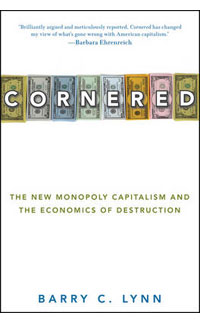
Frank takes his cues from Barry C. Lynn's 'Cornered: The New Monopoly Capitalism and the Economics of Destruction' a book whose title suggests more than a little about its content. If a business or a corporation is too big to fail, aren't they also, by definition, too big to exist? Frank (and I) are both fans of the sort of anti-trust legislation that is actually enforced. Imagine that — at this point, you'll have to.
Readers who wish to hear Frank and I converse on the subject of our new game of monopoly, and why civilization is indeed a mistake — beyond those wonderful reasons given by the noted socialist Polish late science fiction author, Stanislaw Lem, need do no more than follow this link to the MP3 audio file.
03-11-10: Lou Anders, Pyr at Five, and DragonCon
Vampire Fang Installation Nightmares
Pyr Books is going to be five years old soon — and not surprisingly, it seems like just yesterday when they launched. How the time gets away from us. I called up Lou Anders, to talk to him about five years of editing a new SF imprint, and find out about their Pyr at Five Contest, and as well to ask about a couple of recent offerings, in particular, Paul McAuley and Kay Kenyon.
McAuley and Kenyon are both working in some fascinatingly developed, if very different, science fiction universes. McAuley is starting with the short view, looking out at the Earth's expansion into the Solar System, while Kenyon has developed one of the most original universes I've ever read — a universe that is enclosed, one that allows those within to walk from one star to another.
Here are two excellent examples of why one genre, science fiction, can really flourish or flounder. A visionary genre requires some vision, and these two writers offer just that, refusing to recycle old ideas, but instead, striking out to use the creativity that science fiction allows.
But Anders and I also talked about the Pyr contest, which asks readers to write about why they love science fiction — and to understand that those reading the essays may not themselves read science fiction. It's a familiar meme from Anders, who regularly worries about expanding the science fiction audience. Like many, he worries where the next generation of science fiction readers is going to come from, and like many, he's not sanguine about the crossover from YA bestsellers like J. K. Rowling and Stephanie Meyer.
To this end, he told me about his experiences at DragonCon, which figures into the Pyr Prize. This convention, which boasts a huge attendance, has undergone a change in recent years, with more interest in literature than before on both sides of the equation. That is, you're seeing more publishers and writers showing up with a presence on the presenter side, and more readers on the attendee side. You can let Lou give you your own nightmares by following this link to the MP3 audio file.
03-10-10: A 2010 Interview with Ken Keegan and Rusty Morrison
OmniDawn Rising
OmniDawn first came into my view via 'Paraspheres,' a collection of New Fabulist fiction that was wonderfully unique. But their bread and butter, their poetry title list is simply amazing in terms of variety and depth and breadth. If you get on their mailing list — and you should — then you'll find yourself exposed to an ever-growing world of new voices in poetry, writers who take themselves and their work seriously.
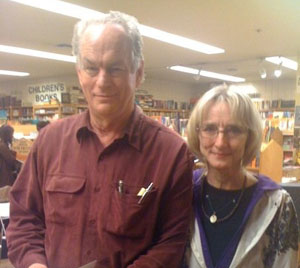
Ken Keegan and Rusty Morrison
What's more, OmniDawn is an old-fashioned press that is using modern technology to up the ante. They take submissions through their website. They have blogs and the above-mentioned mailing list. They operate out of Richmond, California as if they were in New York, New York. They are unapologetically prolific.
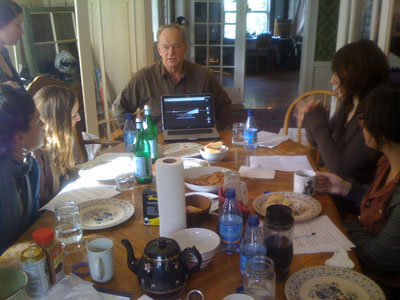
The OmniDawn Team
I gave Rusty Morrison a call to talk to her about her work as an editor and publisher, because frankly, I thought they might have gone under years ago. I got the bonus of talking to Ken Keegan as well. This hasn't been the sort of publishing climate where you'd expect the explosion of work you see from OmniDawn. The larger houses would probably spend more on catering for a major author event than I am estimating OmniDawn spends in a year for like, everything. You can hear how a successful poetry publisher makes it day-to-day by following this link to the MP3 audio file.
Paul McHugh at KUSP
03-09-10: A 2010 Interview with Paul McHugh
"..the strengths of good writing go all the way, across all the genres..." Paul McHugh
In the world of "Write What You Know," Paul McHugh is the Irish King. Put him in front of a microphone, and you can just sit back and let the tape run, because McHugh has been on both sides of the equation. Now, I have to admit — as much as I liked 'Deadlines,' I also wanted to ask McHugh about his work at the Chronicle, particularly about the Asilomar reporting.
I knew a little bit about Asilomar; I knew that it was in Pacific Grove, and that it was this big-deal, big bucks place on some really pristine land. I love to drive down to Pacific Grove and Carmel from Santa Cruz. The drive there is quite calm — pacific, really — and of course the destination is amazing. But what kind of shenanigans had gone on back in the 90's?
McHugh told me about the seemingly innocent phone call that launched on the major pieces of investigative reporting in his twenty-plus year career. The incident he described is mirrored quite well in 'Deadlines.' Then McHugh told me about the goings-on at Asilomar itself, and they were definitely not pretty. Moreover, they have a lot of implications in the annihilated economy of today's California. There are lots of folks around the world, really, who would just love to see California sell off the most prime state parks, and a minority — at this point — portion of the California legislature that would be willing to do so.
I also talked to McHugh about the continuum of writing, from reportage to fiction. To me he sounds like a kid in the candy store. After a career of having to get the quotes right, he's very happy to have his job description changed to, "Guy who writes the dialogue." You can hear our dialogue by following this link to the MP3 audio file.
03-08-10: A 2010 Interview with Joe Hill
"Eventually, the wicked and the unworthy will get their just desserts on the business end of the Devil's pitchfork."
—Joe Hill
It's really just a sorry story from my interviewing past, demonstrating the long learning curve I had to undergo before I came even close to the bottom of cliff I currently stare up at with regards to interviewing competency. The idea being, that one can easily get up a head of steam to interview an author and then talk all that impetus off in the time it takes to get the tape rolling.
To tell the truth there was no need to go through those verbal gymnastics. Hill and I were still going strong, ten minutes past the time when our ever-patient engineer, Howard Gelman, over at KQED, first began to wave his arms and give me the eternally relevant "Time Up" gesture. Since I kept asking questions after I first saw the arm-waving, I'm glad (and as ever, impressed) that I wasn't shown another, less patient gesture.
No matter, I had a hell of a time talking to Hill about the details of his Devil. I think listeners will be surprised to learn his influences, and to hear about all the work that came before the work we saw. Moreover, I think listeners will find that his enthusiasm for his subject is contagious, and I'd be surprised as all get-out if we didn't see a sales bump of some previously stable scholarly authors over at the *.* store. You may read 'Horns' in a trice, but you'll think about it a lot afterwards. A lot of effort goes into writing a novel that is as addictive as this one.
This podcast opens with two readings. The first consists of a short reading, which is the opening paragraph of the novel. It's wonderful piece of writing that sets the surrealish tone, and pulls you right in. The second reading is much longer, 5 1/2 minutes, and it's a piece of writing I really love from much later in the novel. It doesn't give away anything, but it is a rocking Sermon on the Mount of Serpents. You can hear everything by following this link to the MP3 audio file.
New to the Agony Column
09-18-15: Commentary : William T. Vollman Amidst 'The Dying Grass' : An Epic Exploration of Simultaneity
Agony Column Podcast News Report : A 2015 Interview with William T. Vollman : "...a lot of long words that in our language are sentences..."
09-05-15: Commentary : Susan Casey Listens to 'Voices in the Ocean' : Science, Empathy and Self
Agony Column Podcast News Report : A 2015 Interview with Susan Casey : "...the reporting for this book was emotionally difficult at times..."
08-21-15: Agony Column Podcast News Report : Senator Claire McCaskill is 'Plenty Ladylike' : Internalizing Determination to Overcome Sexism [Incudes Time to Read EP 211: Claire McCaskill, Plenty Ladylike, plus A 2015 Interview with Senator Claire McCaskill]
Agony Column Podcast News Report : Emily Schultz Unleashes 'The Blondes' : A Cure by Color [Incudes Time to Read EP 210: Emily Schultz, The Blondes, plus A 2015 Interview with Emily Schultz]
07-05-15: Commentary : Dr. Michael Gazzaniga Tells Tales from Both Sides of the Brain : A Life in Neuroscience Reveals the Life of Science
Agony Column Podcast News Report : A 2015 Interview with Michael Gazzaniga : "We made the first observation and BAM there was the disconnection effect..."
04-21-15: Commentary : Kazuo Ishiguro Unearths 'The Buried Giant' : The Mist of Myth and Memory
Agony Column Podcast News Report : A 2015 Interview with Kazuo Ishiguro : ".... by the time I was writing this novel, the lines between what was fantasy and what was real had blurred for me..."
Agony Column Podcast News Report : A 2015 Interview with Marc Goodman : "...every physical object around us is being transformed, one way or another, into an information technology..."
Agony Column Podcast News Report UPDATE: Time to Read Episode 199: Marc Goodman : Future Crimes: Everything Is Connected, Everyone Is Vulnerable and What We Can Do About It