04-02-10: Income Tax Help with Cynthia Leachmoore
"Anything that you can do to make it easier." — Cynthia Leachmoore
I started this gig, so long ago, because I enjoyed the horror genre and thought that there were a lot of good writers in that genre who simply weren't getting noticed.
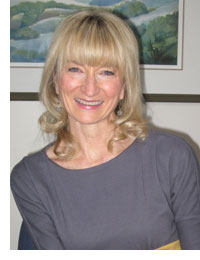
But as far as fears go, financial fears are a lot more pressing than getting eaten by a monster. I know some folks, myself included, who would much rather go monster hunting than deal with their taxes. That's why they invented people like Cynthia Leachmoore, who does, I confess, my taxes.
I'm one of a about ten bazillion people, I suspect, who left the security of the corporate world for the utter financial insanity of creating a business. I don't recommend that you follow my example, but if you do, or if you have already done so, there is a lot you can do to make your financial life easier.
Mostly, it involves setting up some simple regimens and keeping things fiscally clean and simple on a daily basis. Mostly, it involves finding an expert who can help you get set up correctly. Cynthia Leachmoore is exactly that sort of expert.
I brought Cynthia on to Talk of the Bay, on KUSP to help listeners, particularly those who are self-employed, often writers and artists — figure out how to make their lives much less stressful so that the business can proceed without as little attention devoted to the IRS as possible. And even if you don't live in the US, there's a level of organization and sensibility on tap here that can benefit you and whatever you do. And whatever you do, it's always best to square up and face the truth. To hear a good dose of the truth, straight up, no chaser, follow this link to the MP3 audio file.
04-01-10: Speaking Frankly
Thomas Frank Joins the Snake Flag Set
There he was. Thomas Frank, the author of 'What's the Matter With Kansas' and 'The Wrecking Crew,' partying with the Tea Party.
I find it just fascinating that while we read books about newspapers dying, and watch them die in reality, the fact of the matter is that this is an absolutely wonderful time for news itself. Every time you think things have gone off the rails so far you could never get close again, something else utterly unbelievable happens.
Frank and I spoke about his last three columns for the Wall Street Journal, starting with a look at the Texas School Board decisions with regards to the content of textbooks in Texas, and, as a result, through much of the USA. What is so interesting is that Frank's book, 'The Wrecking Crew,' with its idea of a government "captured" by those opposed to the basic principles of government itself, is playing out so obviously around the country, in a variety of venues.
In Texas, for example, some of those on the public school board are opposed to public schools. And again, what comes out of this sort of thinking is a really interesting usage of language, a decision to re-define certain words, or eliminate their use in textbooks. It's positively Orwellian, and funny in a bleak manner. But the long-term consequences are what will prove to be most interesting. What sort of children will we be raising when we have eliminated the word "capitalism" from our textbooks?
But Frank also reported to me on his time spent in DC at the health care protests, where he found the audience to be very polite. This is not the picture we get on television. Nuance works both ways; the nicest mom in the world may be holding a placard with some really incendiary language.
03-31-10: Panel Discussion SF in SF March 13, 2010
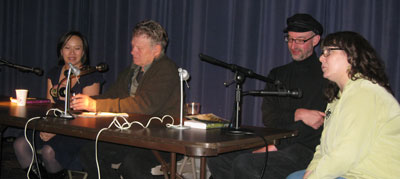
Malinda Lo, Terry Bisson, Chaz Brenchley & Rina Weisman
Put three writers in front of a bar, then behind a desk, put some microphones in front of them, what else can you expect but loosened tongues and uncensored conversation. Bisson and Brenchley had a lot in common. Both are old hands at the writing game, who have written in a lot of different styles with the idea of meeting expectations that they did not create. Have pen, will travel.
Malinda Lo, on the other hand, is much earlier in her career, but she brings with her the sort of experience you can only get working in the publishing world, reading through the slushpiles. As she days, you learn a lot about writing when you're forced to read in this manner.
Brenchley, on the other hand, has been at this since he was a lad, and he's had some success from the get-go. He may write like an angel — that reading still sticks in my mind — but he's spent his time in the trenches.
That just covers the writers on the stage; in the audience we had Howard Hendryx and Kim Stanley Robinson. This is not the only reason that you should hie yourselves hence should you get a chance to attend one of these gigs. But since not everyone can, at last I can record the whole shebang and pt it up for you to hear by following this link to the MP3 audio file.
03-30-10: A 2010 Interview with Jo Nesbø, Part 2 + Complete
"...she could wake up the Bat Man who lives inside that tree..."
— Jo Nesbø
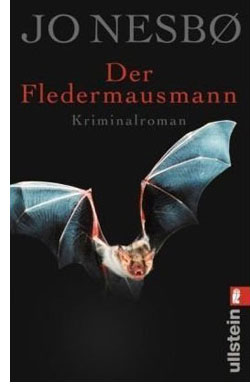
Jo Nesbø is a fan of Frank Miller, so you'd think that the title of 'The Bat Man' for his first novel is no coincidence. Hands down it has to be a reference of some sort to the iconic DC Comics hero. After all, Nesbø even describes his vision or version of Oslo as being influenced by Gotham City. Think about that for a moment. A humble American comic book character now informs top-notch European mystery writers. Oslo via Gotham City; not a route easily mapped via Google.
But for all that Nesbø is informed and inspired by Frank Miller, it was a very different influence that was behind his first novel, 'The Bat Man.' Nesbø told me about how he crafted his first novel and why it was not the first one to be translated in our interview. Readers should know me by now; I'm frankly obsessive when it comes to reading things in order, but with Nesbø, that just had to go out the window.
The good news for super-patient obsessives is that everything getting a translation, so if you want to just hang loose and stock up on the hardcover first editions as they arrive, eventually you'll, be able to read them in the order they were written, so that you can get a complete hold on Harry Hole's character arc. And the better news is that more of the books are out in the UK, and they're out in paperback. At this point you can probably build a pretty good collection to keep yourself busy.
In case you were wondering, it turns out that Nesbø is highly influenced not just by books, but by movies, and to a certain extent, they're the movies you'd expect — and hope for. If you've read his work, you won't be surprised that he's been approached to have the Harry Hole novels brought to the screen. I think listeners will be pleasantly, quite pleasantly surprised at his reason for not letting that happen — yet. All this and more you can hear in the second half of the interview, from this linked audio file. The second half of the interview begins with a reading in Norwegian. I had to ask him to do that twice; the first time he tried to read in Norwegian, he was lapsing into English out of habit.
"I liked the look of the book, it had a pig's head on the cover."
— Jo Nesbø
How many of us have fallen victim to that corrupter of youth, that winner of prizes, William Golding? Boys aren't by inclination big readers. But hell, you put a pig's head on a stake on the cover of a book for kids, or at least so much about them that the censors of youthful reading will occasionally let it pass — and it should come as no surprise that you've hooked another helpless mind into a lifetime of dreamy mental ultra-violence.
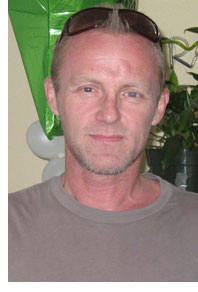
Count Norwegian crime writer and rock star Jo Nesbø as another victim of Golding's 'Lord of the Flies,' a novel that has turned the hearts of many a man-to-be into a cold stone. See, ladies, we're doomed, I tell you doomed. And it's not our faults. One day you're reading a book you borrowed from the library, the next you're imagining serial killers who leave messages in the eyeballs of their victims.
Jo Nesbø was another writer brought to me by Martha Cullimore, and I was so glad she made the trip. I managed to get what proved to be not his first two Harry Hole books, but at least the first two published in English here in the US of A. And that not surprisingly became a topic in our epic conversation, which I'm podcasting in two parts.
The first goes up today, and the next goes up tomorrow, along with a full, hour-plus version for those who have long commutes. The first half of the interview begins with a reading form the book in English.
I tried to get a guitar to bring to the interview, an I wish that I had been to do so, because I'm pretty sure that Jo would have played, well at least three chords on it! In the first part, that I'm podcasting today, we talked about his career as a musician and it is in fact a career. He was, at one point, playing 180 gigs a year — while working as a stockbroker during the day!
I imagine to no reader will be surprised that he eventually forced himself to take some time off, and that was when he began his first novel. You can hear about Nesbø's limited admiration of William Golding and how he started his writing career by following this link to the MP3 audio file.
New to the Agony Column
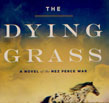
09-18-15: Commentary : William T. Vollman Amidst 'The Dying Grass' : An Epic Exploration of Simultaneity
Agony Column Podcast News Report : A 2015 Interview with William T. Vollman : "...a lot of long words that in our language are sentences..."
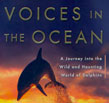
09-05-15: Commentary : Susan Casey Listens to 'Voices in the Ocean' : Science, Empathy and Self
Agony Column Podcast News Report : A 2015 Interview with Susan Casey : "...the reporting for this book was emotionally difficult at times..."
08-21-15: Agony Column Podcast News Report : Senator Claire McCaskill is 'Plenty Ladylike' : Internalizing Determination to Overcome Sexism [Incudes Time to Read EP 211: Claire McCaskill, Plenty Ladylike, plus A 2015 Interview with Senator Claire McCaskill]
Agony Column Podcast News Report : Emily Schultz Unleashes 'The Blondes' : A Cure by Color [Incudes Time to Read EP 210: Emily Schultz, The Blondes, plus A 2015 Interview with Emily Schultz]
07-05-15: Commentary : Dr. Michael Gazzaniga Tells Tales from Both Sides of the Brain : A Life in Neuroscience Reveals the Life of Science
Agony Column Podcast News Report : A 2015 Interview with Michael Gazzaniga : "We made the first observation and BAM there was the disconnection effect..."
04-21-15: Commentary : Kazuo Ishiguro Unearths 'The Buried Giant' : The Mist of Myth and Memory
Agony Column Podcast News Report : A 2015 Interview with Kazuo Ishiguro : ".... by the time I was writing this novel, the lines between what was fantasy and what was real had blurred for me..."
Agony Column Podcast News Report : A 2015 Interview with Marc Goodman : "...every physical object around us is being transformed, one way or another, into an information technology..."
Agony Column Podcast News Report UPDATE: Time to Read Episode 199: Marc Goodman : Future Crimes: Everything Is Connected, Everyone Is Vulnerable and What We Can Do About It