You cannot beat the real thing. You can read all about it on the web, and you can write literary events calendars for your literary hour of radio, you can comb through the piles at that radio station and still miss out on something really exciting. Unless you put yourself in the presence of the real thing. That means getting By Any Means Necessary to a real brick-and-mortar independent bookstore of the type that does events.
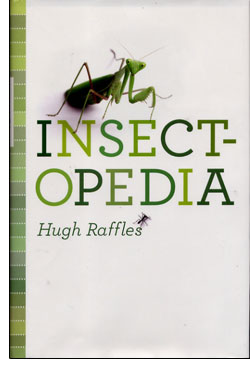
We have lots of those here in Santa Cruz. It was about two weeks ago that I was strolling through Bookshop Santa Cruz and saw a table piled with the sort of book that really gets me going. It was a nice thick hardcover called 'Insectopedia' (Pantheon / Random House ; March 23, 2010 ; $29.95), by Hugh Raffles. The author was going to be in town next week. And the book, a literary work of non-fiction, looked damnably great.
It didn't take me long to lay hands on a copy of Hugh Raffles' 'Insectopedia' and it proved to be even better than I expected. What I knew from looking at it at BSC was that it consisted of a series of short articles (2 pages — 42 pages), all somewhat about insects. There was a chapter titled 'Chernobyl' that looked particularly intriguing.
What I didn't know what that Raffles had written the book in the form of an abecedarium, that is, an A-Z compendium. The 'Insectopedia' is not an encyclopedic book about insects; it's a look at the human stories that unfold when men meet insects. It's an outrageously well-written piece of non-fiction that reads like literary fiction.
Reading; that's what this book is all about. That is, the prose is strikingly beautiful and riotously varied. Raffles can whip up a historical piece of science reporting with elegant diction and admirable pacing. He might slip into a surreal fever dream, or render his own impressions of the unseen world rustling around us. Raffles writes straight science quite well; his language is clear and concise and he knows when and how to dial back or ratchet up the detail. He's an anthropologist when he's not peering at bugs, so his social histories are pointed and amusing.
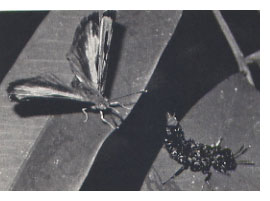
Embarrassed butterfly and beetle; photo by
George Krizek
The book is cunningly orchestrated in terms of sequencing the moods and pieces. Though he uses the abecedarium form well, there's a lot more going on in terms of the ordering than alphabetizing. Raffles will engross you with the history of aerial insect retrieval, then introduce you to a woman who has hybridized art and science by carefully painting deformed beetles she finds near nuclear power plants. You'll get down and dirty with cricket-fighting gambler in Shaghai, and then find form in the ineffable. Each piece has a distinct tone a prose style appropriate to the subject and flow from one to the next keeps us interested in the longer pieces and allows us to enjoy the vignettes that follow.
In a more perfect world, I could see this being done as four-color slick-page textbook-style hardcover with lots of illustrations. But those that are included are enough to spur the imagination without overpowering it. You might linger but you won't be distracted, and you will be thankful, at least, for the odd photo of an embarrassed-looking butterfly and beetle who were apparently interrupted in a bit of inter-species sex. And if the words "insect sexuality" had never before entered your brain, well, Raffles' riff on queer insects will stay there long after the phase is discarded in favor of newer, hipper terminology.
Whether or not you are fascinated by insects — I refuse to cal them bugs — you will be fascinated by the very human stories that Raffles unearths in his search for a vision of the world. a vision of humanity, as seen through compound eyes.
04-07-10:Jorge Luis Borges 'The Sonnets'
Proteus and Poetry
Writers have different impacts to us at different times in our lives. Reading Kurt Vonnegut as a teenager knocked me into a parallel universe, where science fiction was respected literature. Reading Jorge Luis Borges took me in the other direction, into a parallel universe where respected literature might be science fiction. The distinction is subtle but important.
It was Vonnegut who left me with one of those aphorisms that never go away: "Be careful what you pretend to be, because you are what you pretend to be." But what happens when you pretend to be many things, when you are many things? While I always had a sense of who Kurt Vonnegut was as a man in this world, I never could quite wrap my brain around Borges in the same manner. One moment, he was a writer of fiction that seemed to be non-fiction, the next, a creator of poems that partook of prose. He was remote from his creations, as if they were the pronouncements of a god; Proteus.
Jorge Luis Borges fiction is widely available and often in decent first edition hardcovers. Bt his poetry has not been so easy to find. I have a couple of thin paperbacks from the dark ages somewhere in the stacks. But I welcome a new series of books of poetry from Borges, starting with 'The Sonnets' (Penguin Classics / Penguin ; March 30, 2010 ; $18). These books set a nice new standard for Borges' poetry, which is every bit as hard to pin down and Protean as his fiction.
The overarching series of Borges' poetry is edited by Suzanne Jill Levine, with each volume edited and introduced by a variety of writers. The first volume, 'The Sonnets' includes editing and translations, as well as an introduction and notes by Stephen Kessler, recently interviewed here about his novel, 'The Mental Traveler.'
'The Sonnets' has a lot to offer. This is the first time that all of Borges' sonnets have been collected in one volume, and more than half of the poems here are translated into English for the first time. Each poem is printed first in Spanish, then translated on the opposing page in English. This is very simple and very elegant, giving the English reader intuitive insight into Borges work. What's fascinating about this collection is that it offers insight into the breadth of Borges' Protean interests in a single condensed format. In fourteen rhymed lines, one poem after another, Borges defines his cosmos.
Jorge Luis Borges in 1951 by Grete Stern
You will encounter in these poems all the themes of Borges fiction. The librarian, for example, in "Poem Written in a Copy of Beowulf;
"Beyond my anxiety and beyond this writing
the universe waits, inexhaustible, inviting."
I know that I was surprised to find this poem, "Edgar Allan Poe":
Pageants of marble, black anatomy
violated by worms inside the grave
he gathered icy symbols of death's victory.
But of those things he was not afraid.
What he feared was another darkness, love,
the ordinary happiness of people;
what blinded him was not the shiny metal
nor marble tombstones but the simple rose.
As if from the other side of the mirror
he was delivered alone into his complex
destiny: to be an inventor of nightmares.
Perhaps now from the other side of death
he keeps constructing, strong and all alone,
magnificent and horrifying wonders.
It's fascinating to see Borges' perspective here. He is himself a cosmic poet as much as Poe, and if you never get much of a sense of the man behind the writing, it is because he can, more than most writers, view our lives from an infinite distance, reflected in mirrors, lost in his labyrinths.
Nor surprisingly, you can find the poem 'Proteus' —
"Do not be astonished at Proteus the Egyptian,
you, you who are also one and many men."
Beyond the poetry in 'The Sonnets' — which seems like a distance just a bit father than infinite — readers can find the fine work of Stephen Kessler who writes a fine entertaining and authoritative introduction, translates many of the poems, and provides a series of notes for the poems. Though this is a book of poetry and a compact book, it's pretty thick and definitely a book that will last you quite a long time, a book you can return to. A book you can get lost in, a labyrinth of mirrors.
04-06-10:The Hugo Award Reading List
Popular Choices and Limited Voices
The Hugo Award Nominees for the 68th World Science Fiction Convention, Aussiecon 4, have just been announced. You can find the full list here.
As usual, the list makes for an interesting reading guide. And those little numbers nest to each category heading are perhaps the most interesting guide of all.
There's no doubt that the Hugo brings a lot of prestige to the winners and the nominees as well. In the insular world of science fiction publishing they're a career-booster, and they make great blurb-fodder. While there is no way to quantify this, one might suspect that the words "Hugo Award Winner" move just about as many copies of a given book as the words "National Book Award Winner" might if emblazoned on a work of literary fiction. This says a lot about our ever-changing book-buying habits. Science fiction readers are science fiction readers. Their choice to read science fiction sets them apart from what science fiction writer Harlan Ellison liked to call "The great unwashed." And the Hugo sets apart the winners from the SF equivalent thereof. But for all the prestige they grant, they do so as the result of a popularity contest not unlike American Idol.
Let's look at the Best Novel field. The nominees are: 'Boneshaker' by Cherie Priest, 'The City & The City' by China Miéville, 'Julian Comstock: A Story of 22nd-Century America' by Robert Charles Wilson, 'Palimpsest' by Catherynne M. Valente, 'Wake' by Robert J. Sawyer and 'The Windup Girl' by Paolo Bacigalupi. This is a very strong list, and any reader, in or out of the genre is quite likely to find some books they'll really enjoy. I've written about many of them on this site, even though we're not "SF only." Here at Bookotron, you can find interviews with Paolo Bacigalupi, China Miéville and Catherynne M. Valente. Science fiction literature, which is not currently by most accounts a super-strong seller — fantasy generally gets the nod — is in fine shape.
But look at that little number next to the category heading, "699 nominating ballots." That's the number of paid-in-full attendees to WorldCon 68 who managed to turn in a ballot with something legible in the "Best Novel" category. Think American Idol with paid admission and you'll get a good idea of just who your gatekeepers are. They're a self-selected segment of science fiction readers — many of them professional writers themselves, including the nominees. The Hugo nominees are the popular choices of limited voices.
That's not necessarily a bad thing. Remember up above where I said "Science fiction readers are science fiction readers"? It's certainly indicative of reading experience quality that the readers of books care enough to nominate them for an award. But for all the heft the Hugo carries, one must remember that it is not a juried award; it's an award associated largely with the convention at which it is awarded. And scroll down that list to see how voting participation in other categories drops off steeply as you go down the ballot. By the time you get to Best Fan Artist, you're looking at just 199 ballots.
There's a reason for this; the self-selected nominators are plopping in names of what they've read and are familiar with. On one hand, you don't want readers nominating books or stories they haven't read. But the upshot is that again, you are looking at a limitation. Still, expect many announcements from publishers and lots of blurbage to result. According to the website, "Supporting and attending members of Aussiecon 4 are eligible to vote in the final round. Ballots may be submitted online or by paper ballot distributed in Progress Report 3. All ballots must be received by 31 July 2010 23:59 PDT." Awards and blurbs to follow, with sales of books and eventually, somewhere down the line, hopefully...reading. This is after all, about reading.
04-05-10:Zachary Mason Unearths 'The Lost Books of the Odyssey'
Remixing Homer
It's all the fashion these days to remix literature, and frankly it is not a fashion I'm too keen on. But there are ways to do so that don't involve appropriating someone else's text. In this style, the literary model is surprisingly straight out of speculative fiction, though it's my guess those creating these sorts of works don't set out with that in mind.
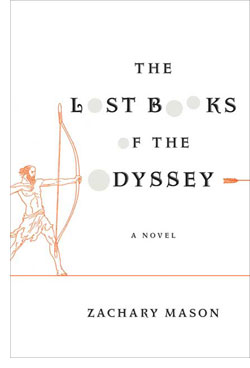
For readers looking to sample some utterly original remixed literature, 'The Lost Books of the Odyssey' (Farrar Straus Giroux ; February 9, 2010 ; $24) by Zachary Mason is a delightful example of what can be done when a literary author approaches a classic story using (consciously or unconsciously) the tools of speculative fiction. Treating Homer's fiction as fact, 'The Lost Books of the Odyssey' is an alternate history that fills in lacunae, reverses perspectives and upends our expectations.
The appeal of 'The Lost Books of the Odyssey' is not merely that it does what it does with Homer's work. If one were to stack all the authors who have riffed off of Homer one of top of another, one man's (or woman's) feet on another's shoulders, you could probably climb to the moon.
What sets Zachary Mason apart from riffers and remixers is his deft, laconic style. With a minimum of words, he sketches powerful miniatures that work like crystal shards driven into our own personal experiences of Homer. Whether you've read the Cliff Notes, an acclaimed translation, or perhaps even if you've just read James Joyce's rather well-known riff, Mason's work confronts your experience in a most direct, unexpected manner.
Mason is a master of the arid. There's a dry wind that blows through this book, coating everything with a fine powdering of dust and grit. Each tale is hard-chiseled down to the skeletal minimum, and they're all beautifully wrought. This is not to say that 'The Lost Books of the Odyssey' is a series of monolithic utterances. But the unity of vision that is at the core of the imagination on the page is quite perceptible. There's a coherent and very active intelligence at work here, but not one that is concerned with showing off; instead, Mason is all about storytelling.
Mason's exploration of the storytelling medium mirrors, in some ways, the voyage of its hero. Beyond the unifying underpinnings (I can only think of the skeletal Harryhausen warriors in Jason and the Argonauts), Mason employs a variety of voices, perspectives and even chronologies to great effect. The language is sometime direct and gritty; "We sailed that night from Ilium. Dirty snow on deck, the sizzle of snowflakes dissolving on the swell, the yellow lights of the city behind me." Other times, for example in the subsequent chapter, it is elegiac and formal: "My birthrights were great strength, copper beauty and enduring sadness." Because the chapters are so short, your reading experience is rather unusual. It's like watching a crinkly old black and white film that has lost none of its power; each short, blacked out scene builds a world; some of them dovetail, some of them contradict, all of them have a raw emotional resonance.
Intriguingly, Mason is a computer scientist, currently working in the Silicon Valley, and one hopes, on more fiction. We can get a glimpse of where he's going here. And reading this, perhaps one might conclude that Mason has more than a passing acquaintance with speculative fiction.
Those among us of a compulsive nature, those for whom book collecting is itself an Odyssey, will want to keep an eye peeled for a true first edition from Starcherone Books, a softcover from a super-small New York publisher. Apparently, when the William Morris Agency saw the original, they bought them all then sold the rights to FSG, who published this revised edition. That of course makes a true first of 'The Lost Books of the Odyssey' .... a lost book of the Odyssey.
There are no guarantees that it will be worth anything in the future, remember. You may journey halfway around the world to find it, bring it back, and realize that your wife has remarried, that you have been forgotten and that the book you bear has no meaning to anyone except yourself. That bit of imagination is my own alternate history. I have arrived in the harbor, and I am walking home. A book is in my hand.
New to the Agony Column
09-18-15: Commentary : William T. Vollman Amidst 'The Dying Grass' : An Epic Exploration of Simultaneity
Agony Column Podcast News Report : A 2015 Interview with William T. Vollman : "...a lot of long words that in our language are sentences..."
09-05-15: Commentary : Susan Casey Listens to 'Voices in the Ocean' : Science, Empathy and Self
Agony Column Podcast News Report : A 2015 Interview with Susan Casey : "...the reporting for this book was emotionally difficult at times..."
08-21-15: Agony Column Podcast News Report : Senator Claire McCaskill is 'Plenty Ladylike' : Internalizing Determination to Overcome Sexism [Incudes Time to Read EP 211: Claire McCaskill, Plenty Ladylike, plus A 2015 Interview with Senator Claire McCaskill]
Agony Column Podcast News Report : Emily Schultz Unleashes 'The Blondes' : A Cure by Color [Incudes Time to Read EP 210: Emily Schultz, The Blondes, plus A 2015 Interview with Emily Schultz]
07-05-15: Commentary : Dr. Michael Gazzaniga Tells Tales from Both Sides of the Brain : A Life in Neuroscience Reveals the Life of Science
Agony Column Podcast News Report : A 2015 Interview with Michael Gazzaniga : "We made the first observation and BAM there was the disconnection effect..."
04-21-15: Commentary : Kazuo Ishiguro Unearths 'The Buried Giant' : The Mist of Myth and Memory
Agony Column Podcast News Report : A 2015 Interview with Kazuo Ishiguro : ".... by the time I was writing this novel, the lines between what was fantasy and what was real had blurred for me..."
Agony Column Podcast News Report : A 2015 Interview with Marc Goodman : "...every physical object around us is being transformed, one way or another, into an information technology..."
Agony Column Podcast News Report UPDATE: Time to Read Episode 199: Marc Goodman : Future Crimes: Everything Is Connected, Everyone Is Vulnerable and What We Can Do About It