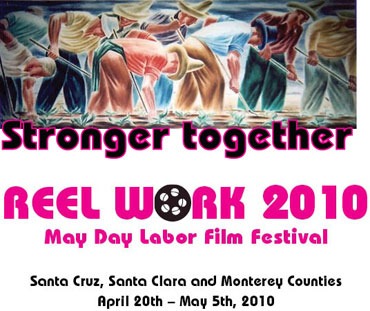
We don't take to no commies here in the US of A. Sort of a shame, but that's a subject for another column. What it has to do with this column is clear; Mayday is not celebrated here in the US, because International Workers of the World is just a bit too "commie" for a country where the John Birch Society is making a comeback. So instead of celebrating Mayday, here in Santa Cruz, some retired SEIU workers decided to start showing movies in the SEIU hall in the vicinity of Mayday lest we forget the latest revision of history.
Live radio is always more fun than you might expect listening to it. Fun, that is, if you enjoy cliffhangers, and have a plan B ready to roll. I guess I can handle cliffhangers and I'm good with Plan B's. Both came into play on Sunday, when I hosted Jeffrey Smedburg and Julian Brackett of Reelwork.org in a show about the film festival themed and timed to coincide with Mayday, I looked out the window before I left and, very Christopher Robin (I still have my hardcover Winnie the Pooh from — before recorded history), very Christopher Robin, I said, "Tut, tut, looks like rain."
And rain it did, with hail, lightning, and "gusty winds." (Courtesy Tom Waits' "Emotional Weather Report.") And I brought with me a CD for a 2008 show featuring Joe R. Lansdale. At a quarter to 7, just fifteen minutes early, Julian Brackett arrived. He's a student at UCSC, working in Community Studies (a department that was recently eliminated from the curriculum thanks to the financial woes of the UC system). Brackett was coordinating the showing of films on campus, but he'd just been brought into the Reelwork organization three days earlier. He informed me that my main guest, Jeffrey Smedburg, would be coming — on bicycle. Once again, I looked out the window — and said "Hell's bells!" (Courtesy my father.) Pouring rain, gusty winds and lightning do not make a fun or even feasible trip on bicycle.
By 6:58, I had Lansdale loaded and ready to play. At 6:59, Jeffrey Smedburg arrived and we managed to get everyone situated in time for the show. I've never experienced a literally last minute arrival before; one that was quite comprehensible in the circumstances. But having been prepared, I did manage not to panic. And I did manage to learn quite a bit about the SEIU, retired union employees and the labor movement here in Santa Cruz.
I found the history of labor and labor in film to be particularly interesting, especially as it relates to Franklin D. Roosevelt. These days, Roosevelt is honored (or vilified, depending on your political perspective), as the man who helped end the Great Depression and he is thought of as a Great Friend to the labor movement. During his own time perhaps, not so much. You can hear some live radio and labor history by following this link to the MP3 audio file.
04-13-10:Three Books with Alan Cheuse
Matterhorn by Karl Marlantes, Lost by Alice Lichtenstein, The Good Son by Michael Gruber
NPR's Alan Cheuse is back with a new selection of books worth your valuable time and money. There are so many books out there, many of them very good; but only a few that demand your time and money. Alan Cheuse has a very strong idea as to why that's the case with this week's selection.
Up for consideration this week are 'Matterhorn' by Karl Marlantes, a Vietnam war novel; 'Lost' by Alice Lichtenstein, which follows the search for a missing man; and 'The Good Son' by Michael Gruber, a thriller of intrigue in the Middle East.
We started off talking about 'Matterhorn,' which is simply superb in terms of craftsmanship and prose as well as possessing an unflinching view of a war that still has lessons to teach us, in terms of eternal as well as immediate themes.
Next, we covered Alice Lichtenstein's latest, an intense burrowing portrait of American families within the engrossing confines of a well-turned plot.
And if you know Alan Cheuse, you know he has the ability to find some great thrillers — so expect something beyond mere entertainment when you start turning the pages of Michael Gruber's 'The Good Son.'
One of the things that becomes apparent when you hear Alan Cheuse talk about books is that he clearly speaks from experience; his own skills as a writer help him shape both his and his listeners' expectations of new reading. The trick of these conversations is to give our listeners a sense of the book, and that's all — which you can hear by following this link to the MP3 audio file.
04-12-10: A 2010 Interview with Jill Levine
Overseeing Borges
It must be like lifting the night; like walking through the mirror. You propose, you accept and in a moment, through the phosphors of the screen and the impermanent scratch of pen on paper, you are editing Jorge Luis Borges. This is Jill Levine.
Suzanne Jill Levine is a Professor in the Spanish and Portuguese Department in the University of California at Santa Barbara and she is the woman who is spearheading a series of Borges editions; two books of poetry and three books of essays. Borges is emerging from the mirror, from the labyrinth or words he created in his lifetime and being re-created in ours. I thought it best to talk to her in person rather than on the phone. If anyone might have intuitively understood the Turing test, it was Borges. In a sense, everything he wrote was just that; a test, to determine using just words whether or not the reader was in fact — human.
I drove out to San Francisco to interview Levine in her hotel, and I must admit that I was sort of surprised that she was traveling to support the release of the books. It seems a bit odd to promote an academic outing like this in the same manner one might send an author to promote a juicy memoir or a saucy new novel. But then, San Francisco does present even the experienced driver with a formidable labyrinth to explore. One must hope that the Minotaur at the center is not the monster we've always been told to expect.
In talking with Levine, I hoped to find out what brought on this interest in his work to the publisher and how her academic work, including 'Manuel Puig and the Spider Woman: His Life and Fictions' informed this work. Editing is a dangerous task, especially when you're looking at a body of work as rich as that of Borges. He repudiated some of his own work, so making choices now has got to be difficult. And we must remember that Borges was the readers' friend; his meta-fiction implicitly understood the import and power of reading on the human psyche.
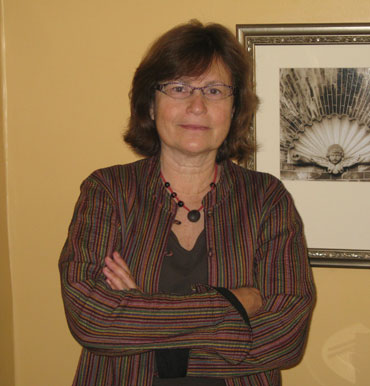
In addition to 'The Sonnets' and 'Poems of the Night,' Levin is releasing three books of selected essays; 'On Argentina,' edited and with an introduction and notes by Alfred MacAdam, 'On Mysticism,' edited and with an introduction by Maria Kodama, and 'On Writing,' which is edited by and includes notes and an introduction by Levine herself. Remember, it takes only two mirrors to create a labyrinth. You can follow me into the labyrinth with Jill Levine by following this link to the MP3 audio file.
New to the Agony Column
09-18-15: Commentary : William T. Vollman Amidst 'The Dying Grass' : An Epic Exploration of Simultaneity
Agony Column Podcast News Report : A 2015 Interview with William T. Vollman : "...a lot of long words that in our language are sentences..."
09-05-15: Commentary : Susan Casey Listens to 'Voices in the Ocean' : Science, Empathy and Self
Agony Column Podcast News Report : A 2015 Interview with Susan Casey : "...the reporting for this book was emotionally difficult at times..."
08-21-15: Agony Column Podcast News Report : Senator Claire McCaskill is 'Plenty Ladylike' : Internalizing Determination to Overcome Sexism [Incudes Time to Read EP 211: Claire McCaskill, Plenty Ladylike, plus A 2015 Interview with Senator Claire McCaskill]
Agony Column Podcast News Report : Emily Schultz Unleashes 'The Blondes' : A Cure by Color [Incudes Time to Read EP 210: Emily Schultz, The Blondes, plus A 2015 Interview with Emily Schultz]
07-05-15: Commentary : Dr. Michael Gazzaniga Tells Tales from Both Sides of the Brain : A Life in Neuroscience Reveals the Life of Science
Agony Column Podcast News Report : A 2015 Interview with Michael Gazzaniga : "We made the first observation and BAM there was the disconnection effect..."
04-21-15: Commentary : Kazuo Ishiguro Unearths 'The Buried Giant' : The Mist of Myth and Memory
Agony Column Podcast News Report : A 2015 Interview with Kazuo Ishiguro : ".... by the time I was writing this novel, the lines between what was fantasy and what was real had blurred for me..."
Agony Column Podcast News Report : A 2015 Interview with Marc Goodman : "...every physical object around us is being transformed, one way or another, into an information technology..."
Agony Column Podcast News Report UPDATE: Time to Read Episode 199: Marc Goodman : Future Crimes: Everything Is Connected, Everyone Is Vulnerable and What We Can Do About It