Guy Gavriel Kay lives one world over. He may spend his time researching in our world, in our timeline; but there's an adjacent universe where lives unfold. That's where his books take place.
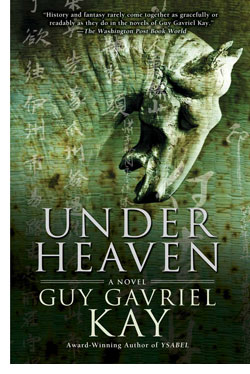
That's where he takes the fruit of his research and creates works like 'Under Heaven' (ROC / New American Library / Penguin Putnam ; April 27, 2010 ; $26.95). The life of the imagination is no different from our daily lives when transformed into language.
Kay has a habit of creating fantasy worlds based on historical models, and his latest novel is no exception. 'Under Heaven' begins with Shen Tai in the mountains. There are no other men, women or children with him, but he is not alone. He has lots of ghosts for company.
Shen Tai is the second son of the late General Shen Gao, and he's spent the last two years mourning at the site of a battle. He is burying the dead, but he is also beginning a journey; and he is the ultimate destination.
Kay's latest novel transforms the Tang Dynasty of the eighth century into the Ninth Kitai Dynasty. This begs the question; why re-invent history? Why research the smallest details of the biggest empires only to ultimately discard them and re-create them in your imagination?
In a letter to readers of the Advanced Reading Copy, Kay answers that he wants a "tale universalized," that by re-imagining a new world based on the real world, he can extract the elements that speak not just to the historical timeline, but to our world, in this moment. And since he does not have access to the historical figures, he does not have to guess what went on in their minds. By creating his own historical parallel, he can make a world and tell a story that is ultimately more coherent, more transparent and more entertaining.
There's no doubt about the entertainment value of 'Under Heaven.' Kay knows how to structure a historical adventure, how to create the vast canvas with the tiny details, and how to draw compelling characters with carefully turned prose.
'Under Heaven' has the advantage of living in a world where the characters' perceptions of the fantastic are as real to the characters as their perceptions of the swords with which they fight their battles.
One of Kay's characters in this novel is a poet, Sima Zian, the Banished Immortal, based Kay suggests on Li Bai, the Tang Dynasty poet. I'll let Kay's poet speak:
"When choosing a bow, choose a strong one,
If you shoot an arrow shoot a long one,
To capture the enemy, capture their leader,
But carry within you the knowledge
That war is brought to bring peace."
For Guy Gavriel Kay, the path to our world, to our lives, leads through worlds of the imagination; thus we invent ourselves, imagine our lives, one day at a time.
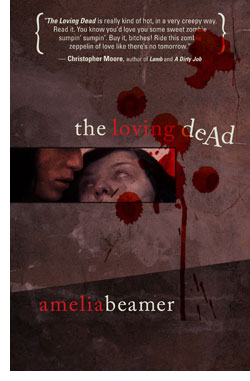
04-28-10:Amelia Beamer Dates 'The Loving Dead'
Sex, Death and Humor
We can blame it on zeitgeist, the current market — anything but ourselves. Still, we're the ones buying all those books about the undead, be they zombies, vampires or some other permutation on un-life after death. I suppose it makes sense mathematically. The dead, after all, are the ultimate silent majority.
Fortunately, the dead tend to stay dead, and we can hope that continues to be the case. But if things change — and we know all the reasons they could, don't we? — then we'll be thoroughly prepared for the facts of, say, zombies, by virtue of all the fiction out there. Covering bases we never thought to exist, Amelia Beamer looks our unhappy world in 'The Loving Dead' (Night Shade Books ; July 2010 ; $14.99) and concludes that in the event of a zombie plague that is a sexually transmitted disease, we can expect more a than few laughs, some entertaining insights into why the world would not be so different with zombies, and hang-ups at the local NPR station when we tried to warn the world.
Because we're so incredibly jaded that we might as well just die and be zombies already, 'The Loving Dead' starts out with a sexual assault, sort-of played for laughs. But that parking lot groper proves to be patient zero so far as Kate and Michael are concerned, and ultimately, something of a spoiler for the party they're throwing that night. One second, drinking and revelry; the next, sex-hungry zombies who are aiming lower than your brains. Makes you almost nostalgic for the brain-eaters.
Not really — Beamer may have some shamblers in her novel, but this is modern farce, purely written and excellently executed. Beamer does not re-invent zombies. She simply puts them in the midst of some twenty-somethings who frankly have other problems just as difficult, mostly one another. Beamer's a skilled writer, and the result is a fun book that you'll finish faster than you'll think possible.
The first key to 'The Loving Dead' is Beamer's quick, smart prose. She writes with a low-key sense of humor that puts everything at a slight distance, in a sense almost turning the reader into a zombie. She makes it alarmingly easy to watch the world go hell, turning that handbasket into a suburban rollercoaster. On a sentence level, her writing is funny sharp and transparent, which may or may not be a good thing depending on how you feel about implied necrophilia.
Beamer's characters are the second arrow in her quiver. She knows that the best way to keep the unreal from being the unreadable is to offer readers pragmatic characters who deal with the problem of zombies using downloaded smart cell phone applications. When you're grounded in the characters' world, you're pretty much ready to accept sexual zombies, since, to be truthful, a fair percentage of women probably already regard most men as sexual zombies already. It's almost hard to tell the difference — no pun intended.
Not surprisingly then, Beamer's smart characters and excellent prose take her through a plot that makes perfect sense — assuming the sexual zombies. In point of fact, if you get a call at an NPR station and someone tells you an item that may well be newsworthy and true, you really don't have the option to put it on the air, even if you think it's true. Alas, I shall have to wait, lonely, bored and even sleepy while the sexual zombie apocalypse happens around me and I broadcast an interview, probably with Beamer herself. We're on the second floor and shamblers may have a problem with the stairs. By then, perhaps, an ARC of the sequel will have arrived. Maybe this time around, the zombies will eat books.
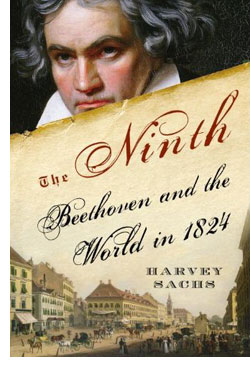
04-27-10:Harvey Sachs Conducts 'The Ninth'
'Beethoven and the World of 1824'
Some things are worth waiting for, and this book is amongst them. I'm telling you about it now for a very specific reason. Now is the time for you to hie yourself hence to the music store, online or otherwise and get yourself a good Herbert von Karajan rendition of the Beethoven Symphonies. You're going to want to read this book, and you're going to want a very specific soundtrack to do so. To my mind, on the audio side, Karajan is the man for this mission; on the print side we're lucky to have Harvey Sachs.
Sachs' new book, 'The Ninth: Beethoven and the World of 1824' (Random House ; June 22, 2010 ; $26) is an irresistible look at the milieu in which Beethoven composed and first performed his masterpiece. Sachs non fiction is smart, entertaining and quite compelling as he examines not just the gray-haired maestro but those around him, in the arts, and in the great houses, to help readers understand more perfectly the cultural and civic and artistic circumstances that gave birth to a work that touches not just our souls, but the eternal.
You cannot deny the power of Beethoven's Ninth Symphony; it simply sweeps you away. And it is easy to let that be that, to let the music speak for itself. As it has now for more than a century.
Still, understanding any work of art in context cannot help but broaden and deepen your enjoyment. And if that understanding comes in the form of a book that it itself a work of art, there's a confluence of ideas and ideals that can change the way you experience a work. That's what makes Harvey Sachs' 'The Ninth' so appealing. It's a closely focused work of history, which in a mere 195 pages, plunges the reader headfirst into a world that helped to make our world. In so doing, it also re-makes our perception of not just Beethoven's most famous symphony, but of the torrent of art that was blossoming forth in Europe at the time; and it was not a happy time either. (Are times ever really happy? Nonetheless...) 'The Ninth' combines historical research, musical analysis and political insights of the period that lets readers synthesize something quite grand. Something to keep up with Beethoven's work.
Sachs' starts right in the thick of things, with a look at the premiere of the Ninth, and thus, with a look at how the music was performed at the time. To listeners who will fill their ears with Karajan's rich and powerful sound (and believe me you will want that sondtrack), Sachs' description of the initial outing is terrifying fragile. The composer himself, of course, was deaf, but that did not stop him from wanting to participate. There were no symphony orchestras as we know them. And Beethoven's innovative use of vocals was married to a political perspective that was diametrically opposed to the prevalent powers of the time.
But Sachs goes well beyond his illuminating you-are-there moments to put all this in context, evoking the writer and other artists who found themselves in a culture that was rich but repressive and aristocratic. Today we'd call them either tyrants or "friendly powers," but in 1824, antiliberalism was making a big comeback. Sound familiar?
Sachs, a conductor himself, also delves into the music in a manner that will turn the heads of those who have no formal musical education. This is a potentially difficult subject, not unlike a book about maths, but Sachs knows how to architect his prose and his approach in a manner that carefully breaks down the technology of music and makes it clear how the technology — the notes and instruments — carry the emotions and the art.
Sachs is a smart writer; he casts a narrow net and keeps his focus tight so that the reader gets all the right bits of the big picture, all the right notes of the grand symphony. 'The Ninth' is a toe-tapping synthesis of art, history and music that will change the way you look at all three.
04-26-10:Yann Martel Metafictions 'Beatrice and Virgil'
Talking Animals and Quiet Humans
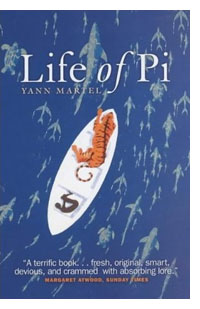
Yann Martel wrote 'Life of Pi' ("No article," he says), a novel that by any measure was a smashing success; a bestseller for longer than most, a Booker Prize winner, and one of those books that is a reading audience favorite. It has a lot of appeal; high adventure, great animals, a direct but nicely-complicated storytelling style. But he's a restless soul, and he wanted to try something very different. This is not generally a path to popularity.
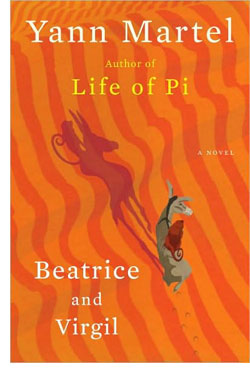
'Beatrice and Virgil' (Spiegel & Grau / Random House ; April 13, 2010 ; $24) is not going to win Martel a lot of friends. It's a novel that follows the high road (meta-fiction) with a hard subject (the Holocaust). Martel takes a lot of chances here, and wants to make a grand statement that has consequences in the world beyond his fictional world. His success in the larger sense can only be measured in the fullness of time. What matters to readers is whether or not this book is a good reading experience. This may hinge, not on the fact of murder, but on how you define a good reading experience.
Yann Martel's novel introduces us to a familiar figure; Henry L'Hote, a writer with a phenomenally successful book behind him and ... not so much in front of him. His follow-on, a paired novel and essay about the Holocaust, is soundly rejected by the same publishers who once embraced him. Still, he gets letters about his first novel, and lives a simple life. A letter, though can change your life, and one that Henry gets certainly changes his.
To say much more about the plot of 'Beatrice and Virgil' is to give away what surprises it has, which are not plentiful. Martel plays with meta-fiction effectively, creating writers and their works, and even a play-within-a-novel, titled "Beatrice and Virgil," in which a howler monkey and a donkey traipse through a wasteland having a rather charming Beckett-style conversation. Out of these disparate parts, he weaves a very unusual vision of the Holocaust, that if not totally successful in terms of creating a dynamic impact, does at least lead readers down a very different path than most novels that concern themselves with this subject.
Martel's best tool is his quiet, well-crafted prose. 'Beatrice and Virgil' is a pleasure to read. There's a direct, understated quality to his writing that does achieve the sort of low-key power required to make his high-minded aspirations achievable. Even through the many layers of playful creation; the play, the letters, the scans of Flaubert, the not-so-sorry story of a writer who just can't live up to his creation, Martel finds the knack of speaking to the reader. He also speaks to the reading experience. The fact that he understands this helps his case, which is nothing less than an attempt to demonstrate that one can write about the Holocaust in a lively, imaginative manner.
But Martel is perhaps a bit too effective at holding back the darkness, and his sublimation of perhaps the defining moment of the Twentieth Century leaves too much unsaid. No doubt Martel is a smart guy; he plays with the identity of Henry L'Hote, turning his analogue into an effective everyman. But if L'Hote connects with his readers, he never quite connects with the subtext.
'Beatrice and Virgil' does have a number of charming moments, mostly in the play, where the language shapes the animal-speakers into a seductive reading experience. Martel has some fun with the world of writing and publishing, and offers his uniquely immersive vision of the animal world; it's not always a nice place to be, however.
In the novel 'Beatrice and Virgil,' Henry L'Hote tells his publisher that he'd like to publish his novel paired with an essay. The publisher explains that this is a really bad idea — and gives some good reasons why. Martel also wanted to publish his novel as a "flip book," he explained in an interview with The Onion. Presumably, he too was talked out of this, but to me, it seems that an essay from Yann Martel might have been just the thing to bring the disparate pieces of 'Beatrice and Virgil' to a more satisfying whole. This is a novel that begins with its own evisceration. One can feel the writer's pain, and that is perhaps the point.
New to the Agony Column
09-18-15: Commentary : William T. Vollman Amidst 'The Dying Grass' : An Epic Exploration of Simultaneity
Agony Column Podcast News Report : A 2015 Interview with William T. Vollman : "...a lot of long words that in our language are sentences..."
09-05-15: Commentary : Susan Casey Listens to 'Voices in the Ocean' : Science, Empathy and Self
Agony Column Podcast News Report : A 2015 Interview with Susan Casey : "...the reporting for this book was emotionally difficult at times..."
08-21-15: Agony Column Podcast News Report : Senator Claire McCaskill is 'Plenty Ladylike' : Internalizing Determination to Overcome Sexism [Incudes Time to Read EP 211: Claire McCaskill, Plenty Ladylike, plus A 2015 Interview with Senator Claire McCaskill]
Agony Column Podcast News Report : Emily Schultz Unleashes 'The Blondes' : A Cure by Color [Incudes Time to Read EP 210: Emily Schultz, The Blondes, plus A 2015 Interview with Emily Schultz]
07-05-15: Commentary : Dr. Michael Gazzaniga Tells Tales from Both Sides of the Brain : A Life in Neuroscience Reveals the Life of Science
Agony Column Podcast News Report : A 2015 Interview with Michael Gazzaniga : "We made the first observation and BAM there was the disconnection effect..."
04-21-15: Commentary : Kazuo Ishiguro Unearths 'The Buried Giant' : The Mist of Myth and Memory
Agony Column Podcast News Report : A 2015 Interview with Kazuo Ishiguro : ".... by the time I was writing this novel, the lines between what was fantasy and what was real had blurred for me..."
Agony Column Podcast News Report : A 2015 Interview with Marc Goodman : "...every physical object around us is being transformed, one way or another, into an information technology..."
Agony Column Podcast News Report UPDATE: Time to Read Episode 199: Marc Goodman : Future Crimes: Everything Is Connected, Everyone Is Vulnerable and What We Can Do About It