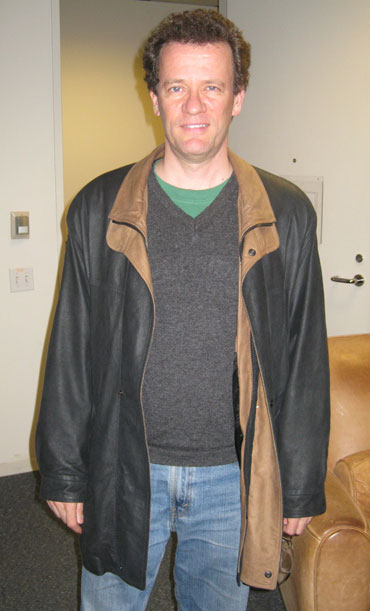
"I just love lighting people up about the music." — David Gordon
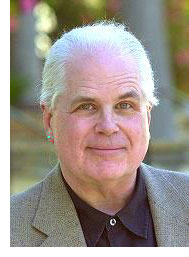
If you step outside your perceived comfort zone, you may find something unexpected happens; either you or your comfort zone has grown. So, in hosting Talk of the Bay on KUSP, I sometimes find that the interviews outside what I think of as my areas of expertise prove to have a universal appeal and moreover, just be one hell of a lot of fun. That's what happened with David Gordon, as he and I talked about his work in the world of classical music, and for the Carmel Bach Festival, now in its 75th year.
David Gordon is an incredibly smart and engaging speaker, and well he should be; he's literally the voice of the Carmel Bach Festival, hosting the concerts with engaging introductions that set the scene and bring the audience into the worlds of the composers whose work is being performed.
Gordon didn't start out as an emcee; he spent most of his life traveling and singing classical music. I talked to him at KUSP live on the air about his life as a classical musician, and his work for the Bach Festival. He provides something utterly unique for this internationally known event; a human voice, language for the music, an entry point for anyone to journey from the 21st century to world of the composers featured in the festival.
But Gordon has done much more as well. He's founded an academy for singers in Carmel, who participate in the show; he's also a teacher. You can hear him tell it all in that rich voice you should make the journey to hear by following this link to the MP3 audio file of our conversation.
04-28-10:Gail Carriger Interviewed at SF in SF on Saturday, April 17, 2010
"It just makes no sense that one little island with terribly bad cuisine would take over the world." — Gail Carriger
...But it makes perfect sense why Gail Carriger would manage to take over the world of steam-driven urban fantasy. She's witty, canny, and thoroughly professional. And, apparently, she throws one hell of a coming out party, or at least she did at the World Fantasy Convention, probably while I was dragging audio from a sound card to my laptop. Bugt all it takes is about fifteen seconds of hearing her talk to know why she is not and will be in the future a writer to watch for. Let's put it this way; as the economy circled the big swirly, she asked Orbit to publish her books as mass-market paperback originals.
At SF in SF, I asked Gail about creating the world of 'Soulless' and 'Changeless' and rapidly found myself in the sort of interview that could easily have stretched into a real-deal "in-depth" chat were I not ever conscious of Time's winged chariot drawing near.
As it were, Carriger and I talked about how she created her world, how she makes this sort of Victoria's Fantasy relevant to this world, and in particular, about her dialogue. One thing you can depend on about writers who are good at dialogue; in general, they're professional eavesdroppers — literally!
One of the things that Carriger manages with her fiction is to appeal to a wide variety of tastes; the steampunk elements of her work and the rigor of her world appeal to science fiction readers, while the supernatural elements will bring in horror fiction readers. Of course her work exists in a netherworld of genres that she herself creates. Unique is always a good call. You can hear her speak about her own work by following this link to the MP3 audio file.
04-27-10:Blake Charlton Interviewed at SF in SF on Saturday, April 17, 2010
"Books that flirt with epic and hop into bed with endless just upset me so much." — Blake Charlton
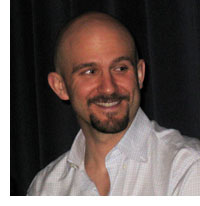
Blake Charlton knows what he's about — no doubt. It's the kind of confidence that when you hear it on tape, or experience in an interview, makes you know that the writing will be sharp, well-directed and particularly entertaining.
For each session of SF in SF, I set up a sort of interview station at the front of the Variety Children's Charity Theater; a couple of chairs and a mic so I can do a classic "single-mic" interview. Passing that mic back and forth can be a godsend when you're trying to wrap you brain around the next question you want to ask. But when I had Blake in the hot seat, I couldn't move it fast enough.
Talking with Blake rapidly become one of those great conversations you can have in a genre bookstore when you meet a fellow reader and discover one thing in common. Out of that single commonality, a whole rapid-fire conversation emerges, and the shared worlds of reading seemed to bond you in ways that are not common and not trivial. On my way home that night, I thought of that conversation often. This was a really fun interview, the sort that makes it really clear why Charlton got a three-hardcover contract from Tor.
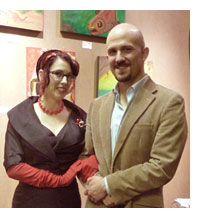
Gail Carriger & Blake Charlton
Generally speaking, I try to keep my conversations at SF in SF on the short side, mostly because there are time limits with regard to how long I can tie up the speakers before the show begins. This translates to: about ten minutes or less. But that just wasn't the case with Blake, who has a lot of interesting stories surrounding his work, most of which I did not get ask him about.
Charlton wanted to make it clear that what he read was the humorous bits early on because he is swell aware that humor works well when read aloud; better than almost anything else. He emphasizes that the bulk of his new novel (which as the quote above suggests, is not too bulky) is a fantastic adventure, replete with monsters, dragons and the sort of thrills that readers of the fantastic will enjoy.
Here's the slight problem with all this good news; Blake Charlton showed up on my radar now, as he finished up his education to become a doctor. And the chances are he'll keep up this dual life, which will necessitate less fiction than we might prefer. On the other hand, chances are it will be really good less fiction. You can hear him explain why by following this link to the MP3 audio file.
04-26-10: A 2010 Interview with Yann Martel
"So I choose to believe that this whole existence makes sense."
— Yann Martel
Yann Martel is a serious, smart and well-spoken writer. He knows what he wants to talk about; the Holocaust and how it is represented in art, movies and writing. He's quick to explain that he has no personal connection; he's not Jewish, he's not related to survivors. He's just intensely, artistically interested in not just what happened, but how we talk — or don't talk — about it. His new novel, which certainly concerns itself, "with the fact of murder," did not come easy. And that perhaps is not just appropriate. It is deliberate.
It is always good to be ready to abandon your expectations with regards to writers. I try to leave mine somewhere on the northbound 280 freeway. It is also wise to never conflate writers with their characters, no matter how many and deliberate the similarities may seem. So meeting Yann Martel, who had just written a book about an author who seemed to use Yann Martel as a template required extra distancing.
Martel is extremely smart and very well-spoken. He's a passionate artist, who pursues his craft even when it is not kind to him. Of course, I have my own pre-occupations as well. For me what was very interesting about 'Beatrice and Virgil' was the aspect of reading and writing, of creating meta-characters who authored fictional narratives. For Yann Martel, it's all about what we don't say, how we do not treat the Holocaust.
Martel is extremely intelligent, and he's a charmingly quick wit. As we plunged into the terra incognita of the process and thoughts behind his novel, we began to pick apart not just his work, but his perceptions of how the craft of fiction itself works. This is a man who thinks a lot about how he writes what he writes. He takes his job seriously. It's my feeling that 'Beatrice and Virgil' has so much subtext, it actually benefits the reader to hear the writer talk about the underpinnings of the novel before reading the novel. Martel die a fine job shining a light on the subterranean sub-structure of 'Beatrice and Virgil' without going too much into the actual text; the idea being that you can hear this interview and head into the novel with a better idea of what the author has in mind beyond, as it were, "the fact of murder."
But we also had a lot of fun digging into his latest, as well as talking about what is currently Ang Lee's upcoming adaptation of 'Life of Pi.' Martel told me that he has a habit of writing a book that comes very easily — and is easily accepted — and alternating thing with a book that is very difficult to write — and is generally not so easily accepted. That translates to a tale about the novel he is currently working on. You can hear my interview with Yann Martel by following this link to the MP3 audio file.
New to the Agony Column
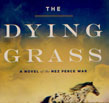
09-18-15: Commentary : William T. Vollman Amidst 'The Dying Grass' : An Epic Exploration of Simultaneity
Agony Column Podcast News Report : A 2015 Interview with William T. Vollman : "...a lot of long words that in our language are sentences..."
09-05-15: Commentary : Susan Casey Listens to 'Voices in the Ocean' : Science, Empathy and Self
Agony Column Podcast News Report : A 2015 Interview with Susan Casey : "...the reporting for this book was emotionally difficult at times..."
08-21-15: Agony Column Podcast News Report : Senator Claire McCaskill is 'Plenty Ladylike' : Internalizing Determination to Overcome Sexism [Incudes Time to Read EP 211: Claire McCaskill, Plenty Ladylike, plus A 2015 Interview with Senator Claire McCaskill]
Agony Column Podcast News Report : Emily Schultz Unleashes 'The Blondes' : A Cure by Color [Incudes Time to Read EP 210: Emily Schultz, The Blondes, plus A 2015 Interview with Emily Schultz]
07-05-15: Commentary : Dr. Michael Gazzaniga Tells Tales from Both Sides of the Brain : A Life in Neuroscience Reveals the Life of Science
Agony Column Podcast News Report : A 2015 Interview with Michael Gazzaniga : "We made the first observation and BAM there was the disconnection effect..."
04-21-15: Commentary : Kazuo Ishiguro Unearths 'The Buried Giant' : The Mist of Myth and Memory
Agony Column Podcast News Report : A 2015 Interview with Kazuo Ishiguro : ".... by the time I was writing this novel, the lines between what was fantasy and what was real had blurred for me..."
Agony Column Podcast News Report : A 2015 Interview with Marc Goodman : "...every physical object around us is being transformed, one way or another, into an information technology..."
Agony Column Podcast News Report UPDATE: Time to Read Episode 199: Marc Goodman : Future Crimes: Everything Is Connected, Everyone Is Vulnerable and What We Can Do About It