05-13-10: Guy Gavriel Kay Reads for The Agony Column Live on May 8, 2010
"A meaty chunk." — Guy Gavriel Kay
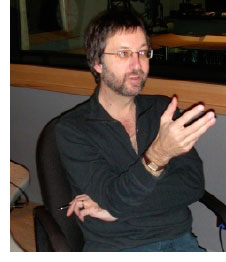
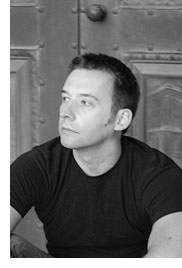
Guy Gavriel Kay arrived to find that his co-star and reader Zachary Mason had read most of Kay's work, uh — in his youth. I wasn't sure what to have Kay read from his latest, as there was so much nice prose in there. I do think that readers will find he gives you enough to totally understand the setting and the set-up. That's quite an achievement for a fifteen-minute reading from a 572-page novel.
Kay also managed to literally satisfy my request that he read us what I called a "meaty chunk" from his novel. As I looked at the audience on that mild spring evening here in Santa Cruz, I noticed more than a few stacks of Kay's signature novels on the tables in the Capitola Book Café.
One of the aspects of these events I was hoping to achieve proved to be quite easily done with the setup provided the Capitola Book Café. There were four rows of four chairs surrounded by six tables with four chairs. The whole affair had the perfect intimate feel that I had hoped for.
Kay's prose in 'Under Heaven' is really quite beautifully sculpted and well-set for reading aloud. There's a measured, epic feel to event he small-scale and appropriately intimate opening passages that he read from. You can hear his reading by following this link to the MP3 audio file.
05-12-10: Zachary Mason Reads for The Agony Column Live on May 8, 2010
"The longest and the shortest pieces." — Zachary Mason on what he was planning to read
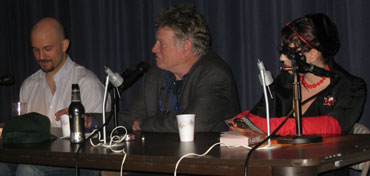
The first Agony Column Live show went off rather well last Saturday. We had bestselling author Guy Gavriel Kay and New York Times-featured Zachary Mason sitting down with a small audience of readers in the intimate space of the Capitola Book Café to read and talk about their writing. The consensus I got from the audience members I talked to afterwards was that they would happily return for more.
I'll start the podcasts from this even with the reading by Zachary Mason from his novel, 'The Lost Books of the Odyssey.' I have to admit that I had no idea what the man himself would be like in person; I loved the book, which casts a haunting, surreal spell.
As it happens, Mason is a relaxed, slightly shy and smart computer scientist who weaves his fiction by first leaving everything, including the Odyssey itself, behind.
He chose to read the longest and the shortest pieces from his novel, which is ... not exactly your everyday, kitchen-window epiphany work that one associates with high literature. He told about the original first edition, and about his style of creation, which involves more subtraction than anything else. That sort of arid feeling I detected is quite purposeful and the result of lots of hard work. To hear that style, follow this link to the MP3 audio file of his reading.
05-10-10: SF in SF, April 17, 2010: Gail Carriger, Blake Charlton and Terry Bisson
"Do you think the popularity of Victoriana in the United States is partly because we've never outgrown the dream of empire, and so we relate?" "Oh, definitely..."— Audience question and Gail Carriger's reply
It is funny how much a bunch of librarians can light up a show. When the time came for the panel discussion with Gail Carriger, Blake Charlton and Terry Bisson, things got fun fast and stayed that way. We were hardly five minutes into proceedings before we began casting actors for roles in movies based on the books. Now that's a literary discussion!
There was a big crowd there to see Gail Carriger and Blake Charlton. Carriger managed to throw a memorable coming-out party at the World Fantasy Convention here in San Jose last year, and the locals who enjoyed that soiree made a point of coming to this one. The advance publicity (difficult to obtain!) in Boing Boing surely helped. But in the end, it was the books that mattered.
Carriger and Charlton had a lot to say about getting into the writing biz. Charlton charmed the audience with tales of his dyslexic youth, and the cheesy paperbacks that turned him into a reader, and eventually, into a writer. Carriger immediately moved to the juicy subject of who would play who in the movie versions of her novels, and Bisson brought his usual bemused perspective to the proceedings. Terry Bisson is in every sense a seasoned, professional writer. He's already done what most every other writer is doing or hopes to do. His observations add a nice measure of depth and experience to the enthusiasm of writers like Charlton and Carriger.
"We have an editorial team at StoryCorps who printed out probably four thousand transcripts."
— Dave Isay
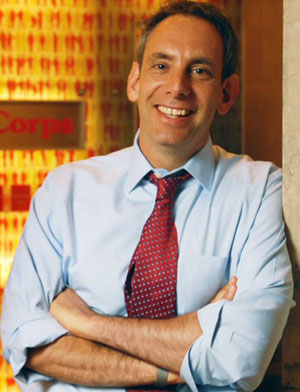
It was spring in San Francisco; sunny but cool, with rain both going and coming. But when we talked, in his hotel room, it was almost like being suspended in light, six stories up. We were really suspended in stories, in the ultimate storytelling project — StoryCorps.
When you interview anyone, you ultimately have to ask a very specific kind of question. You have to ask something you want to know. And as much as I had heard the stories, read the blurbs and website and the handouts and the thises and that's, I really wanted Dave Isay himself to tell me about how and why he created StoryCorps. I knew it was a question he'd been asked; but selfishly, I wanted him to tell me.
Which, he did, in the precise manner of a man who had immersed himself in America. One of the things I really admire about StoryCorps, aside from the simple brilliance of the idea, is that it hearkens back to some great efforts in the past. While we climb ever so slowly out of the worst financial times since the Great Depression, it makes perfect sense that Isay's WPA-like project unfolds in a slow fractal growth across America. Isay is at the precise center of an audio snowball, at this point 30,000 interviews and growing every day.
This kind of archive even now is an incredible and impressive work of data architecture. Each interview is facilitated and annotated by the facilitator. The kind of cross-referencing and indexing that they will be able to achieve is astonishing. This portrait of the actual America, not the cartoon version, is what will, in the fullness of time, become history.
Moreover, one can see that even this gigantic amount of data and vision is just a small subset of what they will be able to eventually accomplish. Now here's an amazing bit of information: Isay told me that going in, they expected that maybe 60%-70% of the participants would give them permission to post the interviews for general public access.
08-21-15: Agony Column Podcast News Report : Senator Claire McCaskill is 'Plenty Ladylike' : Internalizing Determination to Overcome Sexism [Incudes Time to Read EP 211: Claire McCaskill, Plenty Ladylike, plus A 2015 Interview with Senator Claire McCaskill]
Agony Column Podcast News Report : Emily Schultz Unleashes 'The Blondes' : A Cure by Color [Incudes Time to Read EP 210: Emily Schultz, The Blondes, plus A 2015 Interview with Emily Schultz]
07-05-15: Commentary : Dr. Michael Gazzaniga Tells Tales from Both Sides of the Brain : A Life in Neuroscience Reveals the Life of Science
Agony Column Podcast News Report : A 2015 Interview with Michael Gazzaniga : "We made the first observation and BAM there was the disconnection effect..."
04-21-15: Commentary : Kazuo Ishiguro Unearths 'The Buried Giant' : The Mist of Myth and Memory
Agony Column Podcast News Report : A 2015 Interview with Kazuo Ishiguro : ".... by the time I was writing this novel, the lines between what was fantasy and what was real had blurred for me..."
Agony Column Podcast News Report : A 2015 Interview with Marc Goodman : "...every physical object around us is being transformed, one way or another, into an information technology..."
Agony Column Podcast News Report UPDATE: Time to Read Episode 199: Marc Goodman : Future Crimes: Everything Is Connected, Everyone Is Vulnerable and What We Can Do About It