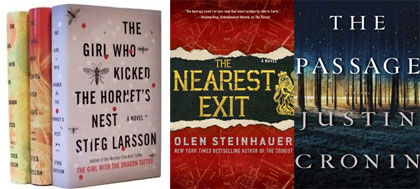
The Millennium Trilogy by Stieg Larsson, The Nearest Exit by Olen Steinhauer, The Passage by Justin Cronin
Even as I type the write-up of this podcast on my hopefully-working computer, I'm getting ready for another confab with Mr. Cheuse later this week. I trust that readers will understand that it will take me a few days to catch up with myself. The last time I caught up with NPR's Alan Cheuse, we were both reading a batch of thrillers that generally speaking, lived up to that description.
One of the most difficult things to admit as a reader, to experience as a reader, is the end.
The end of a great novel; the end of a great series; the end of an author's work. Knowing, that you can never read a book from an author whose work you enjoy for the first time again. This is the end.
In this, case, the end comes with more bangs than whimpers, but plenty of both in 'The Girl Who Kicked the Hornet's Nest' by Stieg Larsson. If you've been hiding under a rock, or more likely, swapping out one logic board after another in the faint hope of getting your computer to the point where you can once again return to your normal workflow, (only to find yourself up against a gnarly license manager that thinks your trying to steal the product you paid $600 for), then you might not have noticed that in your absence, the late Stieg Larsson slipped in and conquered the world of bestselling, intelligent thrillers. Alan and I first set our sights to discuss these books, so that the esteemed critic may suggest why they are more than worth your valuable time.
Worth your time as well is 'The Nearest Exit,' by Olen Steinhauer, his sequel to 'The Tourist,' featuring the return of Milo Weaver. For readers who like murky, grey-on-grey espionage novels with characters as complicated as the plots they are caught up in, this is a great way to vacation in Berlin. But please make sure you read 'The Tourist' first to fully enjoy your stay.
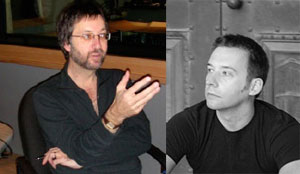
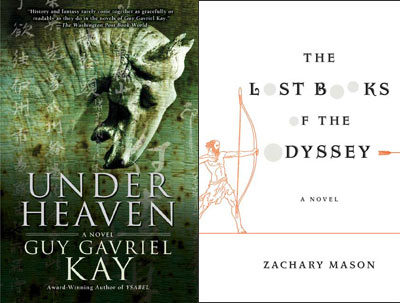
A Panel Discussion with Guy Gavriel Kay and Zachary Mason, March 8, 2010
The idea is sort of to build an avalanche. You plant the seeds of the snowball and sent it downhill, Pretty soon you don't have to do anything. It's a panel discussion and the authors are talking to one another as well as to the moderator — in this case, me.
Zachary Mason and Guy Gavriel Kay and I had a very entertaining conversation about how and why they write fiction that falls just a bit outside of every easily-defined genre.
It's not easy to set up an event that involves two authors. Even one can be a challenge; thus the May 22 appearance at the Capitola Book Café by Carlos Ruiz Zafón ends up getting postponed. But having managed to get Mason and Kay sitting at the table with me, it was not difficult to get them talking. As they did talk, I began to re-think the seating arrangement. Maybe the moderator shouldn't sit in the center. I'll certainly explore that possibility in upcoming events.
"..these are common human foibles and failings, it's just that they get magnified in a combat, war situation..." — Karl Marlantes
When you read Karl Marlantes' 'Matterhorn' you'll find an impeccably crafted and powerful novel — period. In a sense it's a historical novel, insomuch as it is set in Vietnam during our war, but it is so immersive, so engaging, and so foreign to our experiences now that it reads like a science fiction novel. For all the passion, power and strangeness in the novel, you'll find Marlantes himself to be quite a scholar. He's really quite down-to-earth.
I spoke with Marlantes at KQED bright and early at, what, 8:30 AM on a Monday morning? I had no idea what to expect, but I think listeners will find his story of writing the book and the stories behind the book nearly as amazing as the novel itself. You can understand why they put him in charge; he has the naturally powerful voice of a leader.
As an interviewer, in these sorts of situations, there are many temptations. One is to simply focus on Marlantes' own time in Vietnam, which is certainly germane, but only so much. I could easily have spent most of the interview talking about the thirty-year process of writing 'Matterhorn.' And I could simply focus on the wild events in the book itself, but I trust that at this point most listeners will understand that I eschew talking about the plot; I want to illuminate, not ruin the reading experience.
The interview opens with four short readings to give a flavor of the novel, separated by bits of music from Jon Hassell. You can actually hear the gears grinding in my tiny little brain and Marlantes' entertaining responses by following this link to the MP3 audio file.
New to the Agony Column
09-18-15: Commentary : William T. Vollman Amidst 'The Dying Grass' : An Epic Exploration of Simultaneity
Agony Column Podcast News Report : A 2015 Interview with William T. Vollman : "...a lot of long words that in our language are sentences..."
09-05-15: Commentary : Susan Casey Listens to 'Voices in the Ocean' : Science, Empathy and Self
Agony Column Podcast News Report : A 2015 Interview with Susan Casey : "...the reporting for this book was emotionally difficult at times..."
08-21-15: Agony Column Podcast News Report : Senator Claire McCaskill is 'Plenty Ladylike' : Internalizing Determination to Overcome Sexism [Incudes Time to Read EP 211: Claire McCaskill, Plenty Ladylike, plus A 2015 Interview with Senator Claire McCaskill]
Agony Column Podcast News Report : Emily Schultz Unleashes 'The Blondes' : A Cure by Color [Incudes Time to Read EP 210: Emily Schultz, The Blondes, plus A 2015 Interview with Emily Schultz]
07-05-15: Commentary : Dr. Michael Gazzaniga Tells Tales from Both Sides of the Brain : A Life in Neuroscience Reveals the Life of Science
Agony Column Podcast News Report : A 2015 Interview with Michael Gazzaniga : "We made the first observation and BAM there was the disconnection effect..."
04-21-15: Commentary : Kazuo Ishiguro Unearths 'The Buried Giant' : The Mist of Myth and Memory
Agony Column Podcast News Report : A 2015 Interview with Kazuo Ishiguro : ".... by the time I was writing this novel, the lines between what was fantasy and what was real had blurred for me..."
Agony Column Podcast News Report : A 2015 Interview with Marc Goodman : "...every physical object around us is being transformed, one way or another, into an information technology..."
Agony Column Podcast News Report UPDATE: Time to Read Episode 199: Marc Goodman : Future Crimes: Everything Is Connected, Everyone Is Vulnerable and What We Can Do About It