06-17-10:Seanan McGuire Reads at SF in SF on June 12, 2010
"The Alchemy of Alcohol"
She had a choice. Seanan McGuire offered to read one of two stories; One funny and light, the other dark and depressing. There was no competition when she put it that way. The overwhelming response was that she should read "the funny one." Brave soul. Funny is relative. But McGuire succeeded in every respect when she read "The Alchemy of Alcohol."
Because there are clearly not enough "bar stories" in the SF&F genre, somebody over at DAW decided to commission 'After Hours: Tales from the Ur Bar,' and the rest is now recorded-on-digital-audio history. Seanan McGuire read her contribution to this anthology, "The Alchemy of Alcohol" at SF in SF, and I'm guessing sold a few copies of the book right then and there. McGuire's story starts with a body in the bar, and works the absurd angles of fantasy fiction for some extremely satisfying laughs.
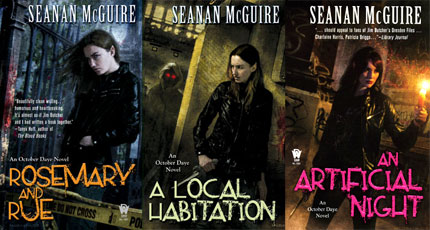
McGuire is up for a Campbell Award this year at the Aussie Worldcon. She's the author of the October Daye novels, which are detective novels with a fae spin to them. Thus far she has 'Rosemary and Rue' and 'A Local Habitation.' Coming up are 'An Artifical Night', 'Late Eclipses' and 'The Brightest Fell.' That takes us into 2011. Hopefully the rest of us will make it there as well!
McGuire is a great reader of her own work. And to my mind, as well as others in the audience, this setup is good enough to warrant a return trip. Alas, the podcast is at least postponed and has at this time been removed at the author's request.
06-16-10:Deborah Grabien Reads at SF in SF on June 12, 2010
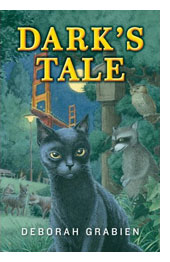
'Dark's Tale' and 'London Calling'
Deborah Grabien at read from two very different new books at SF in SF on June 12; 'Dark's Tale' (Egmont / Random House ; March 23, 2010 ; $15.99), a "tweener" book for ages 9-12 and 'London Calling,' the latest J.P. Kinkaid mystery. Truth to tell, I'd have been hard put to say that 'Dark' Tale' was a tweener book. It seemed pretty gritty and grim to me. But perhaps that's just what the kids want — or are.
Grabien comes from a performance world, so there's no doubt that she knows how to read in a manner that makes her words seem immediate and hard hitting. As part of the panel discussion, she spoke quite a bit about what she can and cannot include in a "tweener" book like 'Dark's Tale.'
But I can see why she wrote and how she sold it. It's the perfect book for cat lovers, and based on Grabien's work with the feral cat population in San Francisco's Golden Gate Park.
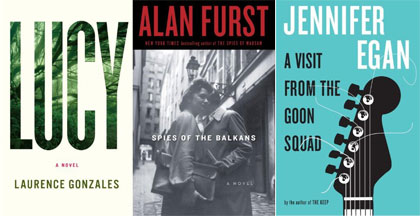
Lucyby Laurence Gonzalez, Spies of the Balkansby Alan Furst, A Visit From the Goon Squad by Jennifer Egan
I don't think we could pick more different books than the three that Alan Cheuse and I discussed this week. We start with a page-turning beach read, follow up with a well-crafted historical spy novel, and finish with punk rock experimental literature. There's certainly no danger of either Cheuse and I or readers getting in a rut!
Surprisingly, to me at least, I think Alan was more enamored of 'Lucy' than I was. 'Lucy' is the sort of science fiction novel that looks like and feels like a mainstream thriller. It's a case of be-careful-what-you-pretend-to-be; to my mind science fiction might find it lacking, while more mainstream readers will enjoy the speculative elements.
Both Cheuse and I quite liked 'Spies of the Balkans,' which is a finely-written historical spy novel of the sort that Furst has become the leading exponent of. Set in Greece in the run-up to World War II, we meet Costa Zanna, a cop in Salonika, a port city in Greece, as he becomes embroiled in the coming war and involved with a woman who is quite likely not who she seems to be. Furst gets all the details right, knows how to plot, and writes engaging characters whom we enjoy see coming closer. It leaves the reader wanting more; what more could we ask?
And finally, Jennifer Egan is back with 'A Visit from the Goon Squad,' a brilliant and brilliantly enjoyable novel that manages to use the tropes of experimental fiction in a manner that make the book grippingly intense, funny, and endlessly enjoyable to read. You'll be hearing a lot more about this book here, so stay tuned. In the interim, here's a link to the MP3 file of my conversation with Alan Cheuse about these three books.
06-14-10:A 2009 Interview with Juliet Schor
"...We need to move to much more open, collaborative, sharing knowledge systems."
— Juliet Schor
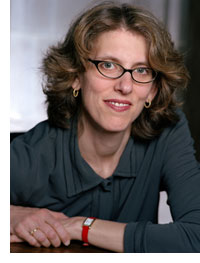
What she says! Sometimes, I feel like I'm running a sort of subterranean college course with a very nebulous throughline, and as I edited this interview with Juliet Schor, I couldn't help but think that this would be the class I'd have right after the Cory Doctorow interview. These two writers have so much simpatico, and are speaking so much to opposite sides of the same coin that it's almost eerie.
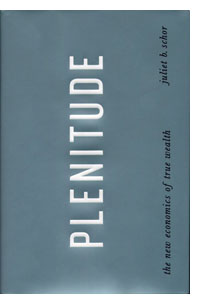
Juliet Schor's book is 'Plenitude,' and it is a fascinating look at how we can effect global change at an individual level with a change of perspective. In a sense, Schor is working the territory of fiction, trying to change our outlook, using the literary device of non-fiction. She's a smart writer, with a lot to say that has never quite been heard in this manner.
Regular readers and listeners probably know that to prepare I generally, though not always, read the book and plaster it full of yellow stickies. There's a reason for this; it makes it a lot easier for me to put together a précis for my interviews. I take that single typed piece of paper with me to interviews and it makes it easy for me to remember what interested me about the book and what I wanted to chat with the author about.
Assuming that I'm not doing two interviews on the same day.
When I spoke with Juliet Schor, I went from that interview to Dan Dion and Paul Provenza. So I printed out both interviews, a map of where I was going, took the paper from my printer and left — only to discover that Schor's interview page had not printed out. Fortunately, I had the book with me as well, and that forest of yellow stickies came in quite handily. I was able to pull my interview outline directly from the book as I spoke with Schor.
'Plenitude' strikes me as something of a game-changing book. It begins with a data-driven, clear-headed vision of the present. Schor musters a lot of numbers that have been out there, but not examined from her fresh and fascinating perspective. As she does, she builds a case for her arguments that change must and can be effected, not via some magical technological fix, but by a groundswell of new understanding. We do not need more wealth. We need to understand the wealth we have now — time and knowledge. Schor believes that we already have the solutions to many of our problems available. You can hear her solutions by following this link to the MP3 audio file.
New to the Agony Column
09-18-15: Commentary : William T. Vollman Amidst 'The Dying Grass' : An Epic Exploration of Simultaneity
Agony Column Podcast News Report : A 2015 Interview with William T. Vollman : "...a lot of long words that in our language are sentences..."
09-05-15: Commentary : Susan Casey Listens to 'Voices in the Ocean' : Science, Empathy and Self
Agony Column Podcast News Report : A 2015 Interview with Susan Casey : "...the reporting for this book was emotionally difficult at times..."
08-21-15: Agony Column Podcast News Report : Senator Claire McCaskill is 'Plenty Ladylike' : Internalizing Determination to Overcome Sexism [Incudes Time to Read EP 211: Claire McCaskill, Plenty Ladylike, plus A 2015 Interview with Senator Claire McCaskill]
Agony Column Podcast News Report : Emily Schultz Unleashes 'The Blondes' : A Cure by Color [Incudes Time to Read EP 210: Emily Schultz, The Blondes, plus A 2015 Interview with Emily Schultz]
07-05-15: Commentary : Dr. Michael Gazzaniga Tells Tales from Both Sides of the Brain : A Life in Neuroscience Reveals the Life of Science
Agony Column Podcast News Report : A 2015 Interview with Michael Gazzaniga : "We made the first observation and BAM there was the disconnection effect..."
04-21-15: Commentary : Kazuo Ishiguro Unearths 'The Buried Giant' : The Mist of Myth and Memory
Agony Column Podcast News Report : A 2015 Interview with Kazuo Ishiguro : ".... by the time I was writing this novel, the lines between what was fantasy and what was real had blurred for me..."
Agony Column Podcast News Report : A 2015 Interview with Marc Goodman : "...every physical object around us is being transformed, one way or another, into an information technology..."
Agony Column Podcast News Report UPDATE: Time to Read Episode 199: Marc Goodman : Future Crimes: Everything Is Connected, Everyone Is Vulnerable and What We Can Do About It