07-16-10:Allegra Goodman Meets 'The Cookbook Collector'
Modern Love
I date myself; not in the romantic sense, mind you, but in that I heard Peter Gabriel's first hit off his first solo album in my brain as I read 'The Cookbook Collector.' This business of romance, and it is a business, a BIG business, can become a fallback position for readers. It gets inserted into every-damn-thing.
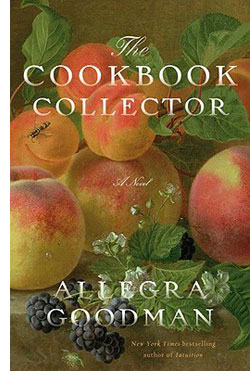
It sometimes seem that the unwritten commandment for every novel is that the basic story is: boy meets girl. Or vice versa. At least in novels like Allegra Goodman's 'The Cookbook Collector' (Dial Press / Random House ; July 6, 2010 ; $26), that's upfront and the main story. No fooling around in this novel of ... fooling around.
So, yep, "Modern Love," from Peter Gabriel's 1976 eponymous album — 'cause that's all it was, an album, back in a thoroughly different world — still rings true, or at least in my ears when I browse 'The Cookbook Collector.' While back then I was fond of so-called New Romantic bands, now, I'm not so fond of literary romances. That's generally because in books and worse in any sort of video or television show, it's just accepted that somewhere along the line, a couple is going to, and I use this odious phrase purposely, hook up. Because obviously that's the end-all and be-all, the full stop of life. Well get over it New York, get over it Hollowood. Some of us have left the high-school prom behind.
First and foremost Allegra Goodman, who, in "The Cookbook Collector,' manages to turn modern moirés into a compelling story. My personal prejudices played deeply into my willingness to even open the book to page one, because often this sort of work gives me the heebies. That said, here's a book about life in Silicon Valley, used book stores, book collecting and cookbooks. Given that backdrop, I'm at least willing to give the author a chance to let her story of hearts and minds coping or at least attempting to, unfold.
As ever, the prose, not the play, is the thing. Goodman writes with precise, clipped sentences that scurry across the pages and take us in tot he very busy worlds of Emily and Jess. Emily's in tech, Jess works at a used bookstore. There is indeed a collection of cookbooks. It's 1999, and the world looks ready to party like it is 1999. Dating myself again. Maybe this time I'll get serious.
'The Cookbook Collector,' to its credit, spends as much time musing about money and its pernicious, fortuitous and irresistible attraction as it does about the heart. After all, we do love our money. In this sense, as it tracks through a past wherein we know what will unfold — eventless Y2K, eventful dawn of the twenty-first century (thank you very much, Sir Arthur C. Clarke!), boom, crash, burn — 'The Cookbook Collector' is another addition to that economic fiction genre I've been on about for a while now. And that is a huge saving grace, even though it tempts Goodman to front-load this novel with a cast that grows faster than complaints about the national debt. By hewing to the facts of the matter, Goodman has more room to work with her hearts, to be generous, and yes, funny.
'The Cookbook Collector' is really quite amusing. That is, it is seriously funny without being condescending, stupid, vapid, or silly. The whole economic aspect keeps it well away from being too girly, well mostly. Guys, just hide it in the DJ from a James Rollins novel. It's worth your time. It's worth anyone's time. It may or may not be for all time, but 'The Cookbook Collector' will make verify your bankbook balance as well as your emotional balance. It's probably a good idea to keep an eye on both. Financial romance — love your money.
07-14-10:The Glorious Average
Harvey Pekar and the Path Most Taken
I guess it's not a surprise that we're so taken with the heroic. All the overblown fuss and nonsense serves as an admirable distraction from lives that for the most part seem to consist of going to work, sitting down for dinner and reading or watching television until sleep overtakes us. Chronicling that kind of life, telling the stories of going to work and coming home, takes a very special kind of talent. And it requires a resolves to keep on chugging ahead, for good or ill, focusing on the material and letting success take care of itself. Harvey Pekar had exactly that kind of vision and exactly that kind of talent.
Pekar's chronicles of the lives of everymen like himself were, surprisingly, not for every man. I don't know about you, but I'd rather watch fashion models dissect dead bodies on TV than look in the mirror.
But over a career that spanned more years than I know, Pekar focused on the small and the unimportant, and in the process, found that them to be neither. Pekar was the master calculator of the glorious average.
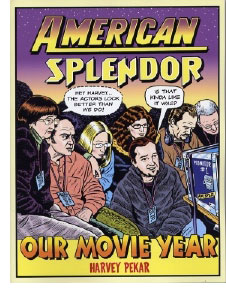
I came to Pekar late in my game, though I'd flashed on him in my misbegotten youth. But in his ongoing masterpiece, 'American Splendor' and in seemingly ten-thousand side projecst, the tireless writer focused on himself and his world, and in the process created a vision of our world.
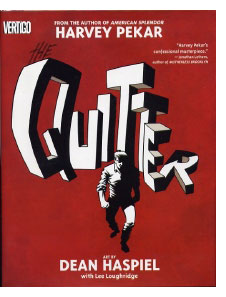
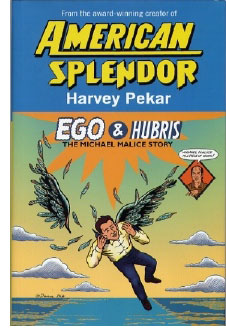
In works like 'The Quitter' and 'Ego & Hubris: The Michael Malice Story,' Pekar showed us the gritty world of our own lives, illuminated by fine writing and keen observations that managed a feat that seems almost impossible — he made the mirror bearable.
Pekar came to his craft not through some simple process of being utterly brilliant and walking into the limelight, but by virtue of relentless hard work — in effect the same thing he wrote about. By approaching his art from underneath, rather than above,
Pekar enables himself and his readers to try on their own clothes, their own lives from the perspective of an artist, with the idea that such lives are innately worth as much as any other life. He wasn't gentle with himself or his characters.
Nobody really got any breaks and the hard knocks were not compensated with magical gifts or mystical insights. Still, as often as not, his characters were alive at the end of the story, and ready to live another day.
And here's where Harvey Pekar manages himself one bit of artistic magic, one gift from all the work that he did in his life just to show life as life — nothing more, and nothing less.
Pekar left us recently, at least the man who wrote the words did. But his stories, those powerful stories remain with us.
Every time we open up something he wrote, Harvey Pekar lives another day in another life. Every time we we sit down weary, tired, and look at our aching feet, we have the chance to see them as Harvey Pekar saw them. Taking the next step — a step worth taking.
07-13-10:Peter S. Beagle Says 'We Never Talk About My Brother'
Literary Urban Fantasy
Urban fantasy.
These days, the phrase brings to mind an endless parade of supernatural romances, and is roped around everything from fluff-filled teen-romances to hard-boiled faerie detectives. And everything yes everything is a series, first in a trilogy last in the second trilogy, the first of five, the second of six, the third of seven, the fourth of eight.
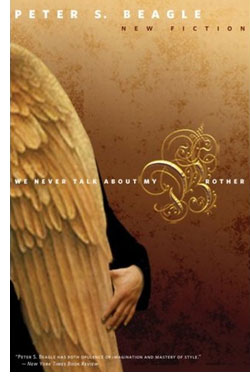
Set 'em aside for a moment to luxuriate in some superb literary urban fantasy. It's not brand spankin' new, but it is sure as hell worth you time and money. I'm talking about Tachyon Publications 'We Never Talk About My Brother' (Tachyon Publications ; March 15, 2009 ; $14.95) by Peter S. Beagle. This collection of short stories offers a readers a chance to escape reality by cutting close to the truth. The heart is not a rational world.
These days, the phrase brings to mind an endless parade of supernatural romances, and is roped around everything from fluff-filled teen-romances to hard-boiled faerie detectives. And everything yes everything is a series, first in a trilogy last in the second trilogy, the first of five, the second of six, the third of seven, the fourth of eight.
Set 'em aside for a moment to luxuriate in some superb literary urban fantasy. It's not brand spankin' new, but it is sure as hell worth you time and money. I'm talking about Tachyon Publications 'We Never Talk About My Brother' (Tachyon Publications ; March 15, 2009 ; $14.95) by Peter S. Beagle. This collection of short stories offers a readers a chance to escape reality by cutting close to the truth. The heart is not a rational world.
The stories in 'We Never Talk About My Brother' offer readers a landscape of the heart, filtered by a mind with a bent for the surreal rendered in precise prose. Beagle's vision of the world is not pure emotion, but rather, the essence of our lives, reworked so that the tangled jumble of what we feel and what we think and who we are is made sensible. Of course, since we are not sensible at heart, the stories quickly leave what we generally experience behind and replace it with folkloric evocations our feelings. Alas, we cannot control them, and they are not always or even often gentle.
For me two stories are the exemplars; the title story, in which a man finds that his brother is about to be come the Angel of Death, and "The Stickball Witch," which Peter reads for The Agony Column Live" in today's podcast. Readers will quickly twig to why the title piece got to me; it's a bit of an interview, sort of, and the telling of the tale as a family anecdote is powerful but also very funny. Beagle gets the family tensions right, just right, and once he has us in the grip of the teller's emotions, he can take us pretty much anywhere and does. The raconteur effect can take us handily out of reality to a world in which the fantastic can walk our city streets or smile at us from the television. How would we know what is behind the pixels?
"The Stickball Witch" works on a similar vibe, but is both funnier and lower key. In fact, it would not be out of place in a collection of literary fiction. Here, the narrator recounts a stickball game in which he is finally forced to enter the yard of the local crone, feared and hated, to retrieve a lost ball. Much of the work is simple, straightforward storytelling with a hint of nostalgia. But the power of the emotional truth that informs the narrative is unstoppable. It's really a brilliant work that would have made a perfect and quite memorable episode of The Twilight Zone.
In a sense that's true of all the stories here, but this is beagle's prose and Beagle's world. Still as we read these tales of the city, we find yard, buildings, TV screens that are in fact, mirrors for the heart. Read, and note the moment you fall into the mirror.
07-12-10:Aimee Bender Tastes 'The Particular Sadness of Lemon Cake'
Emotional Synesthesia
It's the mix that matters. Not the balance, but rather the tilt from one state to another, from one emotion to another, where our lives take place. We only realize that we are sad because we were once happy; we only achieve happiness in reference to grief. In those moments when our moods change, when we grow, when we learn, when we become the next versions of ourselves, we are writing our own stories.
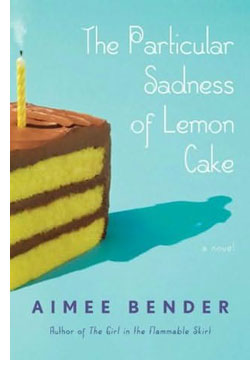
Aimee Bender's 'The Particular Sadness of Lemon Cake' literally and literarily synthesizes this sense of motion and emotion, measuring the differences between who we are and who we appear to be. She captures with perfection the moments in our lives when those people cease to be the same in the journey of Rose Edelstein, a girl who learns at the age of nine that her mother is unhappy — and why.
Bender's second novel is a beautifully understated work of supernatural suburbiana. Yes we have all the markers of a full-blown horror novel here; a troubled family, and a young girl who discovers that she has supernatural talent. But Bender works the story from the opposite side of the spectrum. Rose's parents have common, but solvable problems. Rose's talent is undeniable and troubling, but not life threatening. Rose's small life — a decent suburban school, a big brother who may be a genius but is certainly troubled, a mother who goes through a series of jobs trying to find a place in the world — is generously evoked with a strong sense of story. Aimee Bender loves her characters and their odd lives, and readers are likely to as well.
The Edelstein family is the center of the plot here, with lots of well-written and carefully sculpted character arcs that are genuine and genuinely compelling. We see everything through the eyes of Rose at the age of nine, and again in steps as she grown older. When she first learns that she can taste the emotions of those who cooked her food, Rose has her first inkling that even her parents may not be what they seem. Bender does a superb job as a writer of the uncanny and the supernatural, exploring Rose's "power" with precision. Bender's very smart in this regard, creating and expanding both the readers and Rose's understanding of what she learns from food. In terms of creating a very naturalistic evocation of the supernatural, Bender's novel is second to none. She's also quite adept at evoking an almost Lovecraftian or Borgesian sense of terror, a sense that there is an otherness about in this world that can simply dissolve our expectations without even noticing that we exist.
But Bender is really quite crafty in her exploration of Rose, because we're also getting to know the rest of the family. Her mother's quest for definition takes a turn that could easily lead to melodrama, but Bender resists this temptation and fashions a much more compelling story as a result. Her brother, Joseph, is an increasingly troubled young man, whose story could also be told too vividly. Instead, Bender opts for the uncanny in surreal, terrifying scenes that will replay in the reader's memory like a repeated dream. Rose's father is slyly undertold, but he, too has every bit as fascinating a journey as the rest of this family. Bender sets up everything in a most satisfying manner with allusions that carry us forward and are rewarded as we get to know the Edelsteins.
'The Particular Sadness of Lemon Cake' looks like and in many ways reads like a superbly crafted work of literary fiction. But don't let the fantastic quality of Bender's character work, or her fabulous evocation of suburban Los Angeles fool you. This is easily the best "urban fantasy" you're going to read this year, and perhaps in many years. Forget about faerie wars and supernatural detectives. Think about the world around you about the mysteries it conceals, about the mysteries you yourself conceal. There's so much more to us than meets the eye. But all the senses together, including our sense of love, of honor of family — that's a synesthesia that is naturally supernatural. Aimee Bender evokes the very taste of life.
New to the Agony Column
09-18-15: Commentary : William T. Vollman Amidst 'The Dying Grass' : An Epic Exploration of Simultaneity
Agony Column Podcast News Report : A 2015 Interview with William T. Vollman : "...a lot of long words that in our language are sentences..."
09-05-15: Commentary : Susan Casey Listens to 'Voices in the Ocean' : Science, Empathy and Self
Agony Column Podcast News Report : A 2015 Interview with Susan Casey : "...the reporting for this book was emotionally difficult at times..."
08-21-15: Agony Column Podcast News Report : Senator Claire McCaskill is 'Plenty Ladylike' : Internalizing Determination to Overcome Sexism [Incudes Time to Read EP 211: Claire McCaskill, Plenty Ladylike, plus A 2015 Interview with Senator Claire McCaskill]
Agony Column Podcast News Report : Emily Schultz Unleashes 'The Blondes' : A Cure by Color [Incudes Time to Read EP 210: Emily Schultz, The Blondes, plus A 2015 Interview with Emily Schultz]
07-05-15: Commentary : Dr. Michael Gazzaniga Tells Tales from Both Sides of the Brain : A Life in Neuroscience Reveals the Life of Science
Agony Column Podcast News Report : A 2015 Interview with Michael Gazzaniga : "We made the first observation and BAM there was the disconnection effect..."
04-21-15: Commentary : Kazuo Ishiguro Unearths 'The Buried Giant' : The Mist of Myth and Memory
Agony Column Podcast News Report : A 2015 Interview with Kazuo Ishiguro : ".... by the time I was writing this novel, the lines between what was fantasy and what was real had blurred for me..."
Agony Column Podcast News Report : A 2015 Interview with Marc Goodman : "...every physical object around us is being transformed, one way or another, into an information technology..."
Agony Column Podcast News Report UPDATE: Time to Read Episode 199: Marc Goodman : Future Crimes: Everything Is Connected, Everyone Is Vulnerable and What We Can Do About It