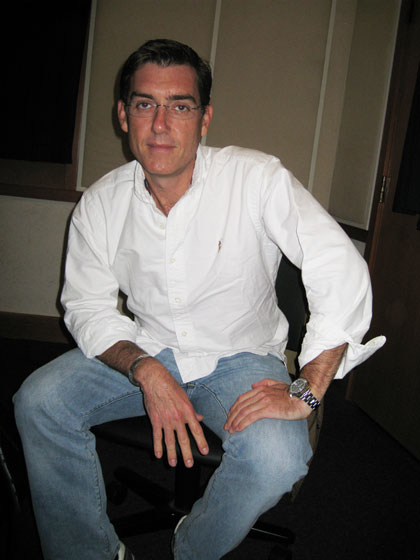
The World Fantasy Convention was a very strange experience for me, as in these situations, I always feel as if I am there — and not there. I feel as if I am a part of the proceedings and yet apart from them. I am ever different in shape from the slot I am supposed to fill. But I remember Tim Powers and that echoing room. I remember that well.
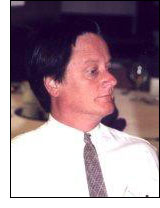
I think that Tim Powers was somewhat nonplussed by my persistence in attempting to interview him. I'd tried once before at the World Science Fiction Convention in Los Angeles, which I attended with my wife. Alas, our schedules did not overlap. This time around, with the help of Rina and Jacob Weisman and the wonderful staff of the World Fantasy Convention, I was much more dialed in. Eventually, I did sit down to speak with Powers.
Powers did not have a new book out at the moment; his most recent was 'Three Days to Never,' a wonderful exploration of the American suburb by way of magic, science and story. Powers at the time lived in Riverside, which is not so far from where I spent many years in the San Gabriel Valley. The southern California suburbs haunt me to this day.
"...they have this theoretical preconception of what history is ..."
—Thomas Frank
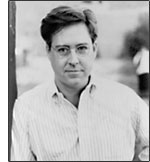
Ah, the lot of the speculative fiction reader is sometimes difficult. And the reading is sometimes even more difficult. Not under threat of — well, it's not torture according to his colleagues, but even if threatened with waterboarding — I'd not venture to read Newt Gingrich's writing. But I would pay attention to the fact that he's written alternate history involving Nazi Germany when he starts spouting off about how America faces a Nazi-like threat from his opposition. Thankfully, Thomas Frank is willing to face worse-than-waterboarding; he read Gingrich's latest screed. Not surprisingly, he has something to say about it.
OK, I'm going to spill Thomas Frank's terrible secret. He liked Newt's bit of alternate history. There, you have it. That said, Frank is rather well-acquainted with the genre, but not in the fashion of those who read genre fiction. That's because as much as we like out Harry Turtledoves, our Brian Stablefords, and everyone else who ever tweaked reality to suit their fictional purposes, the fact of the matter is that history gets tweaked regularly to serve so-called factual purposes. In the immortal words of Nomeansno, "Just Look Around."
Frank is quite adept at looking around seeing the high fictional content of the words of those in the political world. He and spoke about his last two columns that take writers like Newt Gingrich and Jim DeMint to for eliding the details that don't serve their message.
Now this is fine if you're Harry Turtledove and the novel you have written asserts that aliens invaded the earth during the World War II. I happen to love the Worldwar Series, which is seriously goofy fun. On the other hand, when Jim DeMint asserts that progressive Democrat Woodrow Wilson shoved Prohibition down the throats of working-class Americans, that sort of elides the fact that Wilson actually vetoed the Volstead act, the precursor to prohibition.
"...the technology is outpacing our ability to absorb what it is doing to us..."
—Gary Shteyngart
Looking for a fun time in the dismal, as opposed to distant future? Pick up your phone and ring up Gary Shteyngart, who, having created an entire country to lampoon the world in 'Absurdistan,' has now decided to take on the world itself. But that proves to be more difficult than he imagined.
It's impossible to know the number of novels that were scuttled by the fall of the Berlin Wall. The spy novel industry is only now just getting back up on its hind legs again. That single event, which was admittedly historic, had a historic effect on those who would have portrayed it in fiction. Alas, reality does not always cooperate with those who would like it to hold still long enough to write and publish a novel about it.
The next stop on the "Your novel is now obsolete" express is the "Financial Crisis of 2007-2010" (read, worldwide new Depression). How many novelists were happily spinning tales of the Dow 20K? How many novelists were writing speculative fiction (read "science" fiction) set mumble years in the future after a worldwide new Depression?
Well, you can count Gary Shteyngart as one of those trying to keep his science fiction one step ahead of a reality that was crumbling faster than seemed possible. His new novel, 'Super Sad True Love Story' is the sort of book for which the phrase "instant karma" was created. I used one of those new-fangled telephone interview devices to get in touch with, since I'll be speaking with him when he appears at Bookshop Santa Cruz next Sunday evening.
I'll be honest. Between the brutal timing (I have a show on Sunday evenings, fercrissakes, I know) and the unhappy economy, we'll he happy with more people in the audience than on the stage. So, to get a sneak on what to expect, you can follow this link to the MP3 audio file of our interview. This presumes, of course, that the economy and the radio station and the bookstore are still open next week. That's not a given.
08-02-10:A 2010 Interview With Justin Cronin
"A novel is itself a kind of dream."
—Justin Cronin
Sure, that's a lot easier to say when Ridley Scott bought the option on your novel. When you read 'The Passage,' you'll understand why in a heartbeat. The immersive quality makes it feel like a movie. But what you have to buy at the moment is a novel, and the author's voice is a critical part of how well that novel works. You listen to Justin Cronin for a few minutes and forget you're in traffic at your own peril.
In some non-trivial ways, the whole writing and publishing saga of this novel is every bit as grandly adventurous as the tale told in the novel. In some ways it is more improbable. Since when do New York Publishers get behind a honkin' near-future apocalypse via monsters? Now, arguably, circumstances have indeed made what once might have seemed to be utterly improbable and probably impossible at least possible and not improbable.
What's more, Cronin brings some pertinent real-life experience to the table. It's not often that I get to talk about Panic in the Year Zero, but that opportunity afforded itself when I spoke with Cronin. Not only did he have the geek-reference down, he had something better as well. I also had the opportunity to speak with him about the potentially lucrative niche marketing opportunities that await him.
08-21-15: Agony Column Podcast News Report : Senator Claire McCaskill is 'Plenty Ladylike' : Internalizing Determination to Overcome Sexism [Incudes Time to Read EP 211: Claire McCaskill, Plenty Ladylike, plus A 2015 Interview with Senator Claire McCaskill]
Agony Column Podcast News Report : Emily Schultz Unleashes 'The Blondes' : A Cure by Color [Incudes Time to Read EP 210: Emily Schultz, The Blondes, plus A 2015 Interview with Emily Schultz]
07-05-15: Commentary : Dr. Michael Gazzaniga Tells Tales from Both Sides of the Brain : A Life in Neuroscience Reveals the Life of Science
Agony Column Podcast News Report : A 2015 Interview with Michael Gazzaniga : "We made the first observation and BAM there was the disconnection effect..."
04-21-15: Commentary : Kazuo Ishiguro Unearths 'The Buried Giant' : The Mist of Myth and Memory
Agony Column Podcast News Report : A 2015 Interview with Kazuo Ishiguro : ".... by the time I was writing this novel, the lines between what was fantasy and what was real had blurred for me..."
Agony Column Podcast News Report : A 2015 Interview with Marc Goodman : "...every physical object around us is being transformed, one way or another, into an information technology..."
Agony Column Podcast News Report UPDATE: Time to Read Episode 199: Marc Goodman : Future Crimes: Everything Is Connected, Everyone Is Vulnerable and What We Can Do About It