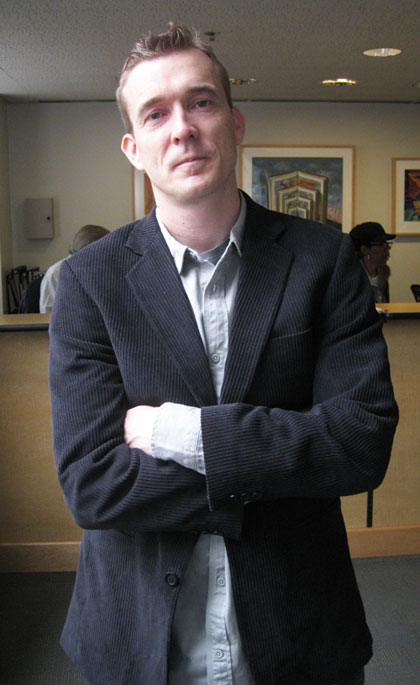
08-11-10:Barry Eisler and David Corbett Live at Capitola Book Café on August 7, 2010
"If anyone thinks it's absurd that the government might assassinate the founder of WikiLeaks, it's quite a bit less absurd than I wish it were"....
—Barry Eisler
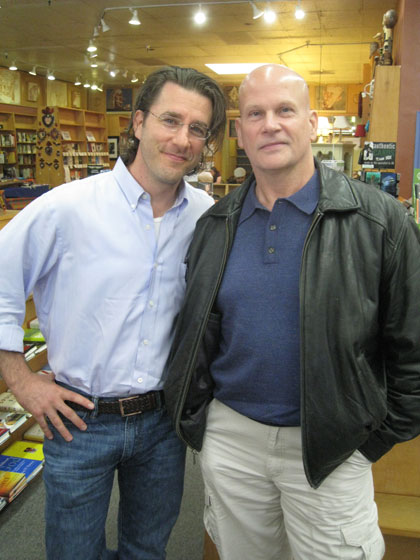
Since David Corbett and I were both planning panels — his for some future con, mine for that evening — we exchanged some thoughts on the subject before and after the show. Mostly we said that a good panel is all about selection. Get great participants, and you've done most of your work — the panelists will naturally speak well with one another. So, as it happens, that proved to be precisely the case as I kept Barry and David mostly by letting them speak their minds. Truth be told, it was a wild evening.
I'm going to podcast the remaining portion of the show in two parts; today's podcast is the bulk of the discussion between Corbett, Eisler and myself. One of the things that made me think that these two writers would work well together is that they both had actual experience in the fields they wrote about. This proved to be the case, as they shared some of that experience.
Of course, both writers also have book that are dealing with so-called "hot button" issues in a manner that proves to be rather prescient. It's one thing to predict a future far enogh down the line that nobody will remember your prediction; it's very much another to start writing a book about an issue a year or two before that issue becomes a national obsession.
Corbett's new novel, 'Do They Know I'm Running?' zeroes in on the pretty much unsolvable problem of – not illegal immigration so much as human migration, the tendency of people to flee from one place to another in large numbers. Not surprisingly, with the state of Arizona having passed an onerously unclear law requiring its law enforcement officers to read the minds of those around them in order to detect who is or is not an illegal immigrant, Corbett's novel is perfectly on-topic and on-target.
08-11-10:Barry Eisler Reads at The Agony Column Live on August 7, 2010
"...they'll pick up that angle and run interference for us..."
—Barry Eisler
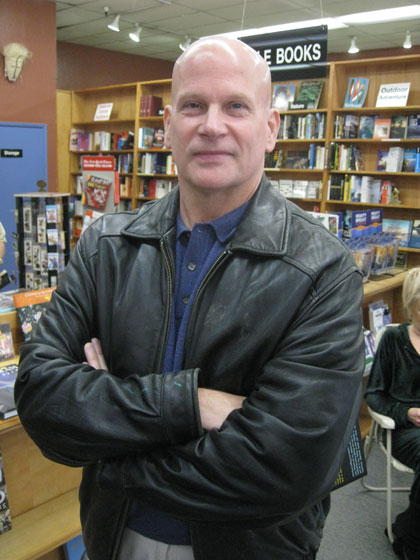
Everybody had a confession before The Agony Column Live; Corbett, that he wanted to work with Eisler because he'd planned to have him on a panel — and Eisler? Well, his was a bit more embarrassing, actually. Eisler admitted out loud that he had been reading the latest novel by "TV personality" Glenn Beck. Yes, it was a reading assignment, for a book review he was to write. But — Glenn Beck. Can you wash your brain?
You know, I actually wrote that sentence (thinking of a Talking Heads Line, "I'm cleaning .. I'm cleaning my brain..") without taking into consideration that I was talking about an ex-CIA guy. If anyone can "wash a brain," it's got to be Barry Eisler. I mean, isn't that in the job description?
All kidding aside, I was really curious as to why Eisler would be reading such a book for review. As far as I knew, Beck's first novel was 'The Christmas Sweater,' a sentimental tome about happiness and light. His second, novel, 'The Overton Widow,' sounded like more of the same. I could just imagine the plot, the poor Overton widow, so sad and lonely...
Ah, it was instead 'The Overton Window.' And it is being pitched as a thriller. Eisler was, not to put too fine a point upon it, unenthused. But I've got to think it had to be better than the book I imagined it to be. Either way, I intend to preserve my precious mind.
08-10-10:David Corbett Reads at The Agony Column Live on August 7, 2010
"These Families are making incredible sacrifices..."
—David Corbett
David Corbett confessed to me before our show at Capitola Book Café that one of the reasons he wanted to come was that he was preparing for a panel that he had put together, and he wanted to see if he could get a dry run working with Barry Eisler. As if they'd have to worry! I've spoken with Corbett on two occasions, and seen Eisler speak live. I knew that this human chemistry experiment was going to lead to spontaneous combustion.
I did actually learn just a bit from my previous gig. At least I remembered to turn on the recorder earlier, which is easier said than done when you're trying to marshal your thoughts for a conversation with two men who have mountains of experience both in life and writing. But, frankly, there was not anything to worry about. Eisler and Corbett were totally easygoing, the crowd, though sparser than I'd like, was engaged, and most importantly, both writers had fantastic material.
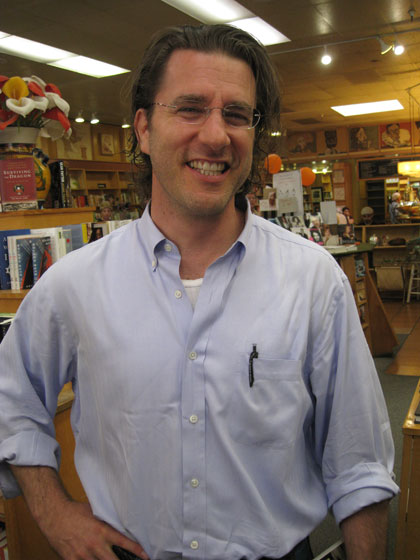
Corbett read the beginning of his novel, immediately immersing us in his powerfully-wrought milieu. And nicely enough, those in attendance responded in the best possible manner; they bought books, which they'll be able to read, and pass on to their friends. One of my contentions in setting up these gigs is that reading is not a solitary activity. When we sit down to read, the experience is part of a larger spectrum. By sitting down together to hear an author read his work in his or her own voice, we're engaged not just with the author, but with one another. You can hear Corbett's voice by following this link to the MP3 audio file.
08-09-10:A 2010 Interview with David Mitchell
"The periodic table of the human heart is still the same now as it was then."
—David Mitchell
It had been a long time since I'd last seen David Mitchell. My world and the world had undergone incredible changes. Nothing, nothing is the same now as it was then. Last time around, he came down to Santa Cruz, where I interviewed him and we spent a lot of the day together. My wife and I took him to the stand of giant redwoods in Henry Cowell State Park.
This time around, I met him at KQED, where he'd spent much of the previous day. After my interview at KQED, he was being hustled off to another. I was a dot on map. But the reading was the same. My immersion in 'Black Swan Green' was not so different from that in 'The Thousand Autumns of Jacob De Zoet.' Books, and conversations with those who write books, seem to be a comfortable constant.
One of the things that most interested me about Mitchell's novel was how he used a relentlessly modern sensibility of language to capture a historical world. Yes, much of the language he uses comes is of the time of which he writes, but in our conversation, I wanted to try to get to at least one of the hearts of the novel, which is the concept of translation, both in the specific sense of converting one language to another, and in the larger sense as well.
Mitchell is quite articulate about his writing process, which encompasses improvisation, research, outlining — he uses every tool in the kit. For a man who writes well about superstition, he himself is clearly not superstitious, at least not in the manner that many writers are. I do understand the hesitation of a writer to talk about works to come and works in progress. Writers worry about expending their inspiration telling the story third-hand before sitting down at the keyboard. That said, Mitchell was happy to talk about this novel in terms of the two that are to follow. They're not exactly a series he says. You can find out why 'The Thousand Autumns of Jacob De Zoet' should go straight to the top of your genre fiction reading list, though it is no fantasy, Mitchell asserts — by following this link to the MP3 audio file.
New to the Agony Column
09-18-15: Commentary : William T. Vollman Amidst 'The Dying Grass' : An Epic Exploration of Simultaneity
Agony Column Podcast News Report : A 2015 Interview with William T. Vollman : "...a lot of long words that in our language are sentences..."
09-05-15: Commentary : Susan Casey Listens to 'Voices in the Ocean' : Science, Empathy and Self
Agony Column Podcast News Report : A 2015 Interview with Susan Casey : "...the reporting for this book was emotionally difficult at times..."
08-21-15: Agony Column Podcast News Report : Senator Claire McCaskill is 'Plenty Ladylike' : Internalizing Determination to Overcome Sexism [Incudes Time to Read EP 211: Claire McCaskill, Plenty Ladylike, plus A 2015 Interview with Senator Claire McCaskill]
Agony Column Podcast News Report : Emily Schultz Unleashes 'The Blondes' : A Cure by Color [Incudes Time to Read EP 210: Emily Schultz, The Blondes, plus A 2015 Interview with Emily Schultz]
07-05-15: Commentary : Dr. Michael Gazzaniga Tells Tales from Both Sides of the Brain : A Life in Neuroscience Reveals the Life of Science
Agony Column Podcast News Report : A 2015 Interview with Michael Gazzaniga : "We made the first observation and BAM there was the disconnection effect..."
04-21-15: Commentary : Kazuo Ishiguro Unearths 'The Buried Giant' : The Mist of Myth and Memory
Agony Column Podcast News Report : A 2015 Interview with Kazuo Ishiguro : ".... by the time I was writing this novel, the lines between what was fantasy and what was real had blurred for me..."
Agony Column Podcast News Report : A 2015 Interview with Marc Goodman : "...every physical object around us is being transformed, one way or another, into an information technology..."
Agony Column Podcast News Report UPDATE: Time to Read Episode 199: Marc Goodman : Future Crimes: Everything Is Connected, Everyone Is Vulnerable and What We Can Do About It