Who are we when we read? Who do we become when we enter the perceptions of the character via prose of the writer? Does our sense of self dissolve and drown in the ocean of words?
Identity is a slippery notion. The second we ponder our own sense of self, the words that do so annihilate the object of our observation. But only if they are our own words, and the self our own self. While reading a book, something different transpires. Immersed in the flow of words, in the flow of a character's perceptions, we slip outside our sense of self. As the author creates a character with carefully chosen language, as a fully-realized human being is revealed to us, in those moments we may step outside ourselves just long enough to meet the stranger, the face we see in the mirror.
In Vendela Vida's 'The Lovers' (Ecco / HarperCollins ; June 22, 2010 ; $23.99), we meet Yvonne, a fifty-three year-old widow, as she arrives in Turkey. She's on holiday, ostensibly to connect with her son and daughter, but her journey is not external. When we meet Yvonne, we do not know who she is, beyond the most basic external facts, but neither does she. In Turkey, first in Datca and then in Knidos, Yvonne finds herself untethered. She realizes that the face in the mirror is that of a stranger.
Vida's novel is a work of character-driven revelation, written in prose that seems inevitable. She creates a sense of destiny in each word we read. The seas and sand that surround Yvonne, the ancient towns and the weather-beaten architecture, have washed away everything but the sparse sentences we find on the pages. 'The Lovers' is a time-worn mirror discovered at the bottom of a drawer, and in the yellowed silver, the images we glimpse seem fraught with unspoken love and repressed distress.
Against this ancient background, Yvonne finds herself in the midst of increasingly and disturbingly absurd modern shenanigans. Though she is supposed to be the sole occupant of the house she is renting, she never even gets a firm footing. Inside, she finds unseemly evidence of the previous occupants. The man who rented the house to her shows up. One of his wives insinuates herself into Yvonne's life. The maid arrives with her family in tow. Vida infuses this with a low-key sense of humor, an undercurrent of the surreal. But Yvonne never really gets a chance to unpack in any sense of the word. She's forced to withdraw, and that inward journey forms the backbone of a plot that unfolds through the revelation of character.
Vida's novel is not just an interior journey however. With deft and powerful strokes, she sends Yvonne further into Turkey and herself, where events unfold that find Yvonne in a hall of mirrors. The problem with mirrors of course, is that they are not magical, but perfectly reflective. The careful prose and the character insights unfold with dizzying speed. This is a novel that etches itself into the reader as if it were one of the reader's own memories. Ultimately, what you discover, if you're lucky, when you look in the mirror, is yourself.
08-24-10:Jeff VanderMeer and 'The Third Bear'
Absurd Is as Absurd Does
Jeff VanderMeer has the storytelling skill set to help us make sense of our increasingly insensible lives, and he deploys it to great effect in 'The Three Bears' (Tachyon Publications ; July 15, 2010 ; $14.95). His seventh collection offers fifteen substantial short stories that demonstrate a unique talent for tweaking the readers' expectations. These stories are lots of fun to read, but they always go a few steps further than just fun. VanderMeer wants to mess with your head.
The title story, for example, gives you a monster, which for me, is a guaranteed good time. Disemboweling, stalking, and intelligent. But VanderMeer is not content to give us a merely intelligent monster. This monster is an artist. And before the chill can finish running up our spines, it is diverted into another place, a perspective where terror is more than merely purgatory.
Other stories veer from office politics into surreal body horror, and obscure literary descents into factual fictional non-fiction. If you have a bit of a hard time keeping up with what is real and what is fiction in the fiction – and you're not watching the network news – then you'll have a good idea of how VanderMeer has subverted not just your sense of story, but your own internal narrative. The form of the story here is as much the story as the elements of the story.
VanderMeer steps from behind the curtain, not so much in the afterword as in "The Errata," in which he fulfills as assignment as a character in one of his own stories. As a Jeff VanderMeer document, 'The Three Bears' seems to be quite close to the beating heart of the physical Jeff VanderMeer. The work is playful, fun, and disturbing, often at the same time. The stories take their time, and unwind slowly in the reader's consciousness. They leave backward-projecting barbs, and don't go away. Instead, these stories fester.
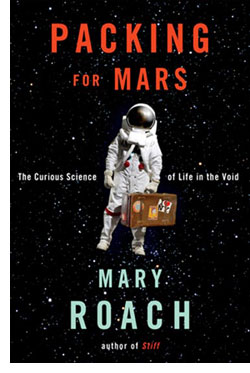
08-23-10:Mary Roach is 'Packing for Mars'
Non Fiction Genre Fiction
The limits of genre fiction are at the heart of its appeal. We know what to expect in a novel about zombies, ghosts, body horror, or space travel. If the subject has some sort of innate appeal to us personally, we know that there's a good chance that we'll enjoy the book. But any given subject may be treated in an entirely different manner. Zombies, for example, get a very serious and somber treatment in 'World War Z' by Max Brooks. It's an oral history. In 'Breathers,' by S.G. Brown, we see a dysfunctional family and a romantic comedy via the zombie. And in 'Stiff,' by Mary Roach, we get a non-fictional treatment of zombies that is very funny.
'Packing for Mars' (W. W. Norton ; August 2, 2010 ; $25.95) is Mary Roach's take on a nuts-and-bolts novel of space travel. It's very funny, entertainingly informative and ultimately offers a goofy but generous vision of that breathing, eating, sweating, and excreting space alien known as the human.
Humans really are alien to space. Everything that we need to live, we have to bring with us. Moreover, much of what awaits us beyond the gravity well, is, if not instantly fatal, either eventually fatal or disablingly harmful. Space is not our friend, and we don't belong there. But like the back of your father's sock drawer, it is endlessly alluring. In 'Packing for Mars,' Mary Roach focuses on the unglamorous aspects of what it takes to get us up in space with carefully crafted comedic joy. We may not belong in space, but we sure as heck can't keep away.
Roach is a genre unto herself, and her science fiction novel latest work of non-fiction is every bit as enjoyable as her other work. She's a master humorist who makes her examinations of actuality as entertaining as any imagined world. 'Packing for Mars' finds her riding the vomit comet, one of those zero-g plane flights, talking with the Japanese scientists who ask their astronauts to fold origami cranes while in a simulation and peering unblinkingly into the unpleasant alternatives not just for space food but also for peeing and pooing in space. You don't have to imagine — Roach will put you right where the squeam hits the ish.
There are lots of choice bits in 'Packing for Mars,' which unfold in compact, expertly written chapters. It's not just the passages on space poo and the problems with carbonated beverages that are funny; everything is. This is because Roach writes with a gracefully understated sense of geeky humor. She knows that timing is everything when it comes to humor, and she always makes her mark. She never forces the issue. Her prose is really a marvel of talent and discipline, matched by her ability to ferret out he most entertaining facts pertinent to her vision of humanity, in this case, humans in space.
Beyond all the wonderful specifics of this book, which are best experienced first hand, 'Packing For Mars' offers a refreshingly honest evaluation of human space travel. It is, of course, crazy, dangerous, and unnecessary. Our level of technology, so potent on the earth, seem positively primitive when we get beyond the atmosphere. The things we take for granted on the ground are often simply unachievable on space. And the humans who are fortunate enough to experience space travel must endure embarrassment and humiliation that is not possible on the earth. It seems like a lose-lose situation. Why bother, then, to send men up in little tins cans?
And here is where the unity behind all of Roach's works makes itself known. No matter what Mary Roach subjects us to, from death itself to life after death or sex, and now, space, no matter what indignities she finds us heaping upon ourselves, Mary Roach likes humans very much. She thinks that we are worth "escapees," wearing the same underclothes until they literally disintegrate, and the hazards of space BO. No matter how smelly or icky we manage to become, Mary Roach sees sweet likable nobility in our absurd behavior. She knows that the drive into space makes life on earth more bearable for those critters that surround her. If Mary Roach is a genre unto herself, and she is, her subjects are the men and women around her. We are her genre.
New to the Agony Column
09-18-15: Commentary : William T. Vollman Amidst 'The Dying Grass' : An Epic Exploration of Simultaneity
Agony Column Podcast News Report : A 2015 Interview with William T. Vollman : "...a lot of long words that in our language are sentences..."
09-05-15: Commentary : Susan Casey Listens to 'Voices in the Ocean' : Science, Empathy and Self
Agony Column Podcast News Report : A 2015 Interview with Susan Casey : "...the reporting for this book was emotionally difficult at times..."
08-21-15: Agony Column Podcast News Report : Senator Claire McCaskill is 'Plenty Ladylike' : Internalizing Determination to Overcome Sexism [Incudes Time to Read EP 211: Claire McCaskill, Plenty Ladylike, plus A 2015 Interview with Senator Claire McCaskill]
Agony Column Podcast News Report : Emily Schultz Unleashes 'The Blondes' : A Cure by Color [Incudes Time to Read EP 210: Emily Schultz, The Blondes, plus A 2015 Interview with Emily Schultz]
07-05-15: Commentary : Dr. Michael Gazzaniga Tells Tales from Both Sides of the Brain : A Life in Neuroscience Reveals the Life of Science
Agony Column Podcast News Report : A 2015 Interview with Michael Gazzaniga : "We made the first observation and BAM there was the disconnection effect..."
04-21-15: Commentary : Kazuo Ishiguro Unearths 'The Buried Giant' : The Mist of Myth and Memory
Agony Column Podcast News Report : A 2015 Interview with Kazuo Ishiguro : ".... by the time I was writing this novel, the lines between what was fantasy and what was real had blurred for me..."
Agony Column Podcast News Report : A 2015 Interview with Marc Goodman : "...every physical object around us is being transformed, one way or another, into an information technology..."
Agony Column Podcast News Report UPDATE: Time to Read Episode 199: Marc Goodman : Future Crimes: Everything Is Connected, Everyone Is Vulnerable and What We Can Do About It