08-25-10:A Live Reading and Interview with Vendela Vida At Bookshop Santa Cruz
"...there was an owl that came into this place we were renting one day..."
—Vendela Vida
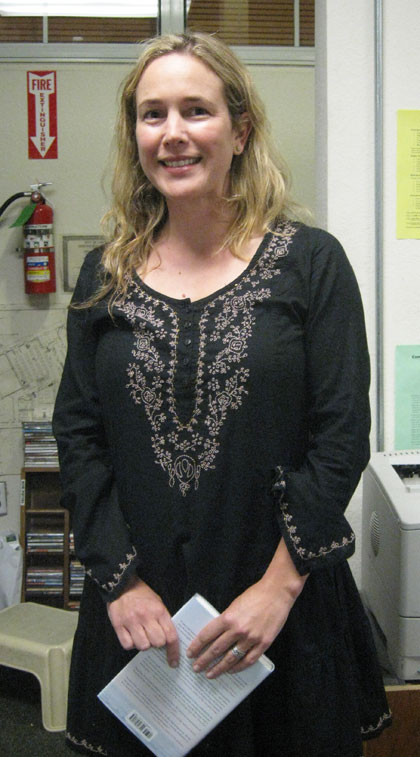
The Vendela Vida event at Bookshop Santa Cruz was almost alarmingly easy. I arrived early and had plenty of time to set up, which proved to be quite fortunate. I literally went through three versions of the audio setup, and made a cable run to Santa Cruz Electronics. In the end, I used the standard issue SF in SF setup, and it worked just fine. I even found the mic stand I'd left behind after the Gary Shteyngart event.
With all the audio setup and tested, I still had plenty of time to re-read the novel, glance at my notes and prepare the scene. But what made all of it so easy, in the end, was the wonderful voice and thoughtful perceptions of Vendela Vida. She was for this interviewer a perfect conversational collaborator.
Somewhere in the depths of time, I lost interest in "Asking Questions" in an interview. This is not to say that I don't ask questions, but I rarely write them down. This generally works to my advantage, even when I actually don't want it to. For example, this time around, I thought that since the phone questions had worked, I'd try to ask them again. But I couldn't remember them, and was happily distracted by the Vida's answers to what I was wondering about.
The evening began with a stellar reading by Vida from her novel 'The Lovers.' After a brief setup, she plunged us into Yvonne's world. Her voice became Yvonne's in that strange third-person translation that happens when we read. It was riveting and dramatic, immersive in the manner of a great reading, and a grand setup for the conversation that followed.
With no audio concerns on my mind, I was free to follow Vida through her sun-drenched creation of Yvonne's world. Eventually, we brought the audience in, and they responded with great questions of their own. I'm not a book group guy, but if I were, here's a perfect book for groups to read. There are so many shades in the novel and so many levels and opportunities for diverging perceptions of the character and events that it really lends itself to a group discussion. Every answer contains the seeds of another question.
"Permission is the unobtanium of human interaction."
—Paul McHugh
Emerging from the surreal fog that settles when you read Jeff VanderMeer, you're going to ask yourself a very simple question; how do I tell my story?
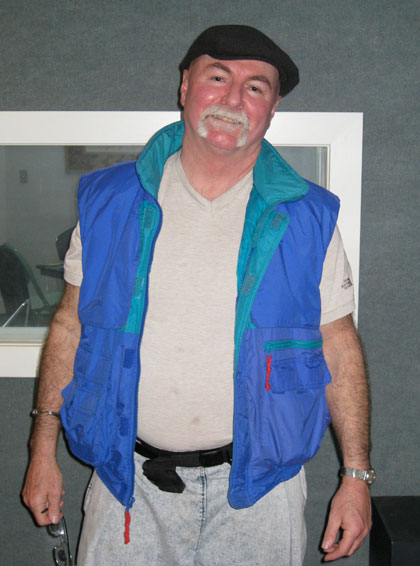
Paul McHugh, author of 'Deadlines,' doesn't just have an answer to that question. He has a workshop at the Henry Miller Library on Sunday, August 29 where he'll give you the tools to do just that, even if you've never thought about writing anything other than a check to pay down the credit cards that are threatening to eat your life and turn it into their own art project.
McHugh is a veteran journalist who spent umpty-ump years with The San Francisco Chronicle covering the out of doors beat. Since we all find ourselves out of doors, in one sense or another, at regular intervals in our lives, McHugh, who turned his own life story into fiction, is the perfect guy to tell us how to turn our lives into a story. Moreover, you can add a side order of fiction.
I managed to catch McHugh at KUSP on his way back from Big Sur, where he'll be conducting the "Art of the Short Memoir" workshop on Sunday, August 29, from 10 AM (http://henrymiller.org/events.html) to noon. I got him to sit down and talk about what he teaches in the seminar, and about his own sense of story.
This is a phrase that seems to be cropping up more often these days as stories and narratives grow around us and assert their power over our lives. We get so caught up in the plot that is our lives that it is easy to forget that we are writing that plot, creating that plot with every second that passes.
McHugh and I had a very interesting discussion about the place of plot and fiction in our own personal narratives. His workshop helps writers an non-writers alike get a better grip on their own narratives, and in a short conversation he more than demonstrated his point.
"There was a second hoax about a shuttle mission..."
—Mary Roach
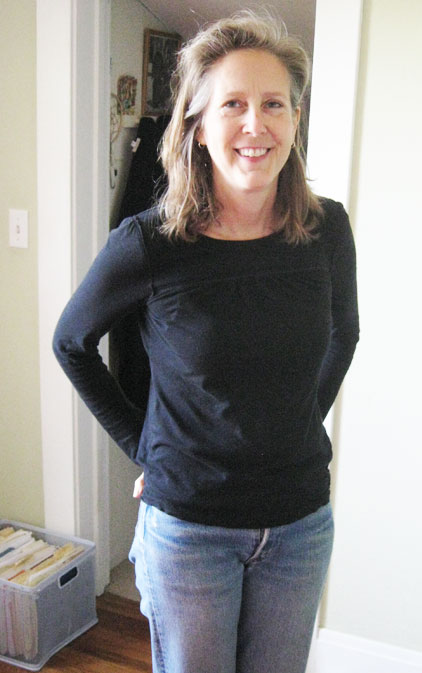
Mary Roach is a lot more popular than you might expect a non-fiction genre fiction writer to be, and the reason for this is easy to see — it is Mary Roach herself. She sweats the same stuff as the rest of us, but she also exudes an enthusiasm for her subject that makes her very engaging and entertaining.
While we might enjoy her take on the perils of pooing in space, what we're really laughing at with her is the ability of mankind to undergo the most extreme of experiences with the sort of utter aplomb one brings to the most mundane of daily chores.
I talked to Roach in her home in Oakland, where we sat hunched over the recorder for about an hour that seemed like ten minutes. Roach really knows her own writing, which is not as common as you might hope. She knows the details, but more interestingly she knows not just details that didn't make it into the book, but as well, her own vision. She understands how she puts these books together.
Aw we talked about how she created her latest work of non-fiction genre fiction, Roach's sunny outlook colored every subject we touched upon. She's easy to listen to because she actually likes her subject — humanity. And she likes us not in spite of our faults but because of them. Flaws make the man.
Mary Roach's books, and I have to consciously remind myself that they are not novels, have a goofy, self-deprecating charm because the author herself does. I asked her off-tape if she'd ever consider writing a novel, and she replied that she has no imagination. I'm not sure I believe that, but I do think she is on to one key aspect of her own appeal.
08-21-15: Agony Column Podcast News Report : Senator Claire McCaskill is 'Plenty Ladylike' : Internalizing Determination to Overcome Sexism [Incudes Time to Read EP 211: Claire McCaskill, Plenty Ladylike, plus A 2015 Interview with Senator Claire McCaskill]
Agony Column Podcast News Report : Emily Schultz Unleashes 'The Blondes' : A Cure by Color [Incudes Time to Read EP 210: Emily Schultz, The Blondes, plus A 2015 Interview with Emily Schultz]
07-05-15: Commentary : Dr. Michael Gazzaniga Tells Tales from Both Sides of the Brain : A Life in Neuroscience Reveals the Life of Science
Agony Column Podcast News Report : A 2015 Interview with Michael Gazzaniga : "We made the first observation and BAM there was the disconnection effect..."
04-21-15: Commentary : Kazuo Ishiguro Unearths 'The Buried Giant' : The Mist of Myth and Memory
Agony Column Podcast News Report : A 2015 Interview with Kazuo Ishiguro : ".... by the time I was writing this novel, the lines between what was fantasy and what was real had blurred for me..."
Agony Column Podcast News Report : A 2015 Interview with Marc Goodman : "...every physical object around us is being transformed, one way or another, into an information technology..."
Agony Column Podcast News Report UPDATE: Time to Read Episode 199: Marc Goodman : Future Crimes: Everything Is Connected, Everyone Is Vulnerable and What We Can Do About It