09-03-10:Bruckner Chase at Blue Ocean Film Festival
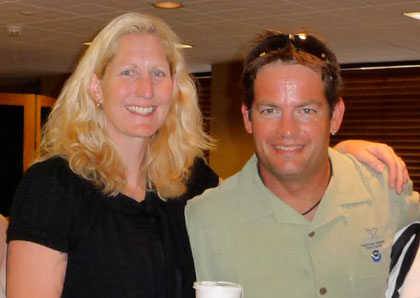
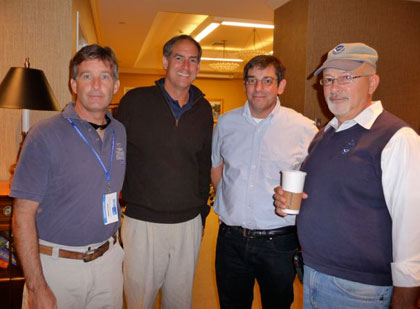
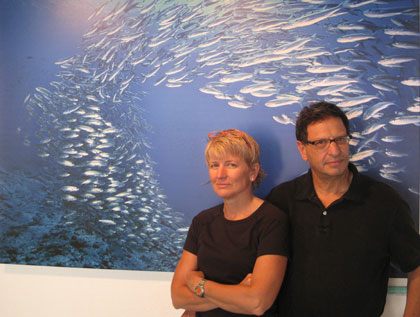
Michelle Evans-Chase and Bruckner Chase
"...a breath to your right and look at the moonset over the Pacific, and a breath to your left and see the sun rise over the mountains..."
—Bruckner Chase
Two days before the Blue Ocean Film Festival began, Bruckner Chase made history. For the first time in thirty years, he successfully swam across the Monterey Bay. It should have been 25 miles, but he drifted and ended up swimming 28. But this isn't simply swimming. Open ocean journeys require quite a bit more than swimming. I hadn't really thought out all the preparations and all the potentialities until I started preparing for the interview. Then the whole journey started to see much more difficult than I could have imagined.
Bruckner Chase was not born an open-ocean swimmer. He made himself that way, and I found out all the details once I sat down to ask him how he had come to the point where, sitting down with me, he was clearly pretty lumpy with jellyfish stings. A swimmer earlier in the week had attempted to do what Chase did successfully, but she was stopped by the thick schools of jellyfish, small and large, that Chase swam through.
If you think that swimming itself is the major obstacle to this sort of feat, you may be correct. But in Monterey, it is instructive to remember that at different points in his journey, Chase swam over kelp forests and a sea canyon over 3,000 feet deep. That's a lot of terrain and the denizens that live there are not so friendly as Flipper. Of course, we only saw the movie Flipper; the real thing might have been a nasty brute. Fortunately for Chase, the dolphins he saw were merely fellow travelers.
09-02-10: BLUE Ocean Film Festival Interview with Ed Lyman and Lou Douros
Ed Lyman, Lou Douros, Rick Kleffel and Dan Basta
In the Wake of Giants
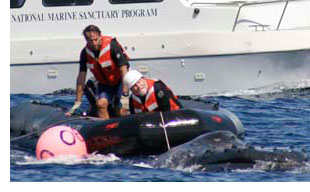
A scene from In the Wake of Giants
Generally speaking, I like to prepare quite extensively for any interview I do. I have a very rigorous process, with lots of steps I like to tick off to ensure that when I sit down to talk to someone, I know who I'm talking to and what I am talking about. Then, of course, just before the interview, I jettison the whole thing and walk the plank unaided.
It doesn't always work out that way. Sometimes You're thinking you have a little break between two interviews, and your facilitator shows up with two unexpected guests. You have about a minute to get their names and occupations right before you turn on the tape recorder, and when you do, things work out better than you could have imagined.
Such was the case with Ed Lyman and Lou Doubros. Our BLUE Ocean Film Festival coordinator, Sarah, brought them up to me after my interview with Dan Basta; Lou, she told me, was the director, writer, and producer of the BLUE selection, "In the Wake of Giants," which was, she told me, about the work Ed did as a marine mammal response manager, large whale disentanglement coordinator for the Hawaiian Islands Humpback Whale National Marine Sanctuary. Got that? Good! Go!
Fortunately, the story they had to tell was too compelling not to be gripping and entertaining. Ed Lyman turns out to be a guy who literally saves the whales, in this case, when they get entangled in sea junk left behind by men; ropes, nets, cables, you name it, if it is a life-threatening entanglement, Ed spends a few days chasing down a whale and them cutting off the cables. Lou Doubros, of Akua Films had the insight to make a movie about Ed and his crew, and the whole shebang proves to be really riveting radio.
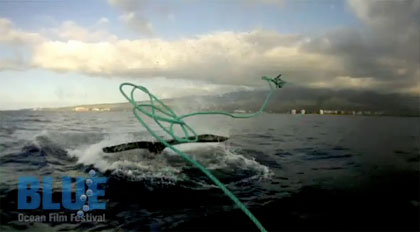
A scene from In the Wake of Giants
In the interview, we talked about both sides of the story; what Ed specifically does, and how Lou got it up on screen for the festival. Like most real-life heroes, Ed tends towards the laconic, but he can't help but tell a great story. There's derring-do, sharp knives, thrashing young whales 35 feet long weighing in at well, more tons than I can remember, and an inflatable boat to pull of this trick. I'll let the two of them tell their story, which you can hear by following this link to them MP3 audio file.
09-01-10:A 2010 Interview with Dan Basta at the Blue Ocean Film Festival
"Experiential learning is the way we learn best."
—Dan Basta
I live on Monterey Bay, about three blocks from the beach. When you walk out on the beach, and I do every single morning, you can see the entire pristine bay — and gain an instant appreciation for the Marine Sanctuary designation that keeps it that way. Dan Basta is the man in charge of our Marine Sactuaries; the Director of the Office of National Marine Sanctuaries, part of the National Oceanic and Atmospheric Administration's National Ocean Service. And you can bet I wanted to talk to him about how he does what he does. Here's an instance where the impact is immediate.
I've spent more time than most talking with engineers, and I know one when I talk to one. It didn't take long for me to suss that Basta was and still is an engineer at heart, and that is the key to his success managing the Marine Sanctuaries of this nation. As he pointed out in our interview at the Blue Ocean Film Festival, the word "sanctuary" is a loaded, emotional term. It is something you might, not coincidentally, seek were ol' Scratch himself to be after you. And for me, this is home.
The challenges of doing what Dan does are enormous and constantly changing. They involve pure engineering efforts and human engineering efforts as well. Dan has written some of the most sophisticated software ever conceived to do environmental simulations, and he and I talked about the problems inherent even with effective software. We talked about how the environmental movements of the 1960's and 1970's brought about some of the most important legislation ever to pass through Congress, and how his work carries on the struggle. You can hear us converse without any struggle; simply follow the link to the MP3 Audio file.
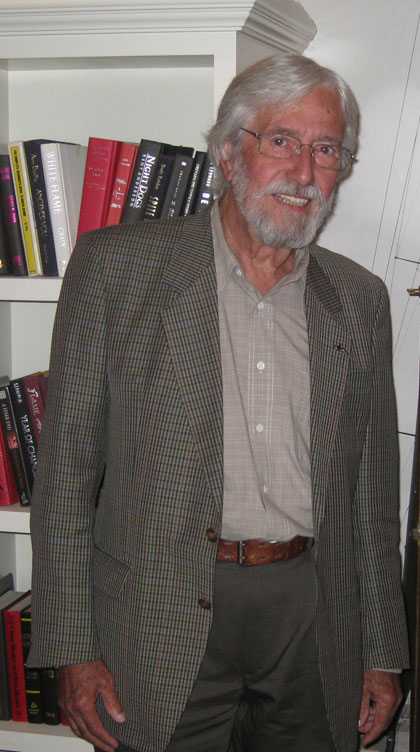
08-31-10:A 2010 Interview with Jean-Michel Cousteau
"We need to change. And we can."
—Jean-Michel Cousteau
Memories beget legends. Those images in our minds that will not go away become to us the basis for our personal mythos. I'm of a generation that grew up on the California coast, and part of my upbringing was spending a lot of time on the water.
And on those rare occasions when my parents would allow me to watch television, there were few allowed shows. Ed Sullivan, pre-homogenization Walt Disney, and of course, since we were water people, Jacques Cousteau. It wasn't until I arrived in a future I could not have dreamed of that I actually met a legend, Jean-Michel Cousteau, Jacques' son, and had the chance to talk with him about the past, the present and the future.
Legends get that designation because they can support it, and Jean Michel Cousteau lives up to his name. He was here in Monterey for the Blue Ocean Film Festival, and I had a chance to sit down and talk with him for a fascinating look at his past, our present and our future.
It's really interesting to me how many of these great underwater explorers got their start early, and Jean-Michel is no exception, except — in his case, his father helped to invent the regulator, and there were, as Jean-Michel told me, no certifications to be had when at the age of 7, his father strapped a tank on his back and sent him underwater for the first time. And that was when ... things changed.
I also spent some time talking to Jean-Michel about current affairs, including the Gulf Oil Disaster, and its relation to his experience with the Exxon-Valdez spill. Not surprisingly, things have not changed, other than the magnitude of disaster. Even the concept of "magnitude of disaster" is odd to me. But to hear a man with Jean-Michel's experience explain it so calmly is indeed chilling.
For a world-renowned conservationist and a living legend, Jean-Michel is refreshingly pragmatic. He does not expect us to simply stop using oil. He knows that just about everything we do is touched by the energy requirement we have, by the energy sources we have. But he does have a a crystal clear vision of the past, a refreshing sense of the present and an energizing view of the future, which you can hear by following this link to the MP3 audio file.
08-30-10:A 2010 Interview With David Doubilet and Jennifer Hayes
"Everything people have always feared about photography comes true underwater."
—David Doubilet
Photography has become a technology-driven art. But no matter how much technology you throw at an art, there is no substitute for vision, which is what David Doubilet brings to his underwater photography. Happily, he is quite cognizant of what he does and how he does it. He's been immersed for a long time. His story is just as captivating as his images.
I had a chance to sit down and find out how Doubilet came to possess his vision, and how he came to develop his art. He began at the beginning, literally, with a Brownie camera. I used to have a Brownie camera, and suspect I still do, somewhere out in the garage, but mine was never put underwater. And that was indeed the start of Doubilet's career. He was selling underwater photographs at an age when most kids are still mowing lawns fdor a living.
The Blue Ocean Film Festival has found its official home in Monterey, California, and Doubilet was here with Jennifer Hayes to show his latest photographs in the gallery, including his nudibranchs. He talked to me about how he created these images by bringing a studio 90 feet beneath the surface of the ocean. These are really quite remarkable; they're so so surreal that they are almost abstract, like logos for an alien civilization.
08-21-15: Agony Column Podcast News Report : Senator Claire McCaskill is 'Plenty Ladylike' : Internalizing Determination to Overcome Sexism [Incudes Time to Read EP 211: Claire McCaskill, Plenty Ladylike, plus A 2015 Interview with Senator Claire McCaskill]
Agony Column Podcast News Report : Emily Schultz Unleashes 'The Blondes' : A Cure by Color [Incudes Time to Read EP 210: Emily Schultz, The Blondes, plus A 2015 Interview with Emily Schultz]
07-05-15: Commentary : Dr. Michael Gazzaniga Tells Tales from Both Sides of the Brain : A Life in Neuroscience Reveals the Life of Science
Agony Column Podcast News Report : A 2015 Interview with Michael Gazzaniga : "We made the first observation and BAM there was the disconnection effect..."
04-21-15: Commentary : Kazuo Ishiguro Unearths 'The Buried Giant' : The Mist of Myth and Memory
Agony Column Podcast News Report : A 2015 Interview with Kazuo Ishiguro : ".... by the time I was writing this novel, the lines between what was fantasy and what was real had blurred for me..."
Agony Column Podcast News Report : A 2015 Interview with Marc Goodman : "...every physical object around us is being transformed, one way or another, into an information technology..."
Agony Column Podcast News Report UPDATE: Time to Read Episode 199: Marc Goodman : Future Crimes: Everything Is Connected, Everyone Is Vulnerable and What We Can Do About It