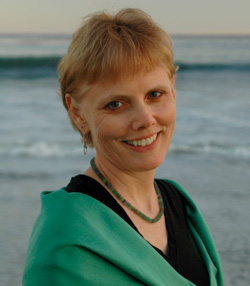
"You're giving them light and color and a story, and in doing so they begin to transform."
—Laura Davis
My second interview with a writing teacher for Talk of the Bay was with Laura Davis, who works with a more traditional model of teaching writing. Her approach is classic; write your best work, bring it in and read it aloud to a group. Davis acknowledges the therapeutic benefits of writing, but emphasized craft. Words and revision matter.
For Laura Davis, the art of writing is an art that can be taught, that students and those interested in writing can learn. That's an important proposition to understand going in. Davis emphasizes the craft and the creativity because one leads to the other. As you improve your craft, you gain insight into your creative process.
But the reverse is true as well. By understanding your self, your own personality, particularly with the art of writing memoir in a creative manner, you can improve your craft. The idea is that our lives, and our understanding of ourselves, is a narrative process. We tell ourselves stories about who we are. On one hand, we want to be honest, so as to gain insight into who we actually are.
09-21-10:A 2010 Interview with Lauren Mari-Navarro on Writing, Memoir and Therapy
"...after they did this four consecutive days of writing, they found that people had fewer visits to the hospital..."
—Lauren Mari-Navarro
Readers more than anyone know the value of writing. But there's more this than the simple act of reading. The not-so-simple act of writing has a value to the writer, a therapeutic value that can be measured. In my guise as the host for KUSP's Talk of the Bay, I recently spoke with two writers who teach writing. Lauren Mari-Navarro is a Licensed Clinical Social Worker who talked with me about the measurable benefits of writing — a science admittedly still in its early stages, but in retrospect, intuitively obvious.
Lauren Mari-Navarro is a therapist who works with the mind-body approach to emotional health. She's got a very interesting slant on the benefits of writing, and she works with more than simply writing in her practice. I talked to her about her work with Memoir writing, and she quickly dove into the scientific research about the physiological effects of writing.
For me, this is where things started to get really interesting. Mari-Navarro went directly to the science and the studies that show that writing has a physiological effect on the brain. If, when you sit down to write you are changing the physiology of your brain, then language is indeed, as William Burroughs once put it, "A virus from outer space."
She's also got a very interesting technique she calls SoulCollage, which involves creating your own tarot deck. While she does not subscribe to the supernatural explanations as to how and why the Tarot deck works, she does think that creating your own Tarot-like deck has obvious and immediate therapeutic benefits. You can hear my conversation with Lauren-Mari-Navarro by following this link to the MP3 audio file.
09-20-10:A 2010 Interview With John Brandon
"There's just tons of great writing about New York, but if I step out of a cab in Manhattan, the energy is so strong and finished, and I just feel like, there's nothing for me to do."
—John Brandon
If you read 'Citrus' County' you won't find it any surprise to learn that John Brandon is a rather down-to-earth writer. I have to admit that while setting up the interview was easy getting there was not, however. I set up to interview him in his hotel, which seemed pretty simple. But then, on the way there, I had a feeling, and decided to call the hotel and make sure he was there. Alas, he was not, and I realized that I did not know where he was staying. Moreover, I did not have with me, in my iPad email queue, the name of his publicist. I was on the road to San Francisco. I had about an hour to figure all this out.
As fate would have it, I managed to get just a glimpse of his publicist's name before the email was automatically emptied from the iPad trash. Careening over Highway 17, I frantically searched for her online and with some luck, managed to find her email, but not her phone. Fortunately for me, she answered her email promptly and gave me the hotel location, which was a good deal distant from where I thought it was.
That proved to be problematic when I tried to get there, as the surface streets in san Francisco are unpredictable at best and predictably bad at worst. There was a 200 foot crane blocking the lane of my route. It was life in the big city.
Fortunately, we made it in time to talk, and I set up in the lobby of Brandon's hotel. When we started things were relatively quiet, but as the interview progressed more people came in and doors started crashing and people started talking — loudly. But over the years of using my now trailing-edge technology, I've learned that this generally doesn't cause as much of a problem as it seems when you're in the moment. I try to focus on the interview and not the crashing madness around me.
Brandon is an easy-going, smart writer, who understands his own process and his own inclinations. Not surprisingly, he's spent time teaching, which explains both why Mr. Hibma is such a great character and why Brandon's own thoughts about writing are so clearly expressed. You can hear Brandon, a few very backgroundy crashes — but not the crane — by following this link to the MP3 audio file.
New to the Agony Column
09-18-15: Commentary : William T. Vollman Amidst 'The Dying Grass' : An Epic Exploration of Simultaneity
Agony Column Podcast News Report : A 2015 Interview with William T. Vollman : "...a lot of long words that in our language are sentences..."
09-05-15: Commentary : Susan Casey Listens to 'Voices in the Ocean' : Science, Empathy and Self
Agony Column Podcast News Report : A 2015 Interview with Susan Casey : "...the reporting for this book was emotionally difficult at times..."
08-21-15: Agony Column Podcast News Report : Senator Claire McCaskill is 'Plenty Ladylike' : Internalizing Determination to Overcome Sexism [Incudes Time to Read EP 211: Claire McCaskill, Plenty Ladylike, plus A 2015 Interview with Senator Claire McCaskill]
Agony Column Podcast News Report : Emily Schultz Unleashes 'The Blondes' : A Cure by Color [Incudes Time to Read EP 210: Emily Schultz, The Blondes, plus A 2015 Interview with Emily Schultz]
07-05-15: Commentary : Dr. Michael Gazzaniga Tells Tales from Both Sides of the Brain : A Life in Neuroscience Reveals the Life of Science
Agony Column Podcast News Report : A 2015 Interview with Michael Gazzaniga : "We made the first observation and BAM there was the disconnection effect..."
04-21-15: Commentary : Kazuo Ishiguro Unearths 'The Buried Giant' : The Mist of Myth and Memory
Agony Column Podcast News Report : A 2015 Interview with Kazuo Ishiguro : ".... by the time I was writing this novel, the lines between what was fantasy and what was real had blurred for me..."
Agony Column Podcast News Report : A 2015 Interview with Marc Goodman : "...every physical object around us is being transformed, one way or another, into an information technology..."
Agony Column Podcast News Report UPDATE: Time to Read Episode 199: Marc Goodman : Future Crimes: Everything Is Connected, Everyone Is Vulnerable and What We Can Do About It