10-08-10:Charles Stross Issues 'The Fuller Memorandum'
The Cold War for Human Souls
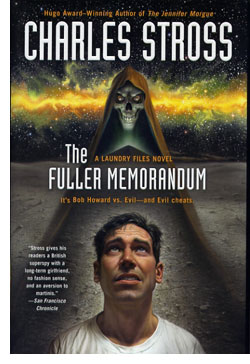
OK, I admit, I'm just a sucker for a quick (for me), easy (for me) and super-fun (for me) Charles Stross Laundry Files novel, in this case 'The Fuller Memorandum.' ( Ace / Penguin ; July 6, 2010 ; $24.95). Stross deftly combines computer geek and sysadmin humor (I spent 20 years in the biz), Lovecraftian monsters and spy novel tropes into novels that are intelligent, imaginative and flat-out fun. There are a lot of supernatural series out in the world at the moment, but The Laundry Files are easily the best you can ask for.
Now, we all like to think of our Lovecraftian monsters as being along the lines of Cthulhu — squidian yet amorphous. It's easy to forget that Lovecraft himself favored Egyptian locales as well as his underwater cities, and derived parts of his mythos from those of ancient Egypt. It's not all tentacle porn.
For all the enchanting monsters and well-wrought spy-novel riffs, the real appeal of 'The Fuller Memorandum' — and all the other Laundry Files fiction — is the first-person narration of Bob Howard. Stross does a number of things with his narrator, even while readers find themselves immersed in a propulsive narrative.
First and foremost, there's that immersion in the story, and it's important. The Laundry Files are the on-the-job memoirs of Bob Howard. He started out as a geekish sysadmin, but found himself pulled into a world-within-our-world where high-powered computers and their computations drive a wedge into reality that lets in the magic. It's never good magic, and those who seek to use it never have good intentions — at least for most of us. This time around, there's a mole in the agency, and the titular memo that has gone missing along with Bob's boss. There's a dead civilian who may just be the first of everyone to die. With Bob telling the story, the action is continuous and compulsive.
But it's also consistently and quite mordantly funny. Stross successfully translates the self-(and everyone else)-deprecating humor of harried, overworked, under-staffed, under-funded computer systems administrators to the world of spies, and then the world at large. Swap out your antedated, antiquated VAX server running an obsolete version of the FoxPro database, then swap in the spy bureaucracy and ageless, formless soul-devouring entities. The first thing you'll find is that they aren't all that different, and the way we need to deal wit them is not all that different. The next thing you'll find is that this is really, really funny. Stross deftly confabulates the absurdity of government, supernatural horror and employment with consistently funny results. The fact that you're laughing makes the plot and the characters charming and engaging.
But while the action is continuous and the tone is light, there's a nice sense of literary history to these novels as well. Each novel riffs of the work of a well-regarded spy novelist, in this case, Anthony Price. For those familiar with the work of the target there's a frisson of familiarity and divergence, and for those not familiar with the work, there's a nice pointer to a background body of work. But simply the idea that these books acknowledge literary history — and a part of literary history that doesn't generally get much acknowledgement — gives the series a more grounded and rich feel.
And this gets us back to Bob Howard and his stalwart wife / fellow agent Maureen. In a welcome change of pace, Howard got the girl in the first novel. Instead of a consistently frustrated courtship — or a series of them — the Laundry files offers readers a decent vision of a married couple growing into their marriage and careers. Sure, they get to haggle with monsters and monstrous computing power, but Stross understands the appeal of domesticity. Even if it comes with the Eater of Souls.
10-07-10:Amir D. Aczel 'Present at the Creation'
Machines, Ideas and the Universe
The world it seems, is still with us.
Try as we might, we've not managed to annihilate it in one of the many fashions proposed by men and women of all stripes; we've (thus far) escaped nuclear war, we've not (yet) warmed the planet to the point of making it incompatible with human life, our sins have not (in our lifetimes) brought about an Apocalyptic retribution by any one of a number of Divine Beings, and we have not (as of this writing) managed to create a black hole that sucks in the planet.
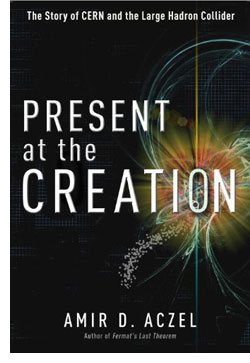
The last option comes to us courtesy of the Large Hadron Collider, and of course, the science tells us this is simply impossible. But for all the attention grabbed by the search for the "god particle" and the potential for world-ending destruction — the ultimate episode of Destroyed in Seconds — there's not been much talk about the LHC itself. And as Amir D. Aczel points out in his book 'Present at the Creation: The Story of CERN and the Large Hadron Collider' (Crown / Random House ; October 5, 2010 ; $25.99), it's certainly a topic worthy of our attention. It probably won't change the world. But it might fundamentally change our understanding of the world.
Whether or not we discover the god particle, or bring about the end of the world, the Large Hadron Collider is certainly worth our attention. Amir D. Aczel managed to get access to the whole shebang — the scientists, the machinery, the laboratory — and 'Present at the Creation' is his look at the science and engineering behind the creation of the LHC, as well as the science being explored by the LHC.
There are lots of challenges in writing such a book. The information needs to be accurate, but it also needs to be entertaining. And there are a variety of subjects to treat here; from the physics that might suggest to build such a machine, to the engineering behind building it, to the physics that might emerge from the experiments being done upon completion. Fortunately, Aczel is up to the task; he understands not only the science, but also his readers.
Aczel cuts deftly between scientists at the controls of the LHC, the history of the science itself, and the engineering miracles required to build what Aczel calls the biggest, most complicated machine ever created by man. By keeping the pace quick, he holds the readers' interest in a subject that does indeed have some serious eye-glazing potential.
Readers who enter will indeed want to be informed about the physics that informs the LHC, but you need to be a physicist to understand. Aczel is adept at bringing readers into the physics without lecturing. He does so by dividing up subject into chunks we can understand and writing in clear, organized prose. So long as you're up for some physics, Aczel delivers the information you need to grasp the enormity of the project in a direct, digestible manner.
And the project, with its implications are enormous; nothing less than the beginning of the universe. But the human aspects are almost equally as impressive, because CERN and the LHC have required intensely coordinated cooperation on an international scale. And for all the science, all the technology, all the engineering and fabrication of parts and pieces, the end result is that the LHC is indeed something quite ... human. It is our curiosity about the universe wrought into steel and wires and plates and boards.
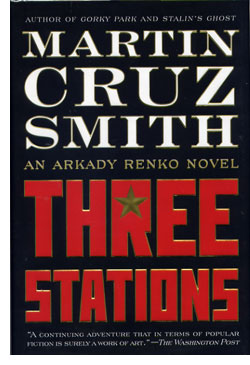
10-05-10:Martin Cruz Smith 'Three Stations'
Russia's Surreal Present and Our Unpleasant Future
William Gibson famously suggested that the future has arrived, but that it isn't distributed evenly. This is often taken to suggest that those high-tech-pockets of America where the surfaces gleam and the depths are digitally enhanced will be eventually be replicated from sea to shining sea. But there's ample evidence that this is an upside-down vision. Those isles of the wired may instead belong to a past that never quite comes to fruition. For the future, for, at least, our future, we may have to look elsewhere.
With the American empire in decline, our future may be present outside of America. Russia, itself once a leader in technology, of not societal innovation, may be just the present where the American future is to be found. Martin Cruz Smith has spent the last 37 years visiting and writing about Russia; he began his first Arkday Renko detective novel, 'Gorky Park,' in 1973. The latest Arkday Renko novel is 'Three Stations,' a compelling and surreal vision of the sort of chaos towards which the American empire is lurching. It may not be a pretty picture of our future, but it is a joy to read.
'Three Stations' begins with the loss of a child. Maya is a fifteen year-old girl riding "hard class" on a train bound for the Three Stations platforms in Moscow. She chooses an empty compartment but is soon joined by visitors welcome and unwelcome. Stupendously tired, she falls asleep, only to awaken without her child. Arkady Renko, called to help his friend Victor Orlov out of the "sobriety station" (read: drunk tank), joins Orlov at the scene of what may be a crime. A young woman, who looks to be a prostitute, has been found dead in one of the many parts of Three Stations. Renko suspects a crime has indeed been committed, but his superiors disagree. He pursues the case in spite of their escalating threats.
Smith's novel is sparse and intense. He's an expert at creating vivid and memorable characters with a few deft strokes. That's all for the best, because there's a large cast in 'Three Stations,' and lots of threads to follow. In fact the whole world seems to be coming unraveled around Arkday, Maya, and everyone else. So much is happening so quickly that crime and the worst intentions tend to prevail. Everything is broken, battered, and running on empty. Money is not quite meaningless, not yet, but it's getting there. Orlov, Renko, Maya, Renko's teenaged protégé, Zhenko, and a cast of criminals that are positively Dickensian are vividly portrayed. No matter who you are with in 'Three Stations,' it's a compelling perspective.
Of course, this is due to Smith's ability to orchestrate chaos and create surreal beauty. His writing is superb. The descriptions of places and people are vivid, but never overdone. He has a great sense for conveying a complicated scene of action, putting us in settings of peril with propulsive prose and gut-wrenching emotion. Russia, right now, this moment, is reeling from a series of economic blow that have created an income gulf; on one side are the penniless and dirt poor, and looking across the abyss are the once-wealthy and once-powerful whose money is vanishing. The rich are no longer safe in Smith's vision of Russia. All that separates then from the peasantry is a veneer that is rapidly eroding. Those parts of the country that are not already hellish are collapsing downwards, ever downwards.
Smith's sense of plot is loose and frightening. He creates an ambience where it seems that anything can happen at any time, no matter how unreasonable. He renders this despair engagingly bearable with characters we really care about, and a bleak but very funny sense of humor. Amidst death, squalor and a willful blindness to reality, Smith finds wit and humanity. He genuinely likes all his characters, even those who are not so gentle.
Though 'Three Stations' is set in a rigorously realistic though surreally-rendered version of Russia, no western reader can experience this novel without more than a tinge of fear. 'Three Stations' depicts a world that has lost its moorings. Panic and a sense of savage self-preservation seem to be an utterly reasonable response to the world of 'Three Stations' and any moment of humanity, of giving, seems positively heroic. Our most hopeful response to Smith's vision is "There but for the grace of God, go we." But in the back of our minds, that sentiment is uneasily revised to, "There but for about three more years of this, go we." Our future may have already arrived. It will catch up with us, and the chances are we won't even know that it has happened until we look back on a happier, saner past — a past that is the world as we know it now, this minute. Enjoy reading 'Three Stations.' When we arrive there, the books we have to read may not be so agreeable.
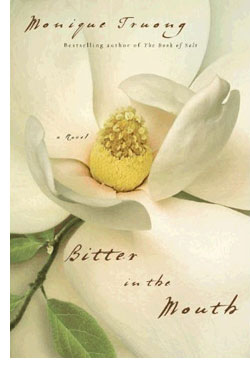
10-04-10:Monique Truong 'Bitter in the Mouth'
Syneaesthetic Southern Gothic
Linda Hammerick is returning to Boiling Springs, North Carolina. It's her childhood home, a small town in the south where she grew up, mostly under the gaze of her great-uncle, "Baby" Harper Evan Burch. He was the adult she connected with, looked up to, fell in love with as she experienced the world, and the words in the world.
Linda's experience of words is not that most of us share. But it is one that author Monique Truong shares with readers in her evocative and powerful southern Gothic, 'Bitter in the Mouth.' Troung's second novel is the sort of reading experience that lingers in the mind, that readers will find themselves revisiting after they've finished. Truong knows how to remake the world with words.
The southern Gothic is a form that has a wider range than one might suspect, and Monique Troung mines that range with gorgeous language, rich characters and a wonderfully complex plot that upends not just our vision of her novel but of language as well.
As the novel begins, 'Bitter in the Mouth; plays out as a straightforward — then back — memoir of Linda's years growing up in Boiling Springs. She knows that she's different, because she does not just hear words. Some words have what she calls "incomings," tastes associated with word. Until she learns how to control, or at least mute their impact on her, she's held back, her natural intelligence checked by sensory overload. Burt even once she learns to live with her synaesthesia — the name of the neurological disorder from which she suffers — she also has to learn to live within the complexities of her family.
'Bitter in the Mouth' is a gorgeously written, intensely sensual Southern Gothic. It runs to the surreal, but is not so hard-edged as the work of Flannery O'Connor. Instead, Truong trends towards the more gentile styles of Harper Lee. Trends is the operative word here, because Truong is sharper, and the emotional range is more sensual, more severe than it is sentimental. Because Linda's experience of the world is moderated by her experience of words, Truong's prose takes center stage, and earns the spotlight. This is an evocative, sometimes perilously immersive reading experience.
But as important as the prose is to the novel, the plot proves to be equally well crafted and intricate. Truong pulls the reader effortlessly back and forth through Linda's life, where small events prove to compel our attention. For all the weaving and memoir-like stories of family and her past life, the narrative is quite tightly woven across two days. But those two days unfold like a hall of mirrors and our expectations can be upturned with a single sentence.
Truong's fictional family is revealed in layers, and the characters we meet here are utterly engaging, the sort apt to pop up in our reading memories and tell us something we may or may not want to hear. Baby Harper is a dapper, mysterious delight. Linda's mother, DeAnne, is stern, laconic and tightly wound, in contrast to her grandmother, Iris, the sort of grand personality that presides over every scene she enters. Much of the story takes place in letters between Linda and her best friend Kelly, who becomes a sister-of-choice.
Though the story is told entirely by Linda, there's a sort of harshness at work here, a wiry strength that pervades the plot, the prose and the characters. Linda's life, our lives, are seen foreshadowed in the future and with the prescience of the past. Troung's story, Linda's story, of how we come to understand who we are, of how our words can both define and undo our definition of ourselves. Truong reminds us that our lives are a combination of story and memory, of selective editing and sensual immolation. Every moment brings with it the potential for a new incoming, a new synthesis of language and sensuality that can undo all the stories we have ever told ourselves.
New to the Agony Column
09-18-15: Commentary : William T. Vollman Amidst 'The Dying Grass' : An Epic Exploration of Simultaneity
Agony Column Podcast News Report : A 2015 Interview with William T. Vollman : "...a lot of long words that in our language are sentences..."
09-05-15: Commentary : Susan Casey Listens to 'Voices in the Ocean' : Science, Empathy and Self
Agony Column Podcast News Report : A 2015 Interview with Susan Casey : "...the reporting for this book was emotionally difficult at times..."
08-21-15: Agony Column Podcast News Report : Senator Claire McCaskill is 'Plenty Ladylike' : Internalizing Determination to Overcome Sexism [Incudes Time to Read EP 211: Claire McCaskill, Plenty Ladylike, plus A 2015 Interview with Senator Claire McCaskill]
Agony Column Podcast News Report : Emily Schultz Unleashes 'The Blondes' : A Cure by Color [Incudes Time to Read EP 210: Emily Schultz, The Blondes, plus A 2015 Interview with Emily Schultz]
07-05-15: Commentary : Dr. Michael Gazzaniga Tells Tales from Both Sides of the Brain : A Life in Neuroscience Reveals the Life of Science
Agony Column Podcast News Report : A 2015 Interview with Michael Gazzaniga : "We made the first observation and BAM there was the disconnection effect..."
04-21-15: Commentary : Kazuo Ishiguro Unearths 'The Buried Giant' : The Mist of Myth and Memory
Agony Column Podcast News Report : A 2015 Interview with Kazuo Ishiguro : ".... by the time I was writing this novel, the lines between what was fantasy and what was real had blurred for me..."
Agony Column Podcast News Report : A 2015 Interview with Marc Goodman : "...every physical object around us is being transformed, one way or another, into an information technology..."
Agony Column Podcast News Report UPDATE: Time to Read Episode 199: Marc Goodman : Future Crimes: Everything Is Connected, Everyone Is Vulnerable and What We Can Do About It