10-08-10:Mark L. Van Name Reads at SF in SF on August 21, 2010
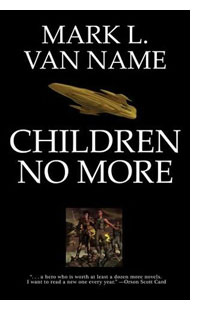
Children No More
"Write what you know." You'll hear that disputed and refuted as often as you hear it revered and renowned. In a sense, it must be complete poppycock, especially for readers of this column, since so much of the fiction here partakes of the imagination. On the other hand, how can it not be true? Mark L. Van Name is clearly a writer who exemplifies, in one man, both sides of that debate.
To begin, Mark L. Van Name reads from his latest novel, 'Children No More,' set in a future (much like parts of our present), where children are used to fight wars. You'll, have to prepare yourself for lots of words that I cannot broadcast on the radio, but Van Name knows what he's about.
Van Name's books are published by Baen, and you might well expect that they would be straight-up military science fiction. But Van Name himself feels that they are detective stories, with a military background. This is pretty clear from the reading, but his reading goes beyond a novel excerpt.
You're also going to hear Van Name read from his essays about his own childhood in a military cult, and even if I tell you that it's going to happen, it's still going to knock you upside the head. The connections between what he lived and what he wrote bring back that "write what you know" saw with a vengeance — literally.
Van Name does a great job of making it clear that sometimes writing what you know requires that you write, in his case, science fiction, because our experience of reality is not always in itself realistic. Our memories bend and warp what happened into a story, because we can understand stories. Let Mark L. Van Name tell you a story or two by following this link to the MP3 audio file.
10-07-10:Amelia Beamer Reads at SF in SF on August 21, 2010
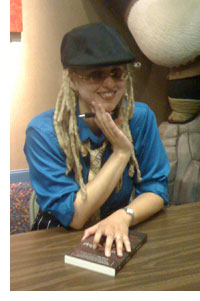
"The Loving Dead"
Amelia Beamer knew exactly how to start off her reading at SF in SF in the August gig. She started with a reading from her book, wherein the character tells a sort of joke that you'll never forget, indeed, one that will a) make you want to buy the book immediately, even before you get to the sex-zombies-in-the-zeppelin-bathroom scene; b) make you want to listen to the reading itself again immediately, because it's just so cool.
Beyond her plotting prowess and prose chops, Amelia Beamer brings something critical to her writing, enabling her to re-animate the zombie genre, which should by all accounts be dead again. What Beamer brings is a quiet, underplayed sense of humor, a let's-roll-with-it sensibility that makes her work engaging even when faces and entrails are on the appetizer menu.
Again and again, in the reading she did, you could hear her quiet but rather powerful sense of macabre humor cutting through the low-key descriptions of things that would make George Romero blush with embarrassment.
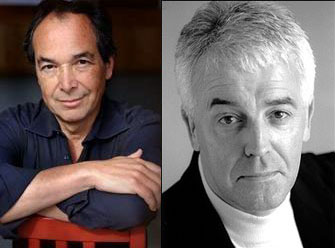
As we sat in the Capitola Book Café with Martin Cruz Smith and Tony Broadbent, talking about book, you could look outside and see the queue for the movie theater next door, and see the people lined up, waiting to have a movie poured into their brain. Inside, we let the authors do the talking.
Readers should remember Tony Broadbent author of 'The Smoke' and 'Spectres in the Smoke,' set in post World War II-London. I invited both writers to come to the Capitola Book Café and talk about how their novels in their far-flung settings spoke not just to the locales in which they were set, but to the modern American reader.
Broadbent started off perfectly, with the prologue to his first novel, which chillingly, to my mind, described the austerity measures of post-WW II London in a manner that made it perfectly clear where we in the US could end up if the economic status continues to go downhill. Martin Cruz Smith read the first chapter of 'Three Stations, then we were off into a discussion of how the mystery genre allows them extract the universal from the particular.
"..the physical return is actually something that I did in the process of writing this book..."
—Monique Truong
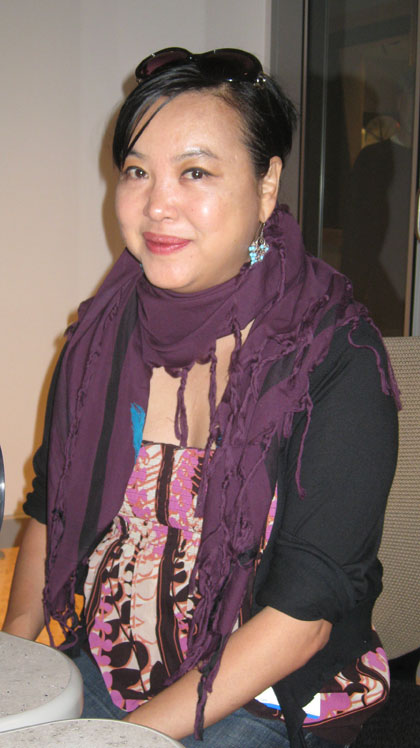
Monique Truong's 'Bitter in the Heart' is a remarkable prose construct. It's intricate, sensual, innovative and gripping. All of which just begs the question, how does a writer go about creating such a work? It's clearly not the result of linear thinking.
Yes, it is a plot-driven work, but it is also a memoir, of sorts, and an innovative prose riff on synaesthesia. Preparing for this interview, I felt myself creating the interview version of the book, with all its back-and-forths, and my attempts to figure out how to evoke from the author the process that resulted in her evocative book. All of this of course, without spoiling the book for the reader.
Truong made that easy, because, as even readers who have not read the book might imagine, the process for creating such a book is largely intuitive and not easily explained. But as Truong and I talked, we got a picture of how she worked and what she worked from.
I wa happy to hear that like me, she was a fan of Dr. Richard Cytowic, whose book 'The Man Who Tasted Shapes' introduced us, and the rest of the world to synaesthesia. Moreover, she noted that the original fellow referred to in the title of the book was a resident of North Carolina, where she herself hails from.
I suppose I should not have been surprised that the Boiling Springs of the novel is not only a real place, but Monique's home town. The reason for my surprise is that Truong does such a fine job re-creating the town as a mythic, almost surreal location.
08-21-15: Agony Column Podcast News Report : Senator Claire McCaskill is 'Plenty Ladylike' : Internalizing Determination to Overcome Sexism [Incudes Time to Read EP 211: Claire McCaskill, Plenty Ladylike, plus A 2015 Interview with Senator Claire McCaskill]
Agony Column Podcast News Report : Emily Schultz Unleashes 'The Blondes' : A Cure by Color [Incudes Time to Read EP 210: Emily Schultz, The Blondes, plus A 2015 Interview with Emily Schultz]
07-05-15: Commentary : Dr. Michael Gazzaniga Tells Tales from Both Sides of the Brain : A Life in Neuroscience Reveals the Life of Science
Agony Column Podcast News Report : A 2015 Interview with Michael Gazzaniga : "We made the first observation and BAM there was the disconnection effect..."
04-21-15: Commentary : Kazuo Ishiguro Unearths 'The Buried Giant' : The Mist of Myth and Memory
Agony Column Podcast News Report : A 2015 Interview with Kazuo Ishiguro : ".... by the time I was writing this novel, the lines between what was fantasy and what was real had blurred for me..."
Agony Column Podcast News Report : A 2015 Interview with Marc Goodman : "...every physical object around us is being transformed, one way or another, into an information technology..."
Agony Column Podcast News Report UPDATE: Time to Read Episode 199: Marc Goodman : Future Crimes: Everything Is Connected, Everyone Is Vulnerable and What We Can Do About It