10-28-10:Laurie David Prepares 'The Family Dinner'
Cooking, Kids and Chaos
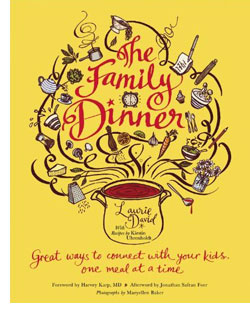
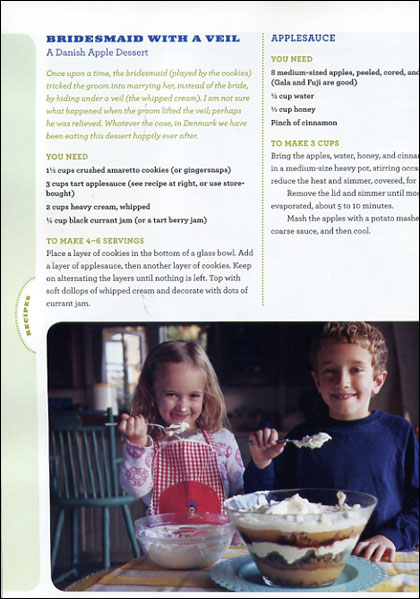
One quick trip through 'The Family Dinner' (Grand Central Publishing / Hachette Book Group ; November 3, 2010 ; $29.99) by Laurie David will tell you all you need to know. Every page is crammed full of stuff. Colors fly everywhere, photos jostle with colored boxes full of type, quotes seem to almost be falling out of the book, activities compete with advice, you can practically hear someone shouting, "Clean up! It's time for dinner!"
Laurie David apparently has a pretty good grasp on the family dinner. It's not neat and tidy. It's not quiet. It's jam-packed with action, craziness, loud voices and the occasional projectile. Her trick, however, was to turn it into a book that itself can help make your family dinners.
In our family, we always looked forward to the Sunday Roast. I'd make a classic roast beef — sirloin tip roast, cross-rib roast, whatever was on sale — or maybe a ham or a leg of lamb, a turkey breast — with garlic mashed potatoes, gravy, peas, or maybe a salad. It was something we all looked forward to. The Sunday Roast.
Laurie David has a practical understanding of how important the family meal is. She realized this at the dinner table, actually talking to her teenagers. But translating that understanding into a book is not an easy task. A family is all about crazy, random, unplanned spurts of energy and invention. A work of fiction can channel that sort of energy, but it's not likely to inspire cooking. Finding a way to express the unpredictable nature of pulling together a meal every single gosh-darned day is not a challenge left to the uninitiated.
It will come as no surprise then that 'The Family Dinner' is not page after page of text with Laurie David laying out recipes and offering tips for napkin-folding and seating arrangements. It's much more akin to a scrapbook put together by an extended family of extremely talented people with a lot of passion for a pet project. The result is as kinetic as it needs to be, inspiring as it has to be, but mostly just packed to the rafters with words, images and ideas that may actually help you to get your family's keesters to the chairs.
'The Family Dinner' does have a plan. You need a plan. The sixteen chapters start with simple steps to get dinners made — and eaten at the same time sitting down together. You get plenty of recipes by Kirsten Uhrenholdt; a chapter on fast recipes, for example, Pan pasta and Chicken Schnitzel. You get slow cooking — Arroz con pollo, or Lentil stew. You also get a chapter on reading at the table, and trust me, reading while eating is one of the great pleasures life can offer.
But 'The Family Dinner' goes a lot farther than recipes. Laurie David talks about divorce, and offers a chapter on showing gratitude. But to just pull out the subjects and the recipes takes the book apart in a way that doesn't suggest its effect. This is an exuberant, joyous book. Sure, it gets a bit on the sentimental side, but David offers everything with charm. There are enough photos and sidebars to keep every chapter as lively and hopping as an active family dinner. And even if you don't have kids around, there's certainly a use for a book based around the ritual of breaking bread and fast with those you love.
Happily, 'The Family Dinner' is a book best experienced in hardcover, in person, in a local bookstore. You open it up and you'll see what I mean. This is "Little House in the Suburbs," 21st century style. It's unpretentious and fun. When Laurie David talks about sitting down with a book for dinner, 'The Family Dinner' is the perfect first course.
10-27-10:Patrick Lee Explores 'Ghost Country'
Once Again Into the Breach
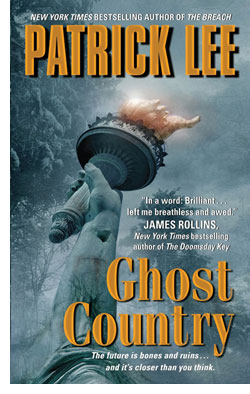
There's a good argument to be made that we are already living in post-apocalyptic times. The end has come, but we're living so fast it hasn't quite caught up with us yet. That feeling of an end already in place pervades the new Travis Chase / Breach / Tangent novel 'Ghost Country' (Harper / HarperCollins ; December 28, 2010 ; $7.99) by Patrick Lee. But don't worry. Lee keeps the forward motion in place, and hurtles the reader of his second Breach novel into a whirlwind of hyperaction cross-pollinated with just enough smart speculation to prevent any rational thoughts from entering the reader's mind.
First things first. 'Ghost Country' is a sequel to last years mass-market paperback original 'The Breach.' That novel is a fun, exciting and smart piece of action-packed American Cheese that involves just enough science fiction to keep the pages turning at a healthy pace. It uses speculative and science fiction elements to add texture and interest to well-orchestrated scenes of action. I wrote about it earlier this year, and if it sounds good to you now, stop reading, go buy the book and prepare to lose some sleep.
'Ghost Country' plays out in the world set up in 'The Breach.' That world includes a super-collider experiment gone wrong, leaving "the Breach," through which emerge things we've not seen before, which generally result in lots of gunfire. In 'Ghost Country', the gunshots begin on the first page, after Paige Campbell leaves the White House. She's just made the unwise decision to try to share her experiences concerning the Breach and Tangent, the gubbermint organization set up to deal with it. Of course, this proves to be a very bad idea, even if she does have some firm notion of the sort of Apocalypse that leaves cities full of rotting flesh, sans zombies to sup upon them. Hoping to avert this, she finds herself instead with a big fat target on her back, on her forehead and probably some electronic tags in places where (like Ghost Country) the sun don't shine. Of course the machinery for the End is place and just about to boot up.
Lee writes remarkably entertaining action set-pieces, and strings them together with equally entertaining speculative elements. In general, I don't like what you might derisively call "sci-fi thrillers." The thrills tend to be too familiar and the speculative elements tend seem like refugee plots from the 1960's run of Lost in Space, minus the camp appeal of Dr. Smith. That's not the case in either 'The Breach' or 'Ghost County.' The body count is extreme, but Lee knows how to put you in the scene. He also knows how to give you main characters whom you will hope can survive. Travis and Paige are vulnerable enough to be likable and competent enough to stay alive in Lee's carefully orchestrated maelstrom of guns, wormholes and that which comes through them.
Lee also knows how to back down gracefully, so that he can end the book and yet prevent RER, "Reader Eye-Rolling," which is the death of most books that try to walk this terrain. This is not to say that your eyebrows will remain level. You might even have to squint now and again. But by the time you realize what's happening, a hundred and fifty pages have been turned while you weren't looking. But you know you were looking, you were reading, even as Lee prevented any thoughts of the real apocalypse that's going on at this minute. (Just ask Matt Taibbi — I will soon enough. and report back to you.) Lee knows that his job is to keep your eyes and mind so distracted that the end he is describing could happen while you were reading, and you'd not notice. In a sense, the book itself becomes the sort of technology it is describing. It makes the world go away.
10-26-10:John Le Carré Examines 'Our Kind of Traitor'
Innocents Abandoned
Writers of espionage fiction left their innocence behind long ago. It's interesting to think of the seemingly endless and endlessly duplicitous Cold War era as "innocent," but it feels right. It seems apt. There were two world political powers, the US and the USSR. Each regularly sent men and women who would seem to be one thing while actually being something very different into the other. This wasn't a new practice, but the Cold War brought out what is arguably the apotheosis of this practice of spying — and spy fiction.
Then the Berlin Wall fell, and with it, a generation of spy novelists.
I'm sure that out there in the world of fiction, there's a novel that addresses the plight of spy novelists deprived of a milieu that seemed to have had eternal life. The end of the Cold War was a boon to life on this earth but the death knell for a generation of writers. No longer could spies come in from the cold. No longer could the flamboyant men of the west face off the stony automatons of the east. The loss was not just that of writers. Readers lost as well. That familiar backdrop was a great place for readers to start their reading experience. We already knew the overarching narrative thrust. We knew the players and the game. All we needed were names and exotic places.
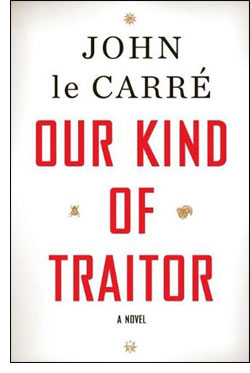
Spy fiction never died and never really went away. Its best practitioners were great writers, who knew how to tell stories. John Le Carré has always been at the top of the genre, to the point where his work is no longer genre fiction. His latest novel 'Our Kind of Traitor' (Viking / Peguin Putnam ; October 12, 2010 ; $27.95), and it's a fine example of how to write a spy novel in the post-Cold War era.
Flamboyance is no longer the sole possession of the west. In fact, in the generation since the Berlin Wall fell, the roles have almost been reversed. The West has become the refuge of anonymous bureaucrats, while Russia has become a home to wild-man millionaires and over-the-top self-styled criminals. Perry and Gail are a mild-mannered, underwhelming British couple on vacation in Antigua. There, they meet a man who calls himself Dima. He claims to be a Russian money-launderer. Lives are changed.
'Our Kind of Traitor' finds Le Carré writing about the big money-markets that have taken the world to the edge of fiscal apocalypse. It's a natural evolutionary follow-on to the Cold War. This is novel that is based on a new vision of the world, one where the governments that used to wield power are themselves being wielded by the current seat of power — those with money. But no matter what the vision of the world that drives the plot might be, Le Carré is working where he always works best, with the dangerous fluidity of our identities. As our knowledge of those around us crumbles, as we find ourselves involved with people we know less and less, our self-knowledge crumbles as well. The firm lines that help us define ourselves break down. Le Carré takes readers on a journey into self-ignorance. It's fascinating, gripping and terrifying.
'Our Kind of Traitor' benefits from a less cerebral story than some of Le Carré's post Cold War material. It's tense and intense, with more plot than you expect from such a character-driven story. We now live in a world where we're spying on ourselves. 'Our Kind of Traitor' works within worlds that previously competed with one another. When we have no enemies without, we create them within. We can no longer come in from the cold.
10-25-10:Philip Roth's Nemesis
The Grammar of Guilt
The English language is a trap. It's too easy, almost natural to speak of what could have been or what might have happened. In that split between the real and the imagined, our conscience is born. If our imagination suggests we made the wrong decision, our conscience — the adding machine of guilt and remorse — torments us with visions of unrealized potential.
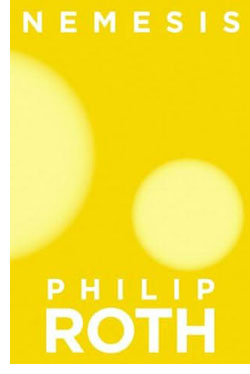
Philip Roth's new novel, 'Nemesis,' is a carefully crafted prose examination of how a single crack in a young man's conscience becomes his undoing. Roth sets the novel in a simpler time. It begins in Newark, in 1944, during the rise of a vicious polio epidemic. This faceless killer is clearly evil, a difficult foe, and the protagonist, Bucky Cantor already feels guilty. He's an able-bodied, well-meaning 24 year-old young man who cannot join his friends at the front due to his bad eyesight. Now, as a playground supervisor in a scorching heat wave, he watches helplessly as his charges are swiftly killed or crippled.
From the first sentence of 'Nemesis' we know that something is slightly askew. Roth's prose is sinewy and vigorous as we are plunged into an epidemic that seems remote and forgotten here in the 21st century. 'Nemesis' beings it into startling, affecting focus, but who is doing the seeing and telling, is left unclear — at least at first. It hardly matters, because the voice is so sure and such a full, beautifully wrought piece of its time. Polio epidemics are no longer an issue in this world. But in 1944, they were a terrifying killer of innocent children. One day a child would have a headache, the next, they might be dead, or crippled. Roth immerses readers in the world — and conscience — of Bucky Cantor, and from beginning to end, it is a compelling reading experience.
Bucky Cantor is a shining example of American fortitude and manliness. He's a Jewish orphan raised by tough but loving grandparents. Roth pulls this off without irony or being overly sentimental by virtue of the simple, unadorned prose voice. As playground supervisor, Bucky's determined to give his best to the kids in his charge. And he does this, becoming more and more concerned about his inability to help those who fall ill to polio. He's got a great girl, Marcia, who is working at a polio-free camp in the Poconos. He's smart, but not intellectual. As the novel begins, he's rock steady, but as the deaths climb, his conscience begins to fracture.
Roth pulls all this off with some of the purest, most muscular prose you'll find in a novel this year. Because we're so immersed in Bucky's life, and in Roth's powerful characterization, we go along with the mystery of just who is telling the story. Roth uses the simplicity of the time and the clarity of vision to keep us involved in the action on the ground, as Bucky comes to a point where he must imagine two possible paths and choose one.
Once Bucky decides, Roth manages to ratchet up the tension and terror. Bucky is at war with his own soul, and with his own imagination of God. Roth re-creates with astonishingly perfect prose idyllic descriptions of a camp in the Poconos and young love. The prose voice lets Roth channel all the innocent joy and power of those simpler times. But Bucky's fracturing mind is certain to undermine that idyll. He knows that polio is a disease, but to him it's evidence that God is either absent or evil. In the absence of God, Bucky feels compelled to take responsibility. The subjunctive tense, the "should have beens" that rattle around in his conscience, offer no possibility of redemption. The grammar of guilt comes with an irrefutable logic.
Roth's resolution of Bucky's dilemma is a compulsive and utterly involving reading experience. He answers our questions — and there are plenty of mysteries to be solved in his swift setup — in a vision of the emotional aftermath of polio. With a close focus on a time of innocence interrupted by a formless killing evil, Roth uses the form of the short novel to examine how language itself, our own inner monologues, are but symptoms of a disease for which there is no cure — our conscience.
New to the Agony Column
09-18-15: Commentary : William T. Vollman Amidst 'The Dying Grass' : An Epic Exploration of Simultaneity
Agony Column Podcast News Report : A 2015 Interview with William T. Vollman : "...a lot of long words that in our language are sentences..."
09-05-15: Commentary : Susan Casey Listens to 'Voices in the Ocean' : Science, Empathy and Self
Agony Column Podcast News Report : A 2015 Interview with Susan Casey : "...the reporting for this book was emotionally difficult at times..."
08-21-15: Agony Column Podcast News Report : Senator Claire McCaskill is 'Plenty Ladylike' : Internalizing Determination to Overcome Sexism [Incudes Time to Read EP 211: Claire McCaskill, Plenty Ladylike, plus A 2015 Interview with Senator Claire McCaskill]
Agony Column Podcast News Report : Emily Schultz Unleashes 'The Blondes' : A Cure by Color [Incudes Time to Read EP 210: Emily Schultz, The Blondes, plus A 2015 Interview with Emily Schultz]
07-05-15: Commentary : Dr. Michael Gazzaniga Tells Tales from Both Sides of the Brain : A Life in Neuroscience Reveals the Life of Science
Agony Column Podcast News Report : A 2015 Interview with Michael Gazzaniga : "We made the first observation and BAM there was the disconnection effect..."
04-21-15: Commentary : Kazuo Ishiguro Unearths 'The Buried Giant' : The Mist of Myth and Memory
Agony Column Podcast News Report : A 2015 Interview with Kazuo Ishiguro : ".... by the time I was writing this novel, the lines between what was fantasy and what was real had blurred for me..."
Agony Column Podcast News Report : A 2015 Interview with Marc Goodman : "...every physical object around us is being transformed, one way or another, into an information technology..."
Agony Column Podcast News Report UPDATE: Time to Read Episode 199: Marc Goodman : Future Crimes: Everything Is Connected, Everyone Is Vulnerable and What We Can Do About It