11-12-10:A 2010 Conversation with Daniel Pinchbeck
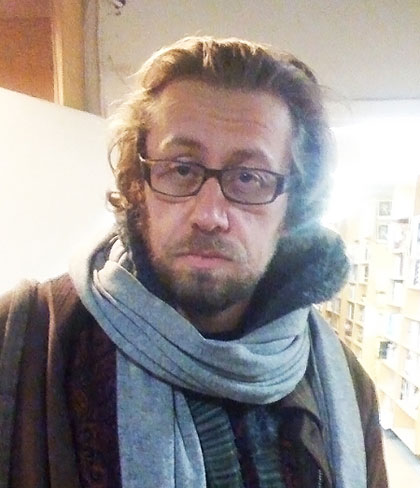
"...corrupt left-wing intelligentsia ... baby-boomer parasites who have been feeding off the fat of the land..."
—Daniel Pinchbeck
Yes, the two clips quoted above did come from different parts of the conversation. And yes, I may well resemble one, the other or both. (Though I'd dispute any membership in the intelligentsia, I would certainly claim to be proud member of the corrupt left wing.) My parasitic days are far from over. But as for the fat of the land, well, even Pinchbeck himself will tell you that things are looking pretty thin out there.
I'll unlatch my mandibles from the bloodstream of the parasitocracy long enough to tell listeners that I am, on occasion, prone to be the victim of my own peculiarities. So, while 9 AM sounds like the crack o' dawn to most normal humans, hell, by then I've been up for five and a half hours. This proves to be helpful if your interview is at 9:00 AM on a Saturday morning in San Francisco, a two-hour drive for me. But others look at 9:00 AM on a Saturday morning and see it as a time to make sure the curtains are firmly closed.
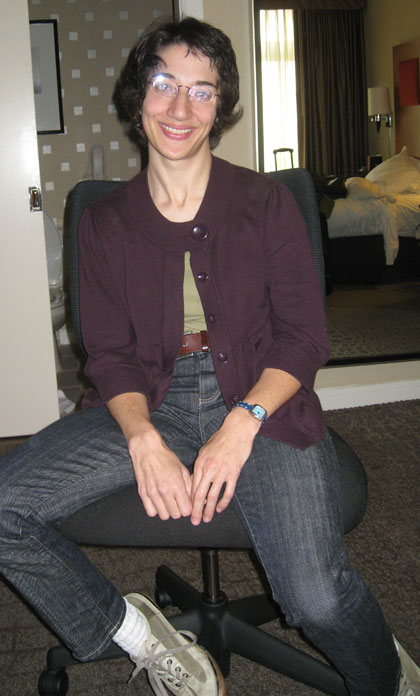
I met videographer Charles Kruger in the lobby of Pinchbeck's hotel, then tortured myself for 15 minutes trying to find a parking space that wouldn't cost me fifteen bucks for two hours — but was shockingly successful. I found Pinchbeck in Starbuck's (he had kindly offered to buy me coffee), then the three of us trooped up to Pinchbeck's room for a chat.
It was an interesting experience. I could feel the palpable pressure and tension that Pinchbeck feels with regards to his work. On one hand, he knows in his heart he has to get his social network and website rolling. He is a man of action. But he clearly feels as well that his readers want him to write, that indeed, he wants to write, his next major work of synthesis and exploration. Even as we spoke, you could feel the ideas welling up within him. He's especially interested these days in aliens and Egypt — and aliens in ancient Egypt.
While I walked away from the interview disappointed in myself — Rick Kleffel, corrupt parasite — upon editing the material, I found that in spite of the early hour, or perhaps because of it, Pinchbeck was in fine Pinchbeckian form. We had a great conversation about his work, and better still, listeners will hear a very unique portrait, Pinchbeck in transition, at the tipping point. He's the canary in the coal mine. You can hear our conversation by following this link to the MP3 audio file.
11-10-10:A 2010 Interview with S. G. Browne
"It was actually fun creating the dynamic between Destiny and Fate." —S. G. Browne
S. G. (Scott) Browne is an interesting writer. His books are immersed in the moment, with prose voices that result in a non-stop stream of dry humor. But even when he's tossing Thanksgiving turkeys on the floor, or trying to have a casual conversation with God, he manages to plug into something much bigger than high-quality yuks.
According to him, it's all an accident. No planning those wonderful literary arcs of theme that pop up. Nope, Scott Browne is just riding the waves.
This time around, I caught up with Browne in the ever-green back office of the Captiola Book Café. He'd just been down to Foothill College at some dreadfully early hour doing a talk, so I ended up meting him at 9 AM. This meant that I was driving around at 9 AM, which is really unusual for me. I felt like I was cutting class. But there I was talking to the man who made Fate and Destiny — who made them funny.
Here's the thing about Browne's books. They're quite funny, true, and they have good characters the reader can form a real emotional connection with, even if the characters are dead, or eternal. These are quintessential good, kind of light comedic reads that are accessible to a very wide audience. But something more happens.
As Browne puts together a perfectly delightful comedic novel, Bigger Themes emerge for readers. Its not like Browne knocks you upside the head with them; they're just there. There's some pith to these fun books. And as a literary interviewer, I want to get to the bottom of the creative process behind that literary heft.
"... and this, I have to say, is controversial, a minority view in evolutionary biology, but it is a view I find persuasive..."
—Kevin Kelly
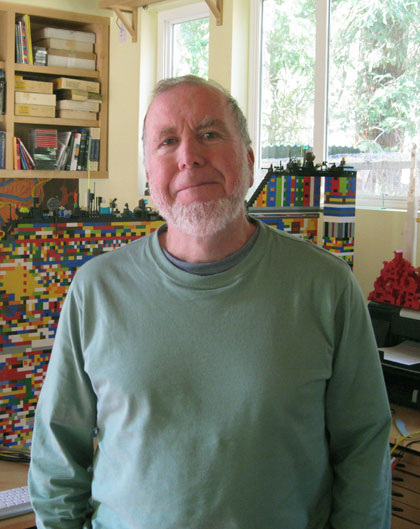
For a guy who is rooting about the very depths of creation, a guy who addressing everything from the Big Bang onward, Kevin Kelly is remarkably easy-going. It was a wonderful autumn afternoon when I drove to Kevin Kelly's house, nestled in a redwood canyon in Pacifica to meet Charles Kruger, videographer for Litseen. We gathered our technology and hustled up to the second floor of Kelly's redwood tower.
Kelly was a genial host, and as we cleared away a few books to set up for the interview, he remarked on the "heavy iron" of my setup. Yes, I admit, I'm a trailing edge technology fan. I have a big, old, clunky Marantz digital recorder. It's as big as my old Teac DAT, but not nearly so heavy, actually. Still, with the big mics, and the iron stands, it is quite a collection of heavy metal. Especially compared to Kelly's handheld Zoom recorder, which does pretty much everything mine does and is about one-sixth the size. Charles' camera is smaller than one of my mics.
But to capture that conversation, you need some heavy iron. Kelly is an engaging speaker, and as we journeyed through a shorthand version of what he wrote in his book, I took the time to ask him how he crafted the book as well. For me this is a very interesting literary work, since it uses many of the techniques of science fiction to a very different aim. No, this is not a book about the singularity, and in fact, Kelly even regretted having to use the word; which he did in reference to our acquisition of language, not the rapture of the nerds.
Kelly's original vision of how he hoped to write 'What Technology Wants' proved to be very different from what eventually happened — and much more difficult. But that was simply the result of the virtues of asking the right question. The upshot was a much lengthier writing process than he had imagined. It's also a more personal book than he had imagined, and to my mind, that makes it a more enjoyable reading experience. You can hear my conversation with Kevin Kelly by following this bit of literary technology to the MP3 audio file.
11-08-10:A 2010 Interview with Myla Goldberg
"The atmosphere of that age is still palpable in my mind."
—Myla Goldberg
Myla Goldberg is a chameleon. From the family dynamics of her first novel, 'Bee Season,' she turned to the 1918 flu pandemic for the meta-fictional 'Wickett's Remedy.' Her new novel, 'The False Friend' is a closely-observed tale of memory and childhood, set in the present — and the main character's past. From the outside, three very different novels. But while a chameleon can change colors, it's still a lizard, no matter what color it may be at the moment. And while Myla Goldberg writes novels that offer quite unique reading experiences, she seems to have an interest in memory.
I spoke with Myla Goldberg in the empty shell of her already-vacated hotel room in San Francisco. It seemed an appropriate setting for a conversation about pasts that have not been left behind. Once we started talking, it became quickly apparent that our conversation, like her novel 'The False Friend,' would be a highly concentrated affair.
Just as her novel manages to pack in all the intensity of a longer work — without feeling overstuffed — so did Myla Goldberg in person. It's not the she speaks quickly, but rather that she is very precise with her words. It's the kind of conversation that you unpack when you're back at home, editing the audio. While I was in the mix, it was all I could do to keep up with her insights.
Goldberg is an expert at dissecting her own writing, and at looking into her own motivations. Obviously, there are some personal aspects to the novel, but just as clearly those end early and the entirety is a work of imagination — informed by experience. Goldberg's influences here — and her reading — are surprising. You can hear her tell you herself by following this link to the MP3 audio file.
New to the Agony Column
09-18-15: Commentary : William T. Vollman Amidst 'The Dying Grass' : An Epic Exploration of Simultaneity
Agony Column Podcast News Report : A 2015 Interview with William T. Vollman : "...a lot of long words that in our language are sentences..."
09-05-15: Commentary : Susan Casey Listens to 'Voices in the Ocean' : Science, Empathy and Self
Agony Column Podcast News Report : A 2015 Interview with Susan Casey : "...the reporting for this book was emotionally difficult at times..."
08-21-15: Agony Column Podcast News Report : Senator Claire McCaskill is 'Plenty Ladylike' : Internalizing Determination to Overcome Sexism [Incudes Time to Read EP 211: Claire McCaskill, Plenty Ladylike, plus A 2015 Interview with Senator Claire McCaskill]
Agony Column Podcast News Report : Emily Schultz Unleashes 'The Blondes' : A Cure by Color [Incudes Time to Read EP 210: Emily Schultz, The Blondes, plus A 2015 Interview with Emily Schultz]
07-05-15: Commentary : Dr. Michael Gazzaniga Tells Tales from Both Sides of the Brain : A Life in Neuroscience Reveals the Life of Science
Agony Column Podcast News Report : A 2015 Interview with Michael Gazzaniga : "We made the first observation and BAM there was the disconnection effect..."
04-21-15: Commentary : Kazuo Ishiguro Unearths 'The Buried Giant' : The Mist of Myth and Memory
Agony Column Podcast News Report : A 2015 Interview with Kazuo Ishiguro : ".... by the time I was writing this novel, the lines between what was fantasy and what was real had blurred for me..."
Agony Column Podcast News Report : A 2015 Interview with Marc Goodman : "...every physical object around us is being transformed, one way or another, into an information technology..."
Agony Column Podcast News Report UPDATE: Time to Read Episode 199: Marc Goodman : Future Crimes: Everything Is Connected, Everyone Is Vulnerable and What We Can Do About It