Our ability as readers to commit to a novel is never going to be greater than the commitment of the writer. This is one of the great potential problems of any work of fantasy or science fiction; if the writer does not intrinsically believe in the world that they have created, if there is not some core of emotional reality at the center of the fantasy, or that is driving the speculation, then all the careful world-building will be for nought. We have to intuit as we read that the writer cares and cares deeply their creation, that the writer's core beliefs somehow inform this work of imagination.
Given the undeniable existence of the world we live, it is natural that writer who choose to imagine another, might simply do so by imagining the end of this world. It's been done in a variety of fashions, but for this reader, the most powerful are those that have a sense of longing for what has passed.
Steven R. Boyett brought one world to a grinding halt back in 1983, when he published 'Ariel.' The premise is deceptively simple; science stops, magic starts. Our world literally stops in its tracks, and there are huge losses, but also huge gains; now, what were once considered magical creatures of fantasy walk the earth. Including the titular Unicorn, rendered with the sort of urban feel that is reminiscent of Peter S. Beagle's classic.
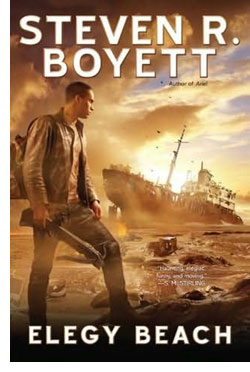
It took Boyett 26 years to return to the world he destroyed, and in the interim, the world he had destroyed had in effect been destroyed — not by Apocalypse, by by creeping change, which is far more thorough. Now he's back and the novel 'Elegy Beach' (Ace / Penguin Putnam ; October 26, 2010 ; $7.99) manages a very difficult feat. Boyett brings back the magic, not just in the first novel, but, more importantly, of the first novel. 'Elegy Beach' is not just the second step in a projected trilogy, but instead, a heartfelt trip back to a world we cared about; as it happens, our world.
Peter Garey and Ariel have, if not adjusted, at least learned to live in the changed world. It helps that they are on opposite sides of the equation, with Peter being the human from the past and Ariel being the Unicorn from what will apparently be the future. But it is one thing to scavenge food from old cans; it is another to grow up in a changed world, and this is what Peter's son, Fred has to look forward to. Fred's allied with Yan, and the two of them are trying to in a sense, unite the past and future, to turn spellcasting into a science. Unfortuantely, Yan wants to usher in the old world.
Against this conflict, Boyett manages to tell the story of a father and son, and to evoke a truly elegiac feel for this world, the one we live in on this day. To this end, Boyett employs truly gorgeous prose to describe the Changed World. Looking at what we might see today as ordinary, perhaps ugly, in the changed light of a world driven by magic instead of science, Boyett employs prose to evoke the magic of our own world. It's a very nice turnaround, and in the tradition of the best novels of after, from Nevil Shute's 'On the Beach' to Walter H. Miller's 'A Canticle for Leibowitz.'
For all the joy to be found in seeing a post-apocalyptic now, 'Elegy Beach' is driven by great characters, particularly Peter and Fred. Father-son relationships can often have a bit of an end-of-the-world feel to them because a son is living proof that a father will end. Boyett explores what happens when the torch passed from one generation to the next has sputtered and died. Sorry son, here's the world, it's in a bit of a mess.
'Elegy Beach' may be a sequel, but like the best, it stands on its own and asks nothing other of the reader than attention. And in fact, it rewards attention, it demands attention, because every generation is certain that they are the last, and in a sense, they're always right. The world I lived in and loved will soon be gone, replaced by another. That which I took for granted will no longer be comprehensible, let alone de rigeur. I'm glad I loved the world, even if it's gone. I remember cutting out the photos from Life magazine from the movie 2001, and thinking, "I'll live in that world." I was ready, but it never came to pass. It ended quietly, one day at a time. As does every world; and not matter which, you are well-advised to love it and do so well before it passes. The next world will not be yours.
02-01-11:Kevin Poulsen Tracks the 'Kingpin'
Silent Crime Wave
We like our crime loud and exciting. We like guns, death, car chases, foot chases, boat chases and GPS-enabled tracking through computers. We like it fast-paced and in our faces. Lots of shouting is required, and when that won't work, be bring out the bullhorns. Crime, it seems, may or may not pay, but it had better damn well be pretty cinematic.
Books don't have to be cinematic, and crime need not be either. Crime works better, actually, when it is quiet and relatively boring to watch. You probably will not see a movie anytime soon where the criminals, or those who pursue them, spend most of their time sitting on their keisters in front of computers. This is not visually stimulating. But this is the way that crime happens, and as well, the way it gets solved. Crime doesn't have to shout. The silent crime wave is the one you have to worry about.
Kevin Poulsen is arguably our top journalist with regards to matters of computer security. While he worked at SRI (Stanford Research Institute) in the 1980's, he spent his spare time as Dark Dante, a hacker who engaged in an escalating series of criminal pranks that ended up with his arrest in 1991. The FBI does not love being hacked.
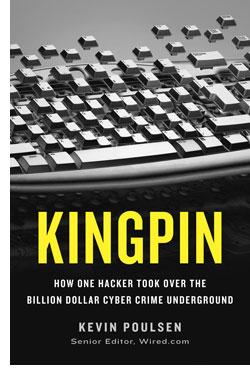
The past is past, and Poulsen now uses his intuitive understanding of computer security to write about the matter and bring what is hidden and incomprehensible to light. He runs the ThreatLevel blog and his new book, 'Kingpin' (Crown Books / Random House ; February 22, 2011 ; $25), is a remarkably well-written true-crime story about his own shadowy counterpart in the world of computer security, a man named Max Butler who worked both sides of the fence.
Poulsen takes a novelistic approach in 'Kingpin,' making use of his extensive interviews with Max Butler to tell a gripping story in prose of a man who was both a White Hat consultant to the FBI and a Black Hat hacker who managed to elude capture by a combination of sophisticated skills and often even just the sort of smarts that told him not to answer the door when the FBI came calling; it turned out that they didn't have a warrant to enter the premises, and as a result, by not answering, he eluded arrest.
The power of 'Kingpin' comes from Poulsen's incredible knowledge of his subject. Because he is so intimately immersed in the world of computer security, on both sides of the question, he can break down the complex and often difficult-to-portray world of crime via computer into scenes that readers who are not so immersed can understand. Poulsen knows how to use the advantages of prose to make his story exciting, though the level of the crimes that Butler was involved is itself quite staggering.
Poulsen also knows the characters on both sides as well. This is a key to making any story work, and Poulsen really gets not just Butler, but the women who hung with him. On the other side, Poulsen writes well from the perspective of law enforcement officers in pursuit of Butler; and here's where prose reveals all of its advantages over film. Poulsen here manages the difficult feat of making a computer database search — and its results — fascinating, even gripping reading. As the words tick away before our eyes, the suspense ratchets up incredibly. The complex concepts that drive the whole computer crime community are becoming simultaneously clear for the reader and the cop on the page, Keith Mularski. As a reading experience, it is utterly compelling and fascinating.
It does help that the story Poulsen is telling is timely and rather staggering in scope. Because it does not require gunshots and chasing and any of the other follies that we're so easily entertained by, we really do not have a handle on just how pervasive this sort of crime is. But what does get reported is not where all the money is. Our press likes to take a big stick and poke at the boogeyman called "The Internet," by which they generally mean some websites. Yes, there are criminal websites, and not just those with criminally bad website design. But the money moves pretty much in silence. The only sound is the sound you just made, typing in the URL that got you here. It's not gunfire. It's the sound of money being moved.
Note: No "cybers" were harmed in the creation of this book review.
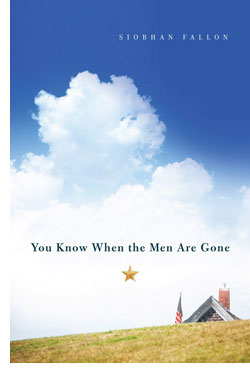
02-07-11: Siobhan Fallon Realizes 'You Know When the Men Are Gone'
A World Within Our World
Fantasy fiction is often defined by "world-building," the technique by which the writer creates a secondary world that may or may not resemble the world in which we live. Great attention is paid to details of character, location, language, history, and all of these are subtly or grossly different than those of the reality we find ourselves confronted with on a daily basis. From 'Lord of the Rings' to 'Dune' to 'The Stand,' world-building has been associated primarily with visions of pasts that never were or futures that might never come to pass.
But world-building is a writerly skill of use in this world, to create realities with which most of us are unfamiliar. Siobhan Fallon's 'You Know When the Men Are Gone' (Amy Einhorn Books / G. P. Putnam's Sons / Penguin Putnam ; January 20, 2011 ; $23.95) creates a world within our world, and tells us stories that show us who we might yet become.
Fallon is married to a commander in the United States Army, and her stories unfold in Fort Hood. The title story, "You Know When the Men Are Gone," is the first story she wrote while living on the base. It sets the scene with remarkable effectiveness. Meg is awaiting the return of her soldier, housed in an apartment complex with other Army wives, where she is almost forced to eavesdrop on her neighbors. Meg has the unfortunate luck to share a wall with Natalya. Natalya is foreign, abrupt, striking and clearly out-of-place. It's only a matter of time before she'll fall out of the world that Meg manages to secure a place in, just barely. It's complicated, with written rules about mowing the lawn and unwritten rules covering just about every moment of the day. Meg fits in; Natalya falls out.
In the story "Remission," Ellen Roddy ignores those rules at her peril, even if she is married to a commander and recovering from cancer. "Inside the Break," Kailani breaks into her absent husband's email to find some very suspicious messages, and the chatter among wives is not comforting. Fallon puts readers into the uneasy lives of the women left behind with alarming ease.
Fallon steps out of her own shoes and writes from the perspective of soldiers as well; "Camp Liberty" is the story of two men in one body; David Mogeson, a investment banker who signs up in the post-9/11 patriotic fever, and "Moge," a sergeant who becomes a squad leader, and a very different man than David Mogeson. In the sinister "Leave," Nick Cash returns home full of suspicion, intent on finding out if his wife is cheating on him. He does not realize that he's not the same man who left.
Fallon's stories are precise. They're extremely well-plotted and paced, each story offering another facet of life in the military, generally in Fort Hood. She creates memorable characters with economy and ease, working effortlessly within the short-story format. You'll remember these people after you read this book; they'll be friends you left behind.
Where you left them is part of the point and part of the power of 'You Know When the Men are Gone.' Fallon's stories interlock, giving us characters who appear in different roles, and seen from subtly different perspectives. The world she builds, the insular life of those in the US military, is complicated and peculiar and fraught with rules that, while they make a certain amount of sense, are still both logical and odd. As people from our world, from civilian life, come up against the often-necessary bureaucracy of the Army, Fallon uses her world-building skill to show us who we are, inside the walls, inside of our hearts.
No matter where you are, no matter what sort of life you are leading, the decisions you make will be human, and will play out in human terms. 'You Know When the Men are Gone' creates a world peopled by characters who once were like us, and may, once again, be like us. And though they may just as easily return to our world as aliens, as outliers, as outcasts, readers might be one step closer to seeing themselves in those distant eyes.
New to the Agony Column
09-05-15: Commentary : Susan Casey Listens to 'Voices in the Ocean' : Science, Empathy and Self
Agony Column Podcast News Report : A 2015 Interview with Susan Casey : "...the reporting for this book was emotionally difficult at times..."
08-21-15: Agony Column Podcast News Report : Senator Claire McCaskill is 'Plenty Ladylike' : Internalizing Determination to Overcome Sexism [Incudes Time to Read EP 211: Claire McCaskill, Plenty Ladylike, plus A 2015 Interview with Senator Claire McCaskill]
Agony Column Podcast News Report : Emily Schultz Unleashes 'The Blondes' : A Cure by Color [Incudes Time to Read EP 210: Emily Schultz, The Blondes, plus A 2015 Interview with Emily Schultz]
07-05-15: Commentary : Dr. Michael Gazzaniga Tells Tales from Both Sides of the Brain : A Life in Neuroscience Reveals the Life of Science
Agony Column Podcast News Report : A 2015 Interview with Michael Gazzaniga : "We made the first observation and BAM there was the disconnection effect..."
04-21-15: Commentary : Kazuo Ishiguro Unearths 'The Buried Giant' : The Mist of Myth and Memory
Agony Column Podcast News Report : A 2015 Interview with Kazuo Ishiguro : ".... by the time I was writing this novel, the lines between what was fantasy and what was real had blurred for me..."
Agony Column Podcast News Report : A 2015 Interview with Marc Goodman : "...every physical object around us is being transformed, one way or another, into an information technology..."
Agony Column Podcast News Report UPDATE: Time to Read Episode 199: Marc Goodman : Future Crimes: Everything Is Connected, Everyone Is Vulnerable and What We Can Do About It