03-05-11:Mark Hodder Winds Up 'Burton and Swinburne in The Curious Case of the Clockwork Man'
Full Steam Ahead
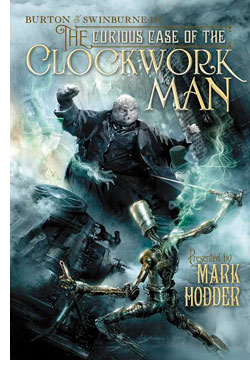
Sometimes the sequel makes the original. Mark Hodder cranked up the pressure with his first adventure for explorer Richard Burton and poet Algernon Swinburne, 'Burton and Swinburn in The Strange Affair of Spring-Heeled Jack.' With 'Burton and Swinburne in The Curious Case of the Clockwork Man' (Pyr / Prometheus Books ; March 22, 2011 ; $16), that book now proves to have been an introduction to a most delightful steampunk universe that is so well-wrought readers will be ill-disposed to the world as we know it.
Of course, it is quite possible that we do not know the world at all, that our paths are mere missteps in a journey that has been bushwhacked by forces unknown. Hodder's contribution to our reality, his so-called fiction, is convincing enough, engaging enough to make readers hope that things will be set aright.
Hodder's a smart writer and he bases his latest novel on a 19th century scandal in which a butcher claimed to be the English Aristocrat Sir Roger Tichborne, who was thought to have been lost at sea many years before. For those who think that celebrity trials are a phenomenon original to the 20th century, the so-called "real" story is a revelation. In Hodder's newest novel, it's the springboard for a weird and Lovecraftian plot that involves materials from beyond this world and snowballs into war. Tichborne appears to be connected to a Clockwork Man found in Trafalgar Square. It is not a friendly invention.
Hodder knows well how to mix in the real and the unreal, and in this novel he extends the world and the story arc of his characters with ease and grace. The story itself is chock-a-block with wild weirdness, excellently executed. Moreover, Hodder advances the larger story of Swinburne and Burton while delivering a very satisfying novel. That said, readers are directed to read the first first, as otherwise, the gears of Hodder's complicated and entertaining universe are likely to seize up.
Particularly notable is the addition of Herbert Spencer, a philosopher and writer whose second book, Principles of Psychology, anticipates modern neuroscience. Hodder makes excellent use of this character and plays him well as a foil for Burton and Swinburne. But Hodder clearly knows how to move adroitly between the real and the unreal. His fictional versions of real-life characters are as compelling as his weird science. Everything fits very nicely into this clockwork universe, which is moving as a wonderfully brisk pace. Readers will surely want to be with Hodder when midnight strikes.
03-02-11:Aaron Ximm and Kaveh Soofi Want You to 'Pat the Zombie'
Low-Hanging, Slowly-Rotting Fruit
It's not always about the most complicated this or meaningful that. Everybody needs and deserves a day off, especially connoisseurs of unusual fiction and non-fiction. And those who write about it.
Apparently, as a parent, one of the things I missed was 'Pat the Bunny.' I guess these books have been around since 1940, so I also missed them as a child. The idea is pretty cute, never quite crossing over into excessively so. These are little board books that have delightful illustrations of a bunny with a touchy-feely deal going on. While I missed them, I can't say I ever felt deprived as either a parent or a child. Until now.
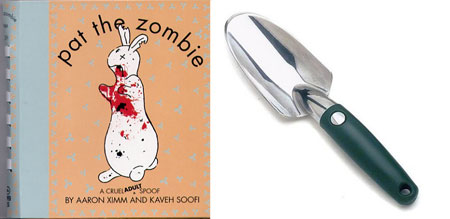
The publishers of 'Pat the Zombie' (Ten Speed Press / Crown Publishing / Random House ; April 26, 2011 ; $11.99) take the whole zombie craze to a whole new level. They want to play it safe and call this "A Cruel Adult Spoof," but don't let yourself be fooled. Here's the perfect way to introduce your pre-verbal baby to the joys of flesh-eating zombies. It's all of eighteen pages long, with bunny-flesh tear-aways, scratch-n-sniffs, and just about every totally inappropriate image and concept you can foist off on those who are just learning to say "Mommy," or looking at words and figuring out that there is some correlation to the letters on the page and the words that daddy says when he drops and breaks a beer bottle in the kitchen.
Writer Aaron Ximm and illustrator Kaveh Soofi (probably not the names you'd find in the "phonebook," remember those? And who can blame you!) have crafted a lovingly done, pitch perfect tale of Paul and Judy. "They can survive lots of things. You can survive lots of things, too...but you probably won't." What you can survive and even thrive from is giving this book to the very young.
Look, it is never too early to start corrupting your children. Innocent is better for this sort of thing! Your tiny tots will totally appreciate your attempts to warp their brains early on. Later in life they will still be able to proudly cling to 'Pat the Zombie.' This is most truly a book for all ages. No matter how man years you have been on this earth, or how few you have left, there's no doubt that this book will retain its "coolness." You just can't go wrong here.
In fact here's a not-too-bad suggestion. If you decide to buy this, buy two. One can go the route of most children's books and get pretty much devoured. Splattered with baby food, bile, blood, barf, whatever! But keep that other one in the wrapper, preserved for eternity, ready to rise again. Oh, it may never get unwrapped. But the whole living dead thing is too good to pass up. Who knows when a 'Pat the Zombie' emergency may come to pass? Be prepared! Your children will thank you. And I promise that they will be no more inclined to murder you with a trowel than they might have otherwise been had you not given them this book. In fact, that strikes me as the perfect pair; 'Pat the Zombie' and a garden trowel for your little darling.
03-01-11:Josh Mohr Leads 'The Termite Parade'
The Enemy Within
Most of us, at some point in our lives, learn what it means to be your own worst enemy. The key word in the previous sentence is learn. Because if we learn, then we do not repeat the mistakes that wrap themselves around the phrase "your own worst enemy." If we do not learn, then we get to experience something that is happily not quite so common — the personal apocalypse.
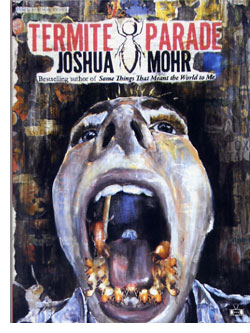
Joshua Mohr's 'Termite Parade' is indeed a parade — of mistakes that do not serve as teaching moments, of compound interest that accumulates daily, of men and women who do not see themselves or others clearly — or all too clearly. These are small lives in San Francisco, the sort of people you know or meet who are friends of friends. Joshua Mohr takes you up close and personal with the people whom you hope will not enter your life. Unless of course they are already there. Or, you are one of them.
'Termite Parade' is told in three points of view; there's Mired (rhymes with wired), who starts the novel telling us, "My life was in the toilet. I was right where I belonged." This is a woman with some pretty serious self-image problems, who has a bad time at a party, with Derek, her boyfriend. Derek, who tells us most of the story, is a mechanic, and probably not a such a bad guy after all. But a single decision can turn not-such into a real shit. And once ina while, you get to hear from Frank, Derek's brother. He's a video editor with delusion of artistry. Or if not delusions, inclinations towards artistry where none is required. It causes problems.
Told in short, staccato chapters, 'Termite Parade' is a grotesque evocation of dissolution and redemption, of lies and truths, and of people who are pretty much all their own worst enemies. None of these people will ever be famous, and none of them are likely to be rich. These are some of the most realistic characters ever to walk off the printed page and into your life. Mohr's episodic style is consistently hilarious. There's pretty much an unstoppable laugh in every chapter, on every page. Whether it is his characters' deeply-seated badness, or the awful situations they manage to work themselves into or the shocking honesty with which the book is written, you're going to laugh.
Of course, some readers may find this book a bit too raw for their tastes, and that's understood. You were warned, not of the rawness, anybody can handle that, but of what you might miss. Mohr has a penchant for making smart observations about our stupiest behaviour. He can write a sentence that will knock a couple of teeth out, then put it in a scene that will kick you in the face. He's an expert at using blue language to make you laugh to make you really, really see these people.
This is not a book of comfort, though there is a lot of joy. Mohr clearly loves life, even at its roughest, lowest point. 'Termite Parade' is a novel that you will rip through in a few moments, with scenes you'll never forget. Mohr writes with authority about really awful things you just might experience, if you have a really bad night followed by a worse day. Reading Mohr's evocation of this kind of reality might be the only thing that could compensate for this kind of reality. Reading about it is much, much better.
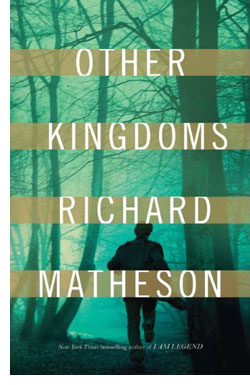
02-28-11:Richard Matheson Enters 'Other Kingdoms'
The World Next Door
The leaves rustle, but nothing can be seen. The branches wave luxuriantly, even though there is no breeze. Though the world is still, you know you are being watched.
Perhaps that which moves through the leaves, the breeze that blows the branches, the eyes that gaze upon you do not strictly reside in this world. We have all felt the presence of an adjacent world, of a place and a time, and even a people who are not in the usual sense here. It is all easily dismissed. It is better ignored. Paying attention to that which is not apart of our everyday reality can be hazardous to your mental and physical health. Of course, it can also bring you one step closer to heaven on earth.
Richard Matheson is attuned to that world. He's lived in it professionally, and brought back from that place stories that reside in the American story as myth, as legend. He's the author of 'I Am Legend,' and indeed, he is legend. Before our passenger planes became victims of hijacking, before they were transformed into weapons and turned against us, Matheson brought back from that adjacent world our fears, and put them on the wing of a plane. He anticipated what would come to pass and turned it into a myth about belief and action.
With his latest novel, 'Other Kingdoms,' (Tor/ Tom Doherty Associates ; March 1, 2011 ; $24.99) Matheson goes one step farther and takes readers into his world, into that world next door, The Middle Kingdom. It's enchanted all right, but that sword cuts two ways. You can fall in love and you can quite simply fall. The trick is to enjoy the first without succumbing to the last, to balance on that precipice. It is perhaps easier, smarter, more enjoyable and more useful to read about it than experience it.
Matheson's novel is told from the perspective of Alex White, an aging author of weird fiction who writes under the name of Arthur Black. Black is quite famous for his Midnight series. White is an entirely different kettle of fish, a man who has finally decided to tell the truth about his inspiration. It is, of course, at least as fantastic as anything he has written.
Matheson's novel follows a young Alex White, an American soldier recuperating from a difficult stint in the Great War by fleeing to the quiet English village of Gatford. But that is not to be his final destination. There he meets Magda Variel. She will lead him one step farther than Gatford, though he will not leave the confines of the village. In the neighboring woods, he will find a neighboring world.
Matheson is a consummate craftsman who knows how to make the unreal real, how to guide readers from the world they reside in to the next world, the world he creates with his prose. He does so by keeping all things low-key. He only tweaks one aspect of reality at a time, and often does so with a gentle sense of humor. As he leads White into the realms of faerie, the Middle Kingdoms, he manages an authenticity and realism that are often absent. As White's perceptions of reality change, so, too, will the reader's. Words can indeed create world, but the most enduring and real of those world contain both danger and beauty; often in the same guise, or guide. Matheson deftly combines suspense and romance in a novel that is compelling and entertaining.
No matter what Matheson writes about, he does so with an easy sense of authority. He simply seems to let a story that has along existed, a tale that has been waiting to be told, to unfold. Matheson strives for reality and manages to evoke it because he understands that our understanding of the world is emotional and irrational. His work is informed with the essence of human stories. It is both simple and powerful. The 'Other Kingdoms' to which Matheson's character Alex White, destined to become the writer Arthur Black, journeys, are the kingdoms to which we awake each day. They are new worlds, the worlds we make as we move forward with out hearts and our minds. They are as close as our breath in the still morning chill.
New to the Agony Column
09-05-15: Commentary : Susan Casey Listens to 'Voices in the Ocean' : Science, Empathy and Self
Agony Column Podcast News Report : A 2015 Interview with Susan Casey : "...the reporting for this book was emotionally difficult at times..."
08-21-15: Agony Column Podcast News Report : Senator Claire McCaskill is 'Plenty Ladylike' : Internalizing Determination to Overcome Sexism [Incudes Time to Read EP 211: Claire McCaskill, Plenty Ladylike, plus A 2015 Interview with Senator Claire McCaskill]
Agony Column Podcast News Report : Emily Schultz Unleashes 'The Blondes' : A Cure by Color [Incudes Time to Read EP 210: Emily Schultz, The Blondes, plus A 2015 Interview with Emily Schultz]
07-05-15: Commentary : Dr. Michael Gazzaniga Tells Tales from Both Sides of the Brain : A Life in Neuroscience Reveals the Life of Science
Agony Column Podcast News Report : A 2015 Interview with Michael Gazzaniga : "We made the first observation and BAM there was the disconnection effect..."
04-21-15: Commentary : Kazuo Ishiguro Unearths 'The Buried Giant' : The Mist of Myth and Memory
Agony Column Podcast News Report : A 2015 Interview with Kazuo Ishiguro : ".... by the time I was writing this novel, the lines between what was fantasy and what was real had blurred for me..."
Agony Column Podcast News Report : A 2015 Interview with Marc Goodman : "...every physical object around us is being transformed, one way or another, into an information technology..."
Agony Column Podcast News Report UPDATE: Time to Read Episode 199: Marc Goodman : Future Crimes: Everything Is Connected, Everyone Is Vulnerable and What We Can Do About It