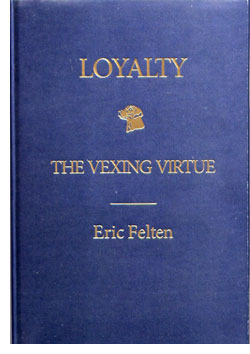
05-04-11:Eric Felten Examines 'Loyalty: The Vexing Virtue'
Resolving the Conflicts Between Good and Good
One might think that one can never have too much "good" in one's life. By definition, virtue is a virtue — but only in a solitude that our lives do not allow. It would be nice were we to have the luxury of adhering to the virtues of family alone; or of love, or the virtue of good citizenship. Reality, alas, does not cooperate. Our lives are messy affairs and the jostling of virtues — and loyalties — is much more complicated than the Platonic platitudes of bleating philosophers.
Eric Felten takes a very peculiar approach to his philosophic work 'Loyalty: The Vexing Virtue.' This is not a general treatise. This is not an examination of life in full, at least not apparently. Felten focuses his work on a single virtue, loyalty, but in so doing, he finds a wealth and variety of human experience and perhaps humanity itself.
'Loyalty' is a little book that benefits from the virtues of brevity. Felten gets straight to the point and examines loyalty from a variety of perspectives, but never gets lost in abstractions. While a book that devotes itself to being solely about a virtuous human character trait pretty much must be a work of philosophy, Felten demonstrates that this does not mean it must consist of mathematicized ethical hair-splitting. Felten makes a smart decision from the get-go and manages to write a book about loyalty that keeps its focus on real life and real-life examples of its subject.
The book unfolds in nine short chapters that examine loyalty from a variety of perspectives. He begins with "The Power of Loyalty," an examination of how loyalty helps us in the most basic sense. Felten starts by looking at the loyalty in the military, citing historical examples and keeping the reader both engaged and grounded. In this manner, the abstract notions of loyalty — the philosophical component — emerge from the reader's mind, not the writer's. It's a smart move. Felten even includes some of his own personal history working with the (in)famous "Prisoner's Dilemma." The often-paradoxical power of loyalty is brought home with a personal experience.
But, as he progresses to "Loyalties at Loggerheads," and "The Ever-Ready Accomplices," Felten begins to make it clear that loyalty can be perceived as more than a simple virtue in itself. Loyalty, which can be used to describe our choices to adhere to other virtues; love, honor, family, or country, for example — becomes a sort of "meta-virtue." In this realm, the simplicity of being loyal gives way to a much more nuanced and complicated juggling of loyalties. In "The Ever-Ready Accomplices," Felten examines how the virtue of loyalty can be turned to vice when, as we so often see, it is used to put country before family.
In successive chapters, each engagingly written and to-the-point, Felten looks at the varieties of loyalty and gives examples that bring home his point in an entertaining manner. But all the while, Felten is doing something rather unique and very interesting for readers. 'Loyalty' is a smashing success at turning the reading experience into a very pleasant and informative thinking experience. Felten helps readers think about loyalty in a philosophical manner by avoiding all the cliches of philosophical writing.
Instead, we're immersed in all the effects of our innate philosophical natures. As readers, our minds are filled with examples of every sort of loyalty one might imagine. Felten directs our thoughts and helps us put together a bigger, more complicated picture of loyalty than might have been imagined possible before reading the book. And by focusing on one virtue that touches all aspects of life, and indeed all virtues, he creates a clear vision of what we are — and what we might become, if we are indeed loyal.
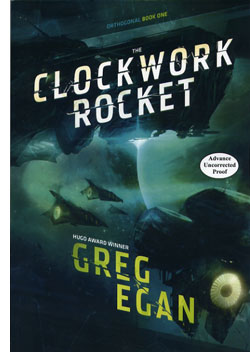
05-11-11:Greg Egan Launches 'The Clockwork Rocket'
Orthogonal Book One
Greg Egan's name really brings home the memories for this reader. I remember as if it were yesterday — jumping at the chance to order Egan's first novel, 'Permutation City' from Mark V. Ziesing Books. This was a time in my reading life when I was slowly returning to science fiction, which I had abandoned for many years. After reading Alastair Reynolds 'Revelation Space,' I once again decided the genre had something to offer, and went in search other other writers with the help of Mark Ziesing. Egan's prescient novel of artificial life and AI changed a game that would not exist for years. It's not an accident that copies of the first edition are rare and valuable. As a work of fiction it is rare — well-written and worth your valuable reading time.
Egan has been back in the game a lot of late and his latest novel, 'The Clockwork Rocket' (Night Shade Books ; July 2011 ; $24.99) is the beginning of an intriguing trilogy he calls 'Orthogonal.' In it, he undertakes a rather remarkably ambitious effort to do nothing less than rewrite the laws of the universe — all while giving us characters we care about embroiled in a ripping yarn. It's just another day in the life of Greg Egan; that is, assuming he decides to move forward through time rather than backwards.
Orthogonal ("relating to right angles; describing crystal structure") is set in a universe which erases the distinction between space-like and time-like relative motion. On his website, Egan writes that he's been thinking about this universe for the past year or so. But as you plunge into the background material, it seems like he must have migrated to his own self-created universe to do so. Given the depth of the writing and thinking, the mathematics behind the physics behind the science behind the fiction, the act of creating the framework to write his adventure seems as if it might have required some of the very tools the characters in his novel must use to have a hope in hell of avoiding an approaching Apocalypse.
The setup is quite enchantingly simple. Even the stars are different on Yalda's world, built on Egan's carefully thought-out revision of physics. Light moves sat different speeds, depending on its wavelength. But when some unorthodox objects, meteors that become known as Hurtlers, threaten her world, they present a problem that threatens her world. If there is but one solution, at least it has the virtue of simplicity. Send a ship into space at near-light speeds. Those in the ship will have hundreds of years to develop a technology that can avert Apocalypse, and they can return only a few years later to save the world that sent them into space. Sounds easy.
Between his fiction and his website, Egan gives readers the best of both worlds. The novels are compelling gritty and very strange, but rooted in great characters who embark on a truly epic quest. Egan gives you generation starships, strange physics, and massive mysteries. He also gives you, via the web, all the physics and math that underlie his imaginative extrapolations. Not that they are necessary to enjoy the fiction; but it's refreshing to see science fiction so firmly based on complicated science.
Happily — and not surprisingly, given the care with which Egan has approached this project — he has a plan for the fiction as well, with the titles, at least, of the two other books in the trilogy out, 'The Eternal Flame' and 'The Arrows of Time'. Like Egan, I believe that his universe makes more intuitive sense than ours, if only because it is convenient to me. I need to move sideways through time to get some work done, and I'm not even in the business of creating universes.
05-09-11:Ann Packer Sings 'Swim Back to Me'
The Written Life
Fiction worth the time it takes to read it must be alive. As we read the words, the characters and places must come to life in our minds without our permission. Perhaps it sounds simple when it's stated this plainly, but the skill it takes to make this happen is anything but simple. In fact, it takes a great deal of talent to make fiction look simple and natural.
Ann Packer's stories and novels are the written equivalent of photographs we might find framed, sitting on someone's desk at work. They spring to life instantly, and in those portraits we find stories that are intricate, natural and compellingly real. The six stories in 'Swim Back to Me' are lives we might have led or might yet lead. The intimacy that Packer brings to her work instantly involves us as readers. Her stories bring her readers to life, and into lives not their own.
"Walk for Mankind," the novella that opens the collection, is set in Palo Alto of 1972, shortly before it began the transformation into what we now call Silicon Valley. Richard Appleby meets his new neighbor Sasha Horowitz in the first week of eighth grade. She introduces herself. She's smart, funny and appealing, and they quickly become friends. Both are children of men who teach at Stanford; Richard's father is stable but divorced, while Sasha's family is unkempt but together. As is often the case, Sasha, the girl, is more mature than Richard. At least, she thinks herself to be. In the course of hanging out and checking out the neighborhood, she meets a twenty-something young man hanging out at Stanford and ... things happen. Richard gets to watch her step into a life he can just about grasp but not join, not quite yet. He's not so happy about what he sees.
Packer's novella is gorgeously written and evocative. It creates that fall and the seasons that follow with perfectly balanced poignancy. There's a whole world to explore in these two families, and Packer knows how to evoke the emotions with minimum fuss and maximum impact. Her writing is so fine that we're swept away into the past, unprepared for the powerful plotting and complex characterization. She gives the world and her characters a nice rough edge that feels right.
'Swim Back to Me' takes its title from a song found in the following story, "Molten," about a housewife who spends her time upstairs in her son's room, listening to his music. This is a carefully layered story in which revelation becomes plot, and leads to actions that are understandable, regrettable and understandably regrettable. The bitterness that burns at the heart of the story lingers after you finish the words.
Carolee and Alejandro, the characters at the core of "Jump" have a more playful relationship; she's his manager at "Copy Copy," but when she gives him a lift, she finds out more than she anticipated. "Dwell Time" is a paradigm of economic storytelling; with Packer deftly creating the large family that results from two divorces and one marriage. Here, as in other stories, she works well creating characters who are not present in the story. Characterization in absentia is a smaller, but no less important part of "Her Firstborn," which also touches on themes found in "Molten," but in an unexpectedly sweet and playful manner driven by nuanced characterization. Packer's stories hang together in a nicely knit manner, even when they're not connected by common characters.
"Things Said or Done" is connected to "Walk for Mankind," as it finds one of the characters in that story, now fifty, confronting an aging parent at a family wedding. There's a wonderfully sweet and bitter tone here that is in perfect keeping with the story that begins the collection. The ties between the two stories, and the thematic ties between all the stories, lend 'Swim Back to Me' some of the feel of a novel. But most of that comes from Packer's ability to evoke life with language. Words, when she uses them, are anything but "mere words."
New to the Agony Column
09-05-15: Commentary : Susan Casey Listens to 'Voices in the Ocean' : Science, Empathy and Self
Agony Column Podcast News Report : A 2015 Interview with Susan Casey : "...the reporting for this book was emotionally difficult at times..."
08-21-15: Agony Column Podcast News Report : Senator Claire McCaskill is 'Plenty Ladylike' : Internalizing Determination to Overcome Sexism [Incudes Time to Read EP 211: Claire McCaskill, Plenty Ladylike, plus A 2015 Interview with Senator Claire McCaskill]
Agony Column Podcast News Report : Emily Schultz Unleashes 'The Blondes' : A Cure by Color [Incudes Time to Read EP 210: Emily Schultz, The Blondes, plus A 2015 Interview with Emily Schultz]
07-05-15: Commentary : Dr. Michael Gazzaniga Tells Tales from Both Sides of the Brain : A Life in Neuroscience Reveals the Life of Science
Agony Column Podcast News Report : A 2015 Interview with Michael Gazzaniga : "We made the first observation and BAM there was the disconnection effect..."
04-21-15: Commentary : Kazuo Ishiguro Unearths 'The Buried Giant' : The Mist of Myth and Memory
Agony Column Podcast News Report : A 2015 Interview with Kazuo Ishiguro : ".... by the time I was writing this novel, the lines between what was fantasy and what was real had blurred for me..."
Agony Column Podcast News Report : A 2015 Interview with Marc Goodman : "...every physical object around us is being transformed, one way or another, into an information technology..."
Agony Column Podcast News Report UPDATE: Time to Read Episode 199: Marc Goodman : Future Crimes: Everything Is Connected, Everyone Is Vulnerable and What We Can Do About It