06-23-11:Kamala Nair Waits for 'The Girl in the Garden'
Haunted by Memory
Memory is a world without borders and a world without end. Within memory, lie more memories, and within each another world. That's why we live our lives moving forward, one second, one step at a time.
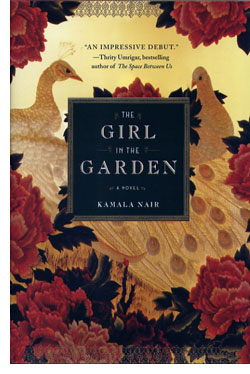
Rakhee Singh is one the verge of starting her adult life — marriage, a job, the whole shebang — when she takes one glance back into memory, only to see a world she thought she'd left behind when she was eleven years old. It proves to be a haunted world, and one she's not yet done exploring.
Readers will be glad she does, and gladder still that Kamala Nair chronicles that journey of discovery in 'The Girl in the Garden' (Grand Central Publishing / Hachette ; June 2011 ; $24.99), a smart, gripping story told in the singular, entrancing voice of Rakhee Singh. When she speaks, you cannot help but listen, and be glad you did so, no matter how disturbing and dark her story becomes.
'The Girl in the Garden' reveals its narrative secret almost immediately; within every frame is another story, and within every story is another frame. Peeling away the layers is a grand part of the pleasure in reading 'The Girl in the Garden.' Soon enough, we find ourselves at what seems to be the center of the story. As a girl of ten, Rakhee, born in the United States, is spirited off to India, and finds herself immersed in a new and alien culture. What she and the reader soon realize is that the Indian culture (and all others, for that matter), consists of stories that swirl around those who live within them. Rakhee proves to be quite a good storyteller.
Nair's novel is at core a story of family, and she gives us a memorable cast of strong characters to take us through the series of nested scrolls. Rakhee's mother, Amma is the first door through which we walk, and she leads the readers to a large cast of women entrenched in roles defined for them by men. Krishna, her cousin, tells tales of something amiss, and Amma's friend, Prem seems threatening as well. Each new face leads to another, all of them memorably written.
'The Girl in the Garden' is the story of more than Rakhee's journey into her own and her mother's past. It is also a story about stories, fairy tales, family stories, and myths. The plot moves in many worlds, real and fantastical. Readers who will be tearing through the first-person narrative will find themselves as entangled as the characters. Nair is a smart writer who knows the power of small stories to drive larger narratives.
The intricately constructed narrative and the heady characters might be enough in and of themselves, but Nair does manage to bring about an effective payoff. 'The Girl in the Garden,' for all the wheels-within-wheels that drive the story, knows that no novel is a perpetual motion machine, and that every journey has not just a beginning, but an ending as well. Readers who enjoy the power of stories in our families and our lives will recognize 'The Girl in the Garden.' They may look out on their own gardens, within their own families and find what haunts them.
06-22-11: John A. Farrell Subpoenas 'Clarence Darrow: Attorney for the Damned'
The Devils in the Details
In fiction, we are abjured to write what we know. In non-fiction, that's supposed to be the law. With biography, this means that we have to stick to letters, documents, and recordings that we presume to be unchanging. The upshot of this is that biography can be static; that is, a single early work can dominate a field.
This can change, however, if new information about a subject comes to light, for example, if new papers are discovered. Then a lifelong interest in a historical figure can be transformed into a transformative work of biography, one that changes the way we see history and those who made it.
John A. Farrell, author of the defining and engrossing 'Tip O'Neill and the Democratic Century' found himself in just such a situation with regards to Clarence Darrow. Here was a man whom Farrell had admired since his childhood. He was also the subject of a defining biography by no less than Irving Stone in 'Clarence Darrow for the Defense'. Darrow played a central role in 'Big Trouble' by Pulitzer Prize-winning Anthony J. Lukas, in 'Big Trouble.'
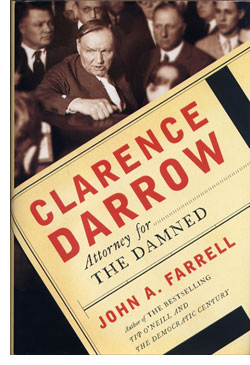
But the discovery of new papers brought to light significant new facts; Darrow was not the man we thought him to be. What we now know offered Farrell the opportunity to write 'Clarence Darrow: Attorney for the Damned,' (Doubleday / Random House ; June 14, 2011 ; 978-0-385-52258-8 ; 564 pages ; $32.50) an immersive, detailed vision of Darrow not just as a hero, but a human.
Farrell's work is exhaustively researched and richly revealing, but it's not exhausting to read. You can't help but realize when you pick up the book that this is a book to get lost in; at 500-plus pages, this is clearly a significant commitment for readers, but the rewards here are revelatory. And Farrell is a smart writer. He does not burden the narrative with unnecessary exotica. This is a focused, intense story of a Byronic hero, a man whose good work outweighed his tragic flaws.
We meet Darrow in Chicago, at the cusp of the decision that will change his life. Farrell sets up Darrow's voyage into populism and the politics of protecting the American underclass, then ratchets back to his childhood. We see him mourn his mother's death, then make the move to Chicago. The bulk of the book then dives into Darrow's legal and extra-legal life, in a series of chapters that are exciting and compulsive reading.
There's a lot to like about Farrell's work. He knows how to create a smart character arc for Darrow, and keep readers involved in the overall reading experience, even as he is presenting evidence that Darrow is not a straight arrow. Farrell highlights the major legal battles that made Darrow famous, some presented with new information that cast the man into a new and less-flattering light. But he also focuses on other ways in which Darrow was well ahead of his time; for example as a champion of women's right to vote.
Farrell's work upends our vision of Darrow as a white knight and rewrites him as a Byronic hero, flawed, but faithful to those he represents — even when he is representing himself, unfortunately. The new material unearthed by Farrell and others enables the author to show Darrow as profoundly intelligent, highly-motivated and ultimately, human. On one hand it's disappointing, but because Farrell knows how to build not just a character arc, but an entire historic vision, it's surely an engrossing reading experience.
'Clarence Darrow: Attorney for the Damned' is superbly written, with prose that flows and keeps the reader deeply involved in another time and place, even as Darrow's progressive views are starkly rendered with regards to their relevance in the here-and-now. What Darrow saw as possible and positive might seem improbable in today's political environment. Farrell's biography is truly new and offers a portrait in depth of a man who helped shape the nation. By rewriting what we did know with what we now know, Farrell's history makes the past present, in our minds. It's up to us to make the messages from that past present in our lives.
06-20-11:Brooke Gladstone Fires Up 'The Influencing Machine'
The Master in the Mirror
"You damn kids," we think — if we're feeling restrained. All the new-fangled media of the next generation seem so overwhelming, so overpowering, and yet, at the same time, so filled with nothingness. Only in this modern world could things go so wrong so fast.
As Brooke Gladstone entertainingly demonstrates in 'The Influencing Machine,' things have been going wrong not just for the past few years, but rather, for the past few centuries. Gladstone is a host for NPR's syndicated program "On the Media," and she proves to be as adept using the media as she is analyzing it.
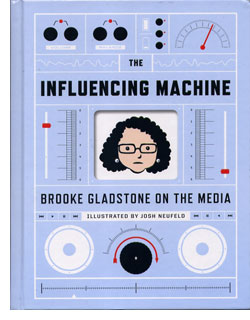
With 'The Influencing Machine,' she manages to do both simultaneously. Written as graphic non-fiction and superbly illustrated by Josh Neufeld, 'The Influencing Machine,' is meta-media that's smart and entertaining. But most importantly, there's a lot of stuff in here that will stick with you long after you finish reading the book. You'll see the way you see the world differently. Welcome to your life in the funhouse mirror.
'The Influencing Machine' certainly lives up to its name in a variety of ways. The book itself is a smoothly wrought machine, whisking the reader through hundreds of years of media history so charmingly that readers won't realize until after they finish the book just how information-rich the reading experience is. While you're inside Gladstone's machine, you're just having too much fun. Overall, the book takes you through the history of news and media, and within each chapter that chronological progress is repeated in miniature. This is wheels-within-wheels that keep your mind moving smartly from one wow-revelation to the next.
While the architecture of the book is itself quite amazing — if intelligently invisible — the content is equally engrossing and very visible. You'll meet the original mind-controlling media machine, one that proves to be a lot older that you would imagine possible. Gladstone creates characters from history using Josh Neufeld's crisp illustrations and quotes that put the reader in the perspective of these characters so that we can understand just how the media has been seen in the past. Because the book itself is thoroughly modern media, Brooke is a character as well, and she inserts herself, along with our modern perceptions, into those historical settings. The result is a schism that makes some sort of objective reality and the filters through which we see it quite startlingly clear.
Gladstone has a sort of science-fictional perception of her media universe. It's generally subtle, but the final passage of 'The Influencing Machine' looks at the near-future and technology that is just around the corner. There's an extended chapter on war journalism, which is harrowing and informative. She examines bias in the media in a manner that is rarely if ever explored. 'The Influencing Machine' is packed with engaging information.
As Gladstone takes us through hundreds, thousands, even millions of years of mass human communication, it becomes quite clear that we the audience are the influencing machine — and the media is as much a mirror as it is a controlling force. Technology may change, but we always regard it as a threatening force, a harbinger and tool of evil, used by unseen "others" to shape our thoughts, even as that messages that technology delivers is shaped by our desires. That she manages to get all this across while entertaining the heck out of the reader is nearly as amazing as what you'll read in here.
Making all this possible is Gladstone's easy mastery of the graphic non-fiction format. The layout, the usage of quotes, passages of pure prose and well-placed panel design make this easy to read even for someone who defaults to prose. Neufeld's illustrations are well conceived, perfectly drawn and printed with great precision. The production and design of the book live up to the content, and that's important in terms making the book an enjoyable reading experience.
In the end, it is clear that 'The Influencing Machine' could not have been done in any other format, or in any other way. Gladstone knows how to tell a very entertaining story, even when she tasks herself with the story of stories. Our media may be a funhouse mirror for our own self-image, ever poised between the Devil and the deep blue sea of possibilities. With 'The Influencing Machine,' Gladstone puts that mirror in the frame and lets the readers step back to realize that, for good or ill, they are in control.
New to the Agony Column
09-05-15: Commentary : Susan Casey Listens to 'Voices in the Ocean' : Science, Empathy and Self
Agony Column Podcast News Report : A 2015 Interview with Susan Casey : "...the reporting for this book was emotionally difficult at times..."
08-21-15: Agony Column Podcast News Report : Senator Claire McCaskill is 'Plenty Ladylike' : Internalizing Determination to Overcome Sexism [Incudes Time to Read EP 211: Claire McCaskill, Plenty Ladylike, plus A 2015 Interview with Senator Claire McCaskill]
Agony Column Podcast News Report : Emily Schultz Unleashes 'The Blondes' : A Cure by Color [Incudes Time to Read EP 210: Emily Schultz, The Blondes, plus A 2015 Interview with Emily Schultz]
07-05-15: Commentary : Dr. Michael Gazzaniga Tells Tales from Both Sides of the Brain : A Life in Neuroscience Reveals the Life of Science
Agony Column Podcast News Report : A 2015 Interview with Michael Gazzaniga : "We made the first observation and BAM there was the disconnection effect..."
04-21-15: Commentary : Kazuo Ishiguro Unearths 'The Buried Giant' : The Mist of Myth and Memory
Agony Column Podcast News Report : A 2015 Interview with Kazuo Ishiguro : ".... by the time I was writing this novel, the lines between what was fantasy and what was real had blurred for me..."
Agony Column Podcast News Report : A 2015 Interview with Marc Goodman : "...every physical object around us is being transformed, one way or another, into an information technology..."
Agony Column Podcast News Report UPDATE: Time to Read Episode 199: Marc Goodman : Future Crimes: Everything Is Connected, Everyone Is Vulnerable and What We Can Do About It