07-06-11:Ben Loory Writes 'Stories for Nighttime and Some for the Day'
Wonder Harder
Wonder comes in many literary forms. A book of photographs may induce wonder at the world as it is, or a science fiction novel may invoke wonder at worlds that cannot possibly exist. Readers may find wonder in a fourteen-line sonnet or a four hundred page epic poem. A well-written work of non-fiction can present the wonder of those who surf one hundred foot waves. A novel about the whaling industry can inspire wonder at the limitless pursuits of a single man. A thick slab of space opera can draw readers outward into the contemplation of an endless universe. A non-fiction work about the unconscious mind can present the infinity inside each of us.
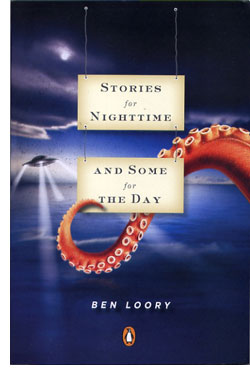
Ben Loory's 'Stories for Nighttime and Some for the Day' (Penguin Group USA ; July 26, 2011 ; 978-0-143-11950-0 ; $15 ; 210 pages) embrace the world with all the weirdness it deserves. In short, succinct tales, Loory finds wonder pretty much everywhere he looks. Loory's work is clean and crisp, with an accent on finding elements of the fantastic in the implements of everyday quotidian life. His work reminds us that all literature is unreal. Loory's work just happens to be more unreal than others'.
There are 40 stories in some two hundred pages here, and the chances are you could read this in a day. But you'd be well advised to pace yourself, to dip in and out of Loory's fantastic literary menagerie. You may meet a magic pig, an empty book, or a land-dwelling octopus. Whatever it is you meet, you can be sure it will be placed in a context that will deliver you, the reader, into a state of high reverie. From one story to the next, from one fable to the next, small morals and big ideas jostle on a level playing field created by the author.
Key to Loory's success is his utterly, persuasively authoritative prose. It seems both obvious and very elusive, this style. Loory strips his stories down to the fewest possible words and then tells us in the simplest terms, where we are and exactly what is happening. More often than not, what is happening is patently absurd (a city-dwelling octopus, a conversation with a moose), and occasionally partakes of science fiction genre tropes. But the words are carved away to the bare minimum. The result is that by virtue of Loory's repressed prose style, he manages to make anything seem real, and is able to find wonder at every stage of the game, to the point nearly midway through the book where we read this sentence: "You should wonder harder, the man's wife says. It would make you a happier person."
Loory's prose is the stuff of which his stories, his dreams are made. Here again, he uses understatement and restraint to make the most outrageous fantasies unfold in a world that seems to be ours. Loory's stories have the effect of reminding us that the world is never ours, that we can become unstuck in life as easily as we dream. Loory often uses the classic science fiction technique of one wonder per story, though few could be considered science fiction.
Indeed, 'Stories for Nighttime and Some for the Day' is an excellent example of the breadth and power of the fantasy genre, though to be honest, it is more sui generis than anything else. These are stories that apparently only Loory can write, and more importantly, stories that can be read only by individual readers. That is, the stories, for all their dry invention, seem to be aimed at each reader's individual heart. These are personal stories, meant for our ears only, for our minds only. They almost seem mathematically inevitable, in the way that intelligent life in the universe is said to be. But math, the universe, science and fantasy itself cannot accomplish what Loory does here. Language, well measured and keenly focused, is the only tool with which one may accomplish the task to hand.
07-04-11:Donald Ray Pollock Sees 'The Devil All the Time'
Flaying Americana
The things that make this country great also make it frightening — very frightening. Opportunity begets regret. Freedom creates monsters. The religions that inform our spiritual lives revel in the glory of what follows. Life in the here and now tends to be a hardscrabble battle for an ever-diminishing slice of happiness that comes from a within that is ever more rotted by our daily struggles. The power of a great novel is that it can turn all of this into a twisted beauty that celebrates those whom it destroys.
Arvin Eugene Russell is not a bad kid, but he's not lucky by any stretch of the imagination, and there is quite a bit of imagination at work in Donald Ray Pollock's 'The Devil All the Time' (Doubleday / Random House ; July 12, 2011 ; 263 pages ; 978-0-385-53504-5 ; $26.95). Pollock's story of good characters, bad characters and worse creeping across the American mid-west is a powerhouse of page-turning southern gothic terror. Pollock knows that there is a beauty at the core of horror, an awe that transcends earthly concerns. But those earthly concerns are awfully powerful, and powerfully awful. They tend to grind up those who get caught in the gears.
Pollock's storyline is grain alcohol Americana. Arvin's father is a World War II vet traumatized by his experiences in the Pacific, and his mother is slowly dying of cancer. There's a homemade altar in the backwoods behind Arvin's cabin, a visiting duet of preachers in the church (one handles spiders, the other young men), a shady sheriff and a husband and wife whose vacations consist of trolling the highways for male hitchhikers who tend to meet an unfortunate fate.
On a prose level, Pollock writes with a clipped precision that is subtly stripped down. You won't notice unless you're looking for it, but Pollock knows how to carve every unnecessary word from every sentence he writes. While the landscape and people he describes are relentlessly realistic, there's a gothic visionary feel to the novel. This book is a pleasure to read. For a finely-written work of art, it's very much a page-turner, the sort of book that will keep you up late because Pollock's prose is beautifully polished and natural to read. Pollock has a deep, distinctive American prose voice.
The characters are a real achievement. This novel offers up a town full of folks so unpleasant you'd want to drive out of your way to avoid that town. What's astonishing that even the most repellant folks are quite entertaining to read about, and not in a prurient manner to simply find out how low they can go (lower than you'd imagine), but because Pollock simply lets them be on the page. As a reader, you know that these people are real and have consequence in their own world. Arvin, the protagonist of the novel, is strong enough to hold his own, hold our attention and engage our sympathy. Even the vermin can make us care about them, even though we know that they are not going to be redeemed.
Paired with the characters and the prose, the other vital component is Pollock's carefully layered plot. He manages to inject tension into the narrative without resulting to artifice. Steering between fate and free will, Pollock manages to keep us engaged from the first page to the last with lots of red herrings and side paths that ultimately lead to an unexpected but satisfying resolution. It sounds a lot easier than it proves to be, but Pollock never overdoes the cleverness of the story. This is America, a land of opportunity that cuts both ways. The abyss is always just around the corner, or in the mirror.
When we choose a book to read, we're engaged in more than self-entertainment. The investment that a book requires, and a good book pays off, that of time and attention, is also an act of self-definition. We redraw the borders of our identity. 'The Devil All the Time' keeps those borders strictly in America, and even if you are not American, you partake of a powerful vision of this country. Abstract values have real consequences in this novel, and the actuality of the consequences in the fiction ripple into the minds of those who experience it. Pollock's celebration of what he destroys offers readers a glimpse of depths within themselves that they can acknowledge and explore with a frisson of fear, but hopefully without any danger of drowning. Hopefully.
New to the Agony Column
09-05-15: Commentary : Susan Casey Listens to 'Voices in the Ocean' : Science, Empathy and Self
Agony Column Podcast News Report : A 2015 Interview with Susan Casey : "...the reporting for this book was emotionally difficult at times..."
08-21-15: Agony Column Podcast News Report : Senator Claire McCaskill is 'Plenty Ladylike' : Internalizing Determination to Overcome Sexism [Incudes Time to Read EP 211: Claire McCaskill, Plenty Ladylike, plus A 2015 Interview with Senator Claire McCaskill]
Agony Column Podcast News Report : Emily Schultz Unleashes 'The Blondes' : A Cure by Color [Incudes Time to Read EP 210: Emily Schultz, The Blondes, plus A 2015 Interview with Emily Schultz]
07-05-15: Commentary : Dr. Michael Gazzaniga Tells Tales from Both Sides of the Brain : A Life in Neuroscience Reveals the Life of Science
Agony Column Podcast News Report : A 2015 Interview with Michael Gazzaniga : "We made the first observation and BAM there was the disconnection effect..."
04-21-15: Commentary : Kazuo Ishiguro Unearths 'The Buried Giant' : The Mist of Myth and Memory
Agony Column Podcast News Report : A 2015 Interview with Kazuo Ishiguro : ".... by the time I was writing this novel, the lines between what was fantasy and what was real had blurred for me..."
Agony Column Podcast News Report : A 2015 Interview with Marc Goodman : "...every physical object around us is being transformed, one way or another, into an information technology..."
Agony Column Podcast News Report UPDATE: Time to Read Episode 199: Marc Goodman : Future Crimes: Everything Is Connected, Everyone Is Vulnerable and What We Can Do About It