09-21-11:Tim Blanning Leads 'The Romantic Revolution'
Pocket Guide to the Underpinnings of the Little Good That Is Left In This Blighted World
"We live on a placid island of ignorance in the midst of black seas of infinity, and it was not meant that we should voyage far," H. P. Lovecraft famously wrote to begin his classic story "The Call of Cthulhu." That's truer now than it was when he wrote it, and it applies to a wider spectrum of ignorance than the scientific variety with which Lovecraft was concerned. We're trapped in a cultural cauldron, where change is equated with good and ignorance is, appallingly, strength.
While scientists debate the possibility of time travel, the world at large has been shoved into the Wayback Machine, with the dial set for the Dark Ages. The sources of beauty and joy in life are being clear-cut by forces who seek eternal security in a world that has already come to an end. We shot past the Apocalypse without noticing it. We can't see what's good around us, and part of the reason is that we've forgotten where it came from and why.
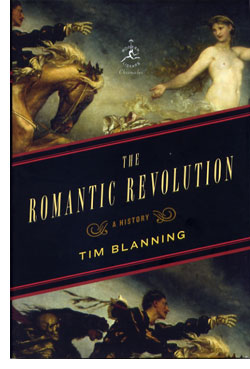
This is why reading is more important than ever. The meditative state that reading requires forces us to step back and take stock of what is out there. And when you can find a book like 'The Romantic Revolution' by Tim Blanning (Modern Library / Random House ; August 2, 2011 ; $22) to induce that state, you stand a chance, just the barest, most infinitesimal chance, of remembering how we arrived in the post-Apocalyptic wasteland that surrounds us.
In a brief, terse, 182 pages, plus notes, Blanning gives readers a breathtaking vision of the Revolution fought with weapons of passion, reason and art. The Romantic Revolution, itself a reaction to the Enlightenment, is half of what makes the illusions we cling to worth clinging to. All may be lost, but we can at least delude ourselves effectively, and the lives, the letters, the thoughts chronicled in this book are largely the reason why.
The question that launched the Romantic Revolution is still being asked, and still relevant today. Back then it was a contest — an essay contest to be sure, but a contest nonetheless. The question, posed in 1749 was, "Has the progress of the science and the arts done more to corrupt morals or to improve them?" (The Dark Ages have been seen as a desirable destination for a long time, haven't they?) Jean-Jacques Rousseau answered that question with an epistolary novel first titled 'Letters from two lovers living in a small town at the foot of the Alps' and later changed that to 'Julie, of the New Heloise.' It was a shot heard round the world — a phrase referring to a later revolution that might not have been coined were it not for the Romantic Revolution.
Blanning wastes no words and covers the big names, the big movements in all the arts that became known as the Romantic Revolution. From the original individualism of Rousseau to the artists, poets, painters and thinkers who made our dreams, our artists and our nightmares worthy of consideration and even veneration, Blanning offers an action-packed philosophical history that looks at the loser — because, yes, the Enlightenment did eventually win — with the eye one of who understands the import of loss. The chances are that we've already arrived in the Dark Ages so many of us seek. But the power of the Romantic Revolution is that individuals who care about their world, and their art and the other individuals who surround them, those for whom the journey is inward, will always be with us. Blanning's book is an essential guide to the backdrop of what's worth saving in this post-Apocalyptic wasteland we inhabit. It might just be us.
09-19-11:Lev Grossman Crowns 'The Magician King'
Prose Magic Undermines The Real Deal
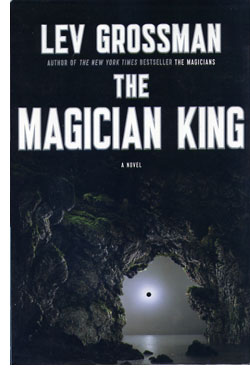
It's good to be king — and that's a problem most fantasy writers simply avoid. Not Lev Grossman, who follows up 'The Magicians' with 'The Magician King,' a superb and subversive sequel that manages the utterly fantastic feat of being in two places at once.
'The Magician King' takes its characters and setting quite seriously, as snarky twenty-something slackers find themselves adrift in a utopian fantasy kingdom powered by magic. A quest is called for, and lives will be changed, perhaps lost. Grossman offers all the high-points of high fantasy nicely ticked-off and excellently executed.
But 'The Magician King' is, at the same time, in the same novel, a send-up of exactly the sort of novel it both pretends to be and actually succeeds at being. The superb, logical plotting in a fantasy setting plays off the droll prose. 'The Magician King' is hilarious and moving — not an easy feat to pull off.
Grossman's novel picks up where most fantasy novels run a slow fade. Quentin, Julia, Janet and Eliot are tetrarchs ruling the magical kingdom of Fillory. There's a problem, though, that becomes rapidly apparent. Happiness is dull. Stability is stultifying. Bored, Quentin looks for something, anything to do, and sets off on an innocuous quest to collect some back taxes. In the tradition of fantasy trilogies, most of which he's read, he gathers a formidable force, and heads out on the open sea. It should be a piece of cake. Alas, it proves to be a bit more complicated than he imagined.
It's easy enough to sail on Grossman's entertaining plot, which twins the story of Quentin's quest with the back-story of Julia's indoctrination into magic. While the rest of the quartet was whirling and twirling in the posh environs of Brakebills in 'The Magicians,' Julia was getting a streetwise education in back alleys and rented crash-pads. Her story lets more magic seep into our world, while in the portions set in Fillory, the slacker-kings get an education in Fantasy Quest, 101. Even low adventure offers the possibility of catastrophic failure, with death as a side-order. And success may not be as entertaining for those on the receiving end as it is for those who read about it.
But crackling right up against Grossman's plot is his prose, and here's where the reading gets really fun. 'The Magician King' is a screamingly funny satire. Every page is packed with sentences like, "Janet was in charge of relations with foreign powers — Quentin called her Fillory Clinton." Even as Grossman makes good on his fantastic premise by taking it with complete seriousness and treating a quest right — finally — he is sending it up with merciless language that is perfectly suited to his characters' perceptions — and ours. 'The Magician King' may be the smartest comedic novel you'll read this year.
Because it took the tropes and treasures of heroic second world fantasy seriously, 'The Magicians' was an outstanding novel, and not just for genre readers. Realistic characters infiltrated a magical world, bringing some back home with them. In 'The Magician King,' those same characters bring a good dose of reality to a magical utopia. Though these novels clearly comprise a series best read in order, each installment has a much more internally complete feeling than the usual one-long-story-divvied-up series. Even when it is being utterly enchanting, 'The Magician King' is savaging satirizing enchantment. In 'The Magician King,' Lev Grossman manages to pull off precisely the sort of magic he's so adept at putting down.
New to the Agony Column
09-05-15: Commentary : Susan Casey Listens to 'Voices in the Ocean' : Science, Empathy and Self
Agony Column Podcast News Report : A 2015 Interview with Susan Casey : "...the reporting for this book was emotionally difficult at times..."
08-21-15: Agony Column Podcast News Report : Senator Claire McCaskill is 'Plenty Ladylike' : Internalizing Determination to Overcome Sexism [Incudes Time to Read EP 211: Claire McCaskill, Plenty Ladylike, plus A 2015 Interview with Senator Claire McCaskill]
Agony Column Podcast News Report : Emily Schultz Unleashes 'The Blondes' : A Cure by Color [Incudes Time to Read EP 210: Emily Schultz, The Blondes, plus A 2015 Interview with Emily Schultz]
07-05-15: Commentary : Dr. Michael Gazzaniga Tells Tales from Both Sides of the Brain : A Life in Neuroscience Reveals the Life of Science
Agony Column Podcast News Report : A 2015 Interview with Michael Gazzaniga : "We made the first observation and BAM there was the disconnection effect..."
04-21-15: Commentary : Kazuo Ishiguro Unearths 'The Buried Giant' : The Mist of Myth and Memory
Agony Column Podcast News Report : A 2015 Interview with Kazuo Ishiguro : ".... by the time I was writing this novel, the lines between what was fantasy and what was real had blurred for me..."
Agony Column Podcast News Report : A 2015 Interview with Marc Goodman : "...every physical object around us is being transformed, one way or another, into an information technology..."
Agony Column Podcast News Report UPDATE: Time to Read Episode 199: Marc Goodman : Future Crimes: Everything Is Connected, Everyone Is Vulnerable and What We Can Do About It