The past is ever ready to rise, to be discovered and brought to light. The secrets that have been buried will hurt once again. The lies that have been concealed will be revealed. And good, honest men will always be in the path of those who wreak violence to conceal their sins.
Ruth Rendell walks both sides of the mystery and suspense aisle. In her novels of psychological suspense, she creates realistically unhinged minds and then turns them loose on an unsuspecting world. In her Inspector Wexford novels, her good-hearted, well-adjusted, well-intentioned detective goes about righting wrongs, or at least, determining who committed them and why. He often puts the doers away. And, just because Rendell as a writer is every bit as complex as the characters she portrays, in her Barbara Vine novels, she delves into history and into first-person narrative to look at crime and society in both a broader and more personal sense.
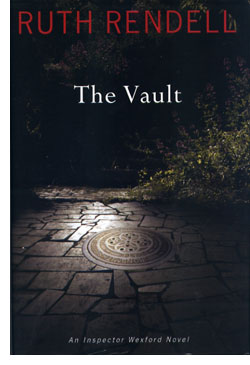
Readers who might suspect that Rendell has gone in every direction possible are in for a delightful surprise with 'The Vault,' the latest novel featuring the now-retired Inspector Wexford, who follows up on the crimes in Rendell's 1999 novel of psychological suspense, 'A Sight for Sore Eyes.' That novel concluded with three bodies in a sealed-off cellar beneath a nice house in London. 'The Vault' begins when a new owner of the house decides to put in a cellar, and unearths four bodies.
Ruth Rendell is not reticent when it comes to killing.
'The Vault' is a superb combination of police procedural and informal sequel, satisfactory on all levels. While it greatly helps to have read 'A Sight for Sore Eyes,' it's not strictly necessary. Of course, since it is one of Rendell's best novels of toe-tapping psychological terror, you can't go wrong. If you have not read it, make that a priority, and you'll enjoy this one even more.
In 'The Vault,' Wexford's retired — but that doesn't keep him out of the action. Called in to consult when the four bodies are discovered, he's got to solve more crimes than he might suspect. Rendell is a master of plotting, and plot provides many of the pleasures in 'The Vault.' In order to untangle the past, Wexford is forced to accept the present. He learns how to noodle around a bit on the computer. And he has to deal with crime in his own world, as his daughter has a comeuppance for her own misbehavior. There's a lot to untangle and Rendell knows how to make it compelling and supremely entertaining.
Rendell's novels are all character-driven, and those wherein Wexford is at the wheel are a nice break from the books in which depravity unravels the lives of those within. 'The Vault' offers the best of both worlds. Wexford's retirement is entertainingly explored, and the tormented minds that out those bodies in the vault are finely flayed for our examination. Rendell does particularly well with those on the periphery of crime, showing the ripple effects on those who are not direct victims.
One of Rendell's strong points is her sense of place, and it is particularly evident in this novel. The house she created for 'A Sight for Sore Eyes' has not aged well, but it is lovingly described. Readers will be treated to the Inspector Wexford walking tour of London. The prose that Rendell applies to both her people and her locations ensure that both are places to which we can return in our memory, should we choose to be haunted.
'The Vault' is not a long novel, but it has a depth that cannot be denied. Rendell's ferocity remains intact, even when she is writing about the very nice Mr. Wexford. At one point, he thinks that, being retired, he is without official power, that he is no Hercule Poirot. The power present on the pages belies that thought. Wexford , and Rendell, have the power to enter our memory and become part of our past; and like the past, they are hard to forget. When we need to we can go back and visit this novel in our minds. We can bring the past to light, examine it, and, if we are lucky, learn from it.
10-03-11:Erin Morgenstern Presents 'The Night Circus'
The Supernatural Stage
Magic is in the mind of the beholder, and it takes many forms. From a simple sunset to a complicated mechanical illusion, to an actual enchantment, it is not what we see, so much as what we perceive to be behind the vision. Our interpretation of what happens is more important that the cogs and gears behind the curtain. And thus, most of what we deem to be magic, is not — even if the enchantment is real. The only magic that is what all trickery, spell casting, psychic powers or undiluted beauty aspire to be is that which we do not notice or identify as such. Magic is by definition unnoticed.
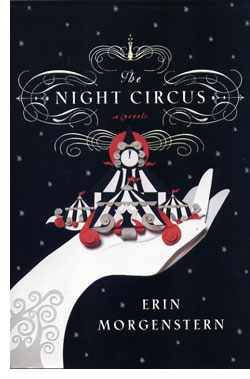
The magic you find in Erin Morgenstern's 'The Night Circus' then, is not to be found in the stage shows of Prospero the Enchanter or even in the Night Circus itself. You'll find plenty of trickery, enchantment and illusion. You'll find love and adventure and high strangeness. It's a superb reading experience.
Morgenstern's first novel begins by directly addressing the reader, describing the arrival of the Night Circus, so-called because it only opens after dark, and closes with the dawn. You are invited to enter; the circus, the magic and the novel begin.
Le Cirque des Rêves, we learn, is the setting for a competition between two enchanters, who have tasked their progeny to carry out a battle by proxy. Morgenstern's novel begins in 1873 as Prospero the Enchanter realizes his daughter Celia has inherited his unique talent. Prospero has more than a daughter, however. He has a competitor; a man in a gray suit ("Mr AH—") who contends that he can teach what Celia has inherited. The battle between these two men has played out before, and in the course of the novel it shall do so again.
'The Night Circus' itself is, of course a carefully conceived piece of magic crafted from prose just musical enough to distract readers from the instrument that plays the tune. Morgenstern's sentences flow eerily off the page and into the reader's mind. There's a distinct delicacy of choice at work here that plays well to the surreal nature of the plot and characters. The writing is precise and detailed, deliciously descriptive when it needs to be, but invisible when that best serves the story.
Characters there are, and many, all of them distinct and distinctly likable. Chandresh Cristophe Lafevre creates the circus, bringing together a core cast, an inner circle of performers, artists and creators. Friedrick Thiessen builds the complicated clock that seems to bind the Circus, but remains outside the show itself. The reader is much more deeply embedded, and everyone in the large cast will linger in memory, in dialogue, in the magic of your reading experience.
Morgenstern is nothing if not ambitious. Rather than craft a simple conflict, Morgenstern subverts the very notion of conflict as a storytelling device. Marco, Mr. AH—'s pulled-from-the-orphanage son, feels no enmity for Celia, the woman destined to be his competitor. Working from the premise that magic requires both a performer and a worthy audience, Morgenstern's characters tend to collaborate rather than compete. The real miracle and magic is that the story keeps a nice momentum.
While 'The Night Circus' has a historical setting and to a degree a historical feel, the overall atmosphere is of a world out of time. Yes, there are dates, and they are in our past, but readers will luxuriate in this novel well into the future. 'The Night Circus' short-circuits stage magic and the supernatural to create a truly surreal vision of creative competition that leads to love. It's weird enough to entertain the gentlemen in the audience and enchanting enough to involve the ladies. The so-called "Greatest Show on Earth" may just have to step aside, at least, after the sun goes down, when the stars shine from the firmament. Before they fall.
New to the Agony Column
09-05-15: Commentary : Susan Casey Listens to 'Voices in the Ocean' : Science, Empathy and Self
Agony Column Podcast News Report : A 2015 Interview with Susan Casey : "...the reporting for this book was emotionally difficult at times..."
08-21-15: Agony Column Podcast News Report : Senator Claire McCaskill is 'Plenty Ladylike' : Internalizing Determination to Overcome Sexism [Incudes Time to Read EP 211: Claire McCaskill, Plenty Ladylike, plus A 2015 Interview with Senator Claire McCaskill]
Agony Column Podcast News Report : Emily Schultz Unleashes 'The Blondes' : A Cure by Color [Incudes Time to Read EP 210: Emily Schultz, The Blondes, plus A 2015 Interview with Emily Schultz]
07-05-15: Commentary : Dr. Michael Gazzaniga Tells Tales from Both Sides of the Brain : A Life in Neuroscience Reveals the Life of Science
Agony Column Podcast News Report : A 2015 Interview with Michael Gazzaniga : "We made the first observation and BAM there was the disconnection effect..."
04-21-15: Commentary : Kazuo Ishiguro Unearths 'The Buried Giant' : The Mist of Myth and Memory
Agony Column Podcast News Report : A 2015 Interview with Kazuo Ishiguro : ".... by the time I was writing this novel, the lines between what was fantasy and what was real had blurred for me..."
Agony Column Podcast News Report : A 2015 Interview with Marc Goodman : "...every physical object around us is being transformed, one way or another, into an information technology..."
Agony Column Podcast News Report UPDATE: Time to Read Episode 199: Marc Goodman : Future Crimes: Everything Is Connected, Everyone Is Vulnerable and What We Can Do About It