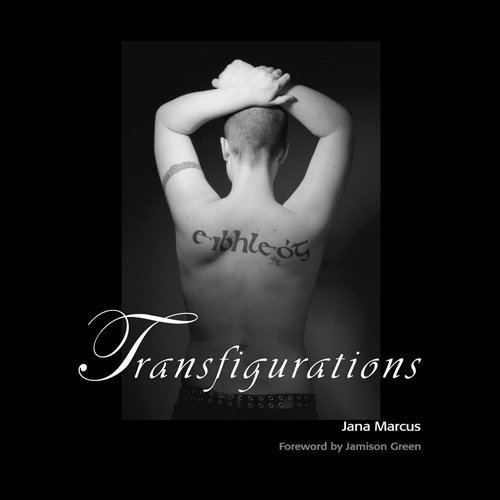
Ultimately, as readers, it is people we care about; the characters we meet in the books we read. Mostly, these are created in words, in fiction and non-fiction. Our minds do the visual work. Jana Marcus flips the switch in more than one way, in 'Transfigurations.' Yes, it is book of photographs of transgender people, in all states. In that sense, the people switch we generally think of as being pretty stable is upended.
But this book also upends our idea of how we encounter character in books. Usually we encounter characters slowly. We get to know them through the words (sometimes "their" words, with the visual image often indistinct, trailing gently away in our imagination. The portraits in 'Transfigurations' knock us upside the head. We are transfixed by the image, and we know the person in that photo immediately. Afterwards, we read their words. It's a complete reversal of how we usually encounter character. But without a doubt, the people you meet here will be in your life for along, long time.
Based on a museum exhibit that has been traveling the country for years, 'Transfigurations' is really a pretty simply out-together book. Incredible, rich, detailed black and white portraits of men who were once women, women who were once men, and people in mid-surgery who are between gender take the reader into a world where our assumptions are undermined. Marcus interviewed the subjects and offers readers a well-edited portion of interview with the portraits, so we do get a fix, in language, in words for each person we meet. The stories are powerful statements of personal bravery, often at odds with the casual, everyday-seeming appearance of the subjects. To read this book is to change your vision of those around you and who they can be.
A book of photography requires more than incredible subjects, though Marcus certainly manages that with ease. The photographs themselves are rich, and have a timeless quality about them. The men and women and those in-between are captured in such a way that their individuality seems to strike out. It's almost reminiscent of what Charles Dickens does with names; these are characters you simply cannot forget.
The production values of such a book are critical, and 'Transfigurations' is crisp and pristine. Funded by a Kickstarter project, this book is more than worth the relatively modest cover price. The paper is heavy, the contrast is amazing, and the book is clearly built to last. It's something you can hand down to those who come after you, and it feels right to do so. This is a book that invites you to join a family, the human family. Welcome to your life.
10-24-11:Michael Reynier Spans ' Five Degrees of Latitude'
Literary Ripping Yarns
The conventions of fiction are not necessarily bad. The guidelines of length, style and content help publishers sell books to the bookstores, and in turn help bookstores sell those books to the reading public. They make it easier to find what we want when we look for something to read. Dividing lines of genre and content may have little literary importance, but at least we know where to look for books that feature elves, detectives, or elves who are detectives. We can easily find a doorstop biography, a 300-page thriller, or a collection of kitchen-epiphany short stories. (Though the latter is something of an endangered species!)
Of course, there are exceptions to be found as well. Robert Coover can put the emotional wallop of a 500-page novel of suburban angst into a 15-page short story. On the other side of the equation, the bestseller lists are filled with books 300 pages and longer that offer less plot and characterization than a short story by Flannery O'Connor. (Has any serial killer novel outdone "A Good Man is Hard to Find?" I don't think so!)
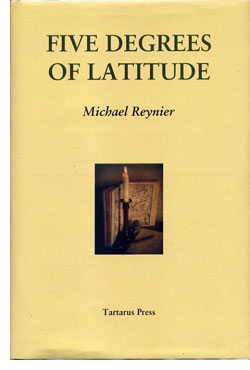
Readers will have to work, really work to find 'Five Degrees of Latitude' by Michael Reynier, and so I'm including a link to the publisher's website. At this point, there are fewer than 300 copies. In a just world, in the fullness of time, the book may be reprinted, but for the time being, this is the only place you're going to find this totally unusual, almost uncategorizable collection of — novellas? Novelettes? There are five narratives in here, each between 40 and 60-something pages. But to this reader, what you have is no less than the equivalent of five full-fledged novels, without an ounce of baggage. At 270 pages, 'Five Degrees of Latitude' is shorter than the average thriller. But in those pages, Reynier offers readers five ripping yarns, all written with an original vision and a literary intelligence that makes them as memorable as they are engaging.
The variety here is simply remarkable. The collection begins with "Le Loup Garou," an historical mystery powered by a very intricate and clever literary framing device. A series of brutal murders and mutilations once haunted a remote French mountain village, and the scholar Professor Florant Hortholary went to investigate; but we know this only though his notes and journals as pieced together by the graduate-student who narrates the story. Reynier creates a remote region so convincing readers will be tempted to try to find it on a map, to no avail. But the involving plot, commanding characters, and emotional power here are undeniably real.
"No 3 Hobbes Lane" is a mystery of a very different sort, as a traveler in England during the Industrial Revolution tries to understand how — and why — a house was built in a most unusual manner. Landscapes are perfectly rendered and yes, unmapped, and the pathos here is leavened by a sly sense of dark humor. Humor is even more evident in "The Rumour Mill," a proto-information age story about an old academic study that has never seen the light of day. The grand characters and understated, well-wrought romance balance out the knife-sharp dark meditations on human behavior.
"Sika Tarn" is an evocative story of a haunted landscape, set on the remote coast of Scotland. Reynier manages to be both subtle and eerie, and seemingly invents the conventions of the classic English ghost story with his own landscape-oriented literary style. The final work in the collection, "The Visions of Lazaro," is unique almost beyond description. It seems to document a religious splinter sect, and contrast that history with a visit to a remote desert outpost. Reynier grounds his work so thoroughly in both literary and academic styles, with a remarkable evocation of a realistic landscape, that it only slowly dawns on the reader that the world we are reading about may not be the one with which we are familiar. As our assumptions and expectations are stripped away, Reynier manages to evoke a true sense of wonder that verges on terror of the unknown. He handles invented technology and cultures here with an economy that is astonishing.
'Five Degrees of Latitude' offers readers very much the equivalent of five novels worth of reading in the space of less than one novel. Each work has a true emotional core, vividly imagined landscapes and characters, unique plots and original literary style. None of them are much like anything you've read, and while Reynier has a certain style that ties them together, they're very dissimilar in terms of content. 'Five Degrees of Latitude' may be the five best books you'll read this year.
New to the Agony Column
09-05-15: Commentary : Susan Casey Listens to 'Voices in the Ocean' : Science, Empathy and Self
Agony Column Podcast News Report : A 2015 Interview with Susan Casey : "...the reporting for this book was emotionally difficult at times..."
08-21-15: Agony Column Podcast News Report : Senator Claire McCaskill is 'Plenty Ladylike' : Internalizing Determination to Overcome Sexism [Incudes Time to Read EP 211: Claire McCaskill, Plenty Ladylike, plus A 2015 Interview with Senator Claire McCaskill]
Agony Column Podcast News Report : Emily Schultz Unleashes 'The Blondes' : A Cure by Color [Incudes Time to Read EP 210: Emily Schultz, The Blondes, plus A 2015 Interview with Emily Schultz]
07-05-15: Commentary : Dr. Michael Gazzaniga Tells Tales from Both Sides of the Brain : A Life in Neuroscience Reveals the Life of Science
Agony Column Podcast News Report : A 2015 Interview with Michael Gazzaniga : "We made the first observation and BAM there was the disconnection effect..."
04-21-15: Commentary : Kazuo Ishiguro Unearths 'The Buried Giant' : The Mist of Myth and Memory
Agony Column Podcast News Report : A 2015 Interview with Kazuo Ishiguro : ".... by the time I was writing this novel, the lines between what was fantasy and what was real had blurred for me..."
Agony Column Podcast News Report : A 2015 Interview with Marc Goodman : "...every physical object around us is being transformed, one way or another, into an information technology..."
Agony Column Podcast News Report UPDATE: Time to Read Episode 199: Marc Goodman : Future Crimes: Everything Is Connected, Everyone Is Vulnerable and What We Can Do About It