|
 |
06-27-09: I, Frankenstein : Mary Shelley, Percy Shelley, Charles Robinson and Peter Ackroyd
It's never too late to re-animate the dead. I don’t care how rotted that corpse is, you can bring the damn thing back to life if you've just got enough juice. Of course, some corpses keep better than others, and literary corpses often seem to grow stronger and more beautiful with age. Take for example 'Frankenstein.' That particular corpse just will not lay down. Mary Shelley's novel is a classic for all the right reasons. It's well-written and nearly two hundred years after being written, it's still thought-provoking. It's tempting to think it's so ubiquitous that we don’t need to read it again. Until now.
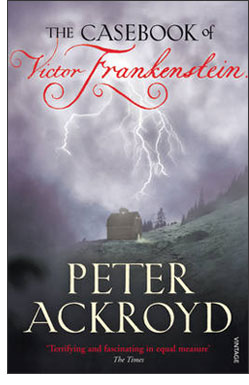
Two new books, however, suggest that it's time to re-animate our interest in the work of the esteemed fictional Doctor Frankenstein. You can go back to basics with 'The Original Frankenstein Or, The Modern Prometheus' (Vintage Books / Random House ; September 8, 2009 ; $14.00) by Mary Shelley (with Percy Shelley), and scrupulously edited by Charles Robinson, or you can take the next step with Peter Ackroyd, returning to his Gothic roots in 'The Casebook of Victor Frankenstein' (Nan A. Talese / Random House ; October 5, 2009 ; $26.95). My take is that you take the Robinson ride first — and it is a compelling ride — then venture further than you expect with Ackroyd.
Robinson's work is really extraordinary, and has a fascinating history. In 1996, he published 'The Frankenstein Notebooks,' a transcription of the manuscripts from the Bodelian Library at Oxford. Thus began a journey into literary history, as Robinson went through the many versions of 'Frankenstein' that were published to determine how and to what degree Percy Shelley contributed to the novel we now know. We get the book thrown at us in high school or college and are generally happy to be on the receiving end. It's a good book. It's aged well. But what we read is not what Mary Shelley originally wrote after that fateful 1816 party in the Alps. This new edition offers a crystal clear glimpse at how fluid and changeable the text to Frankenstein was.
This new edition is a lot more than the paperback versions you've seen in the past. First and foremost, you get Charles Robinson's incredibly interesting scholarly studies, effectively summarized in an introduction as gripping as the novel itself. This is literary history, a vision of writing made clear through painstaking research and detection. Following Robinson's introduction, you get two versions of 'Frankenstein' ; the first presented is the 1816-1817 draft, with Percy Shelley's contributions and changes presented in italics. He wasn't just her husband; he was her senior editor, and he made major changes that emphasize many of the themes you probably wrote about in college. I think most readers will be surprised at how much of the manuscript is in italics. This is your chance to see an editor at work; and not just any editor, Percy Shelley editing Mary Shelley's 'Frankenstein.' But that's not all.
Robinson also includes a second complete version of 'Frankenstein' without Percy Shelly's changes. Not surprisingly, Mary's work is less florid, and more direct than her "collaboration" with Percy. It's probably a bit easier for the modern reader, and certainly something we’ve not seen before. Robinson's scholarship in creating this version of 'Frankenstein' is stellar. For anyone interested in literary history or just great reading, this book is essential — as well as eminently reasonably priced.
But Victor Frankenstein cannot be left alone, and I suppose it's only fair that his corpse, so to speak is re-animated by no less a talent than Peter Ackroyd in 'The Casebook of Victor Frankenstein.' The premise is really quite simple; what happens when two Oxford students get to be friends — if those students are Victor Frankenstein and Percy Shelley? In Ackroyd's novel, it's Shelley's powerful, poetic vision that prompts the beginning of Frankenstein's studies, leading poor Victor to deals with some very unscrupulous Resurrection Men, that is to say, grave robbers. But Victor perseveres, with results that are at least familiar in outline to readers. Ackroyd gambles — and wins — by writing his 21st century novel in a 19th century voice, which speaks to his own level of scholarship and perseverance. Read the two, no three novels back-to-back-to-back and immerse yourself in the risen dead, in literary history in the birth of science and the end of death. Only then might you realize that we long ago conquered death — when we first set pen to paper and undertook to create fiction from the facts of death and the stuff of life.
|
|
06-26-09: A Review of Carlos Ruiz Zafón's 'The Shadow of the Wind' : A Memory of Books
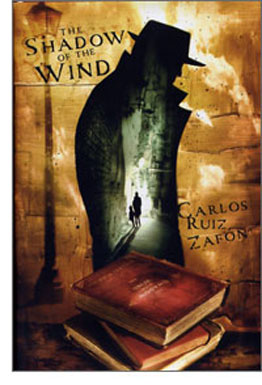
When 'The Shadow of the Wind' first came out in 2005, I was definitely interested, but it slipped by. But when I saw that Subterranean Press was going to do a limited edition, my interest became piqued once again. The original publisher, Penguin Press, is a general-purpose publisher of great repute. But Subterranean Press has character — and character counts, especially in this novel.
When Subterranean's edition arrived, it rapidly become one of those books that followed me around that got into every priority pile I had. I kept picking it up to read, waiting for the right moment, and then when that moment came, I gave myself a special treat — permission to read a four year-old book. Not only that, a long four year-old book. The quality of the prose, the characters, the writing, the very book itself took me in, and there was no going back. Unless it is to re-read this book in some future I can only hope comes sooner rather than later. I hope that readers who picked up this book in the initial release but didn't get round to reading it, and those who perhaps started it but didn't finish will give this edition a try. And if you;ve never picked it up, never read it, you know, I envy you. Here's my review of 'The Shadow of the Wind'.
|
|
06-25-09: Joe R. Lansdale Takes a 'Vanilla Ride' : The Books (and Lingerie) We Can't Put Down
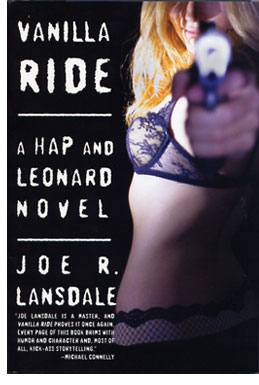
Damn if I don’t feel like I'm doing a public service today. You go to that ol' star-dot-star behemoth bookseller of doom, and you’re going to see a cover image of the latest Joe R. Lansdale book in which the lingerie is the WRONG DAMN COLOR — black ! This is a crime I hasten to correct. It is not black lingerie. It's blue. That there picture to the right is a scan of the real cover. If you don’t think this sort of thing matters, then you probably haven—t read Lansdale yet, and damn again — I envy the hell out of you.
So here's the deal for you never-read-hims. You can pick up most of the Hap and Leonard mystery back catalogue in Vintage trade paperbacks, you lucky sumbitches. I hope to hell they give you the correct reading order; start with 'Savage Season'., but buy it from Mark V. Ziesing online, , please. Looks like they do from the pre-title lineup in his latest, 'Vanilla Ride' (Alfred A. Knopf ; June 30, 2009 ; 24.95) and if there's a better, lewdly hilarious, page-turnin', masterfully plotted mystery novel chock-full o' dialogue so sharp and snappy it'll whack your nose off if you're not careful, then it's probably by the hyper-prolific Lansdale under a pseudonym.
If you're already familiar with Hap and Leonard and Lansdale, then you probably know what I mean about Books (and Lingerie) We Can't Put Down. [Actually the lingerie is generally meant to be tossed to the floor sooner or later.] I got this book, opened it to page one and damn if I didn't look up having read the first chapter. OK, it's only two pages, but then I read the second chapter, too, and then I started skimming around and I cold not find a place in this friggin' book that didn't make me laugh out loud. Lansdale, Hap and Leonard are in fine form here. Plotwise, Chapter two sets things up nicely, with Hap getting a visit from Leonard, who wants a favor that will involve about two hundred something pages of mayhem and laughter. All this with characters you give a damn about. Are we so there? We are so there!
This novel is just about as crisp as you could imagine. The dialogue is vintage Lansdale Hap/Leonard, and the descriptions are as well. Let me quote from page 2: "She had also set her ex-husband's head on fire and put it out with a shovel, which is a far cry from a water hose." So there you have it. A book that will put your butt in a chair and make you read it. It's summer. Don't put the book down, and make sure the lingerie flutters to the floor. And that it's the right color!
|
|
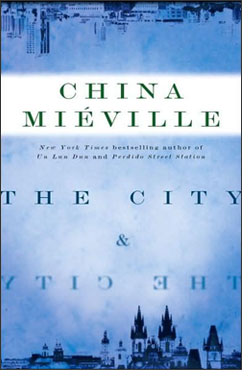
06-23-09: A Review of 'The City & The City' by China Miéville : City Limits
Reviewing books involves a lot more than simply reading the book and making a judgment as to the quality of the work. As a reader, I enjoy book reviews, but often find that they spend too much time on plot, spoiling the reading experience. I don’t want to know what happens. But even if you don’t spell out plot details, you can say too much. The limits of what you can say about a book while preserving the reading experience are different for every book you read and write about.
China Miéville's latest novel, 'The City & The City' is a great case in point. There are lots of different readers who will enjoy this book, and they'll come from different reading directions. Obviously, Miéville's fans will have an interest in 'The City & The City' — but they may not all approve. Since the novel is a mystery, and quite well done within the rules of that genre, mystery readers may also quite enjoy it — but it is a novel by China Miéville, and I can assure mystery readers it is like no other mystery they've read. I've been struggling with what to say about 'The City & The City' for quite some time now, because it is possible to affect the reading experience even when you don’t divulge specific details of a novel. The upshot it simply this; a novel like no other calls for an equally unusual review. Here it is.
|
|
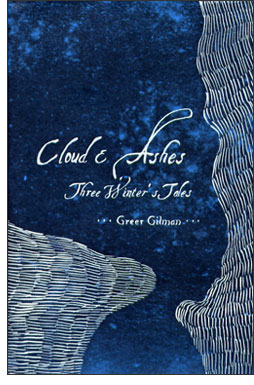
06-22-09: Greer Gilman Stirs 'Cloud & Ashes' : Conjuring Myth With Words
Seeing through the skin of this world is not an easy task. Discovering the eternal beneath the everyday is the work of prophets; describing the eternal for the everyday, the work of mad prophets. Yet when we read their words, these literary stepchildren who perhaps appear once each generation, bring us ease and understanding. This work is a balm that soothes the landscape with language.
A single word, "novel," describes a creation that can offer an infinite variety of experience. It's not often, however, that a single novel can offer within a glimpse of the infinite, the eternal, the beating heart of mind and myth that lies underneath both the world and the words that generally describe the world. Obviously, we don't want to stir up the eternal on a daily basis. It just won’t do. On the other hand, we do need to explore, to understand, and the best means with which to do so is language, of the sort that pops up once in a great while. Greer Gilman's 'Cloud & Ashes' (Small Beer Press ; June 1, 2009 ; $26) is a dense weave of words that manage to still waters and allow us a glimpse of our own souls.
'Cloud & Ashes' it uttered in three breaths, life, eternity, death. The first exhalation is 'Jack Daw's Pack,' a mere 23 pages of brief myth and "Riddles, Turned." The next breath is 'A Crowd of Bone,' a bit longer, nearly 90 pages; and the final draw, 'Unleaving,' is itself a novel within a novel, more myths within myths and stories within stories, topping out at just over 300 pages. This book is not a title to take lightly. Once you engage with Gilman in her dialogue between now and forever, you’re going to want to pay attention, to immerse yourself completely. You can only read this book for the first time once. Afterwards you'll not be the same.
Gilman's powerful work derives its potency from her lyrical language. She's as much a poet as she is a prose stylist and each word is carefully placed for reasons at once apparent and yet somehow mysterious, tethered to a realm beyond words. Gilman's descent into myth and the underworld is from the get-go clearly not an everyday experience. When you sign up for 'Cloud & Ashes,' you're pretty much signing up for a permanent change of perception.
Small Beer Press has no little to do with this change. The book has the sort of precise heft and weight, the right cover and the right type, an indefinably right feel. I remember reading Bullfinch's Greek Mythology for the first time and just knowing that the words would imprint me. Pick up this Small Beer book and you will know that big changes lie within.
'Cloud & Ashes' is not a book for every reader; but it is a book for every human. (It's also a book for every library that desires to be worthy of that appellation.) There might seem to be a contradiction in those words, and there might well be, were every human to read. But to my, mind reading is an effort that exists outside its own exercise; that is when we read, it may feel like an internal, unshared, indeed unsharable experience. But that is not, I think the case. When we read, we go to the place where writing comes from, and in so doing, I think we leave something of ourselves behind as readers. Greer Gilman found whatever it is that is left behind, she has captured it in her net of words and managed to write it down and get it published. That is a herculean feat. It may only happen once in her lifetime or in ours. But it's happened here and now. What you do with it is up to you. For eternity, as it happens.
|
|
|
|
|
|