|
 |
|
|
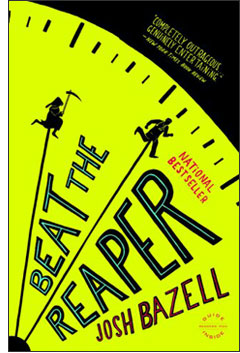
Beat The Reaper — Trade Paperback |
09-18-09: A Review of 'Beat the Reaper' by Josh Bazell : Read the Book
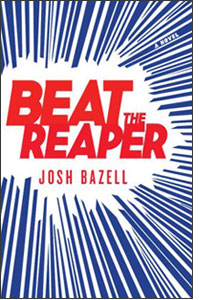
Well, thinking back on it, I've pretty much figured out that the reason I didn't jump all over the hardcover version of 'Beat the Reaper' was, alas, because every time I looked at the book, I felt like someone was trying to poke me in the eye with a bunch of sharp sticks.
Bad covers can do a disservice to a good book, and 'Beat the Reaper' by Josh Bazell is a good book. The eye-poking hardcover just put me right off. The trade paperback cover is an improvement, but only in that it's not a direct visual assault on my unprotected eye sockets. But once you get to the text, 'Beat the Reaper' is an all-out assault on your ability to put the book down. Bazell grabs you and does not relent until the final page. I'm not going to review the book in this commentary; here's a link to the review.
What is of interest, for the purposes of this commentary, is the ease with which one can miss a good book. 'Beat the Reaper' fell to the bottom of the stack because of a bad cover, to a certain extent, an ineffective presentation, and (I'm culpable too) my own laziness in not just giving the book the "read the first few pages" test.
|
|
Beat The Reaper — Hard Cover |
The importance of this test cannot be exaggerated. First off, if you're going to read a book, especially a novel, you’re going to want to start at the beginning. No matter how much you like an author (or don’t), if the beginning of a book puts you off, then the chances of you actually reading it are vanishingly small. On the other hand, if a book grabs you like 'Beat the Reaper' grabbed me, then the chances are you’re going to want to read it no matter what your reading queue looks like. Fairness be damned! Moreover, you need to hold the book in your hand. Reading from an online bookseller that provides "previews" is in no way the same thing as the way you may eventually read the book. (I hope!) So in order to test-drive a book that you might want to buy, you have to find a local independent bookseller that offers a place for you to check out books in comfort. Reading is about the books as much as the text.
|
|
09-17-09: Neil Gaiman Exports 'Odd and the Frost Giants' : Playing Catch-Up
I don't really mind playing catch-up, at least so far as Neil Gaiman is concerned. In this case, we can rewind to almost two years ago, when he first announced the publication of 'Odd and the Frost Giants' for World Book Day, 2008 in the UK.
Let's cut to the chase. Bookfinder.com pulled up a UK first edition — a small paperback, for $29. But soon enough, if not at the moment, you'll be able to get the first hardcover edition of 'Odd and the Frost Giants' (HarperCollins ; September 22, 2009 ; $14.99) in the US. This is a good thing, so if you’re of a compulsive nature, ring up your local independent bookseller, or one of the many fine folks on the web, and make sure you get a First / First. I suppose I'm kind of surprised that they didn't publish this last year, when the film version of 'Coraline' was making the rounds, but presumably they thought it might step on the sales for the film tie-in version of the book.
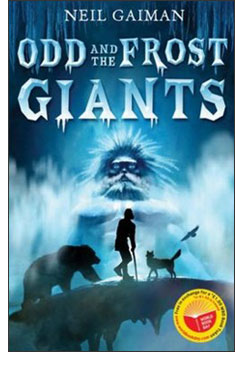
Whether or not you require an uninterrupted countdown row on the colophon page, a new Neil Gaiman hardcover is always worth your valuable time. Here you get a gorgeously distilled exploration of the Norse myths in a delightful little hardcover with an embossed, full-color painting on the cover and several line illustrations inside (all by Brett Helquist). It's a wonderful package, and inexpensive enough so that you won’t feel bad buying a copy for the 8 year-old child in your life and one for your library as well. Maybe two.
The story is charmingly simple. Odd is twelve years old, living in a Viking village. His father died some two years ago, his mother has remarried, and the village is waiting for Winter to end ... but it doesn't. Odd leaves the village to stay in his father's old woodworking hut, where he meets a fox, an eagle and eventually a bear, who will lead him on a journey to end the winter. Frost Giants will of course be involved.
You'll also find finely turned prose, gentle humor and the Norse myths, so cleanly and thoroughly assimilated by Gaiman that is seems we, too are in that Norse village, huddled around a fire, hearing this tale for the first time. Gaiman's simple voice retains the power and grace of the old myths, and the humor as well. One of the things we are reminded of as we read 'Odd and the Frost Giants' is that religions and myths are often simply quite funny; the goofy gods, screwing things up as much as we humans do, only in rather grander style. You know who you are; chances are you've already bought this book. And if you are of a compulsive nature, I hope you find it comforting to think that somewhere, the gods are laughing; with you, at you, what’s the difference? Those gods, they screw it up all the time. They’ve been playing catch-up since time immemorial.
|
|
09-16-09: Kirsten Imani Kasai Sings an 'Ice Song' : One Step to the Left
I like to think there's just one "me." One soul inside one slab of flesh. But I know that's not necessarily the case, that there are "editions of me" — guy who wakes up at 3 AM, guy who spends two hours cooking in the evening, the guy who sits in Grandma's chair to read... Different souls in the same flesh.
Kirsten Imani Kasai understands about the many versions of "I" that one can have in one's life. So well, in fact, that the variety of souls which can inhabit one body get their own versions of the body in 'Ice Song' (Del Rey / Random House ; May 19, 2009 ; $15), an evocative and entertaining novel set in a lavishly imagined world. Kasai's novel is really pretty unique, appropriately enough neither fish nor fowl; science fiction with some of the feel of fantasy, but not fantasy in any traditional form. And whatever form it may have, you can rest assured that it changes.
The conceit, the setting and the characters of 'Ice Song' are all pleasingly complex. The world we know is no longer; the familiar is now unfamiliar and the unfamiliar has become everyday. As the novel begins, Sorykah Minuit steps off the submarine Nimbus into a chilly land where the keening sound of ice sheets sliding against one another is a symphony. She's a lactating mother of twins surrounded by roughnecks and monster-men. But she's also something more; a Trader, a human who can switch genders suddenly. Even in a world of monsters, she's regarded with suspicion and targeted for violence. Some things never change.
Until, of course, her twins are kidnapped and she sets out to take them back. Of course, there's a little hitch in the Trader deal. When Sorykah "trades" and becomes Soryk, she loses her memory and has to build up from Square One. And while there is plenty of technology in this detailed world of the fantastic, alas, yellow sticky notes can't help her remember who she was and what she was supposed to be doing.
Kasai's prose is up to the challenge of a setup reminiscent of the genre-changing classic by Ursula K. Leguin, 'The Left Hand of Darkness.' 'Ice Song'; is a gorgeously immersive novel, with lots of great details that give it a prickly, real-life feel even though the settings and critters are determinedly surreal. And while Sorykah is surrounded by man-monsters, these are not just slavering beasts, but full-fledged characters. It’s a nice touch.
Kasai goes further than most writers — regardless of genre — in creating characters that are sexual beings as well as plot points, and indeed, this is a dual-edged sword, depending on how much you as a reader enjoy richly evoked encounters between a variety of sexes. But sex is not the point here; the characters are, and Kasai uses them to simultaneously explore her rich world and the rich inner world of all humanity. You might finish this novel and in the still grey of the pre-dawn dark, hear a sliver of ice song echoing in one or more of your own minds.
|
|
09-15-09: Sarah Langan Opens 'Audrey's Door' : The House of Tindalos
I love paperback horror novels. It's such a funny form. The whole effect of the design and packaging is to make what often proves to be quite literary and substantial seem as tawdry and lurid and unsubstantial as possible. Take for example, Sarah Langan.
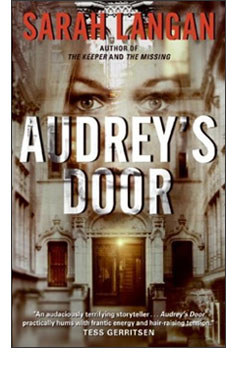
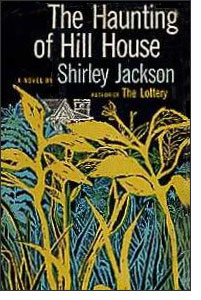
The red type, the looming face, the evil eyes... The packaging for Langan's latest, 'Audrey's Door' (Harper / HarperCollins ; September 29, 2009 ; $7.99), screams lurid horror novel, of the sort you'd find on the racks of your local drugstore. You’d never know it was her fourth novel, that she's been highly acclaimed along the way, or that 'Audrey's Door' is in and of itself an outstandingly imaginative exploration of place and psyche. Compare this cover to the cover of Shirley Jackson's classic, 'The Haunting of Hill House,' first released as a hardcover. This is actually one of the reasons I write this column. Now look, I don’t mean to be high-falutin'. I like high grade American Cheese. I love a good quick monster book, and lots of books that look like this are fine monsterish books, or whatever. (Many are, well, not worth your time or money.) But Langan is, to my mind, more than an author of fun supernatural novels. She's an accomplished writer who could be more effectively marketed as a trade paperback or hardcover novelist – with the quality stuff. That would be in a world where using the supernatural literary toolkit didn't somehow automatically disqualify you from being literature. Still, I suppose in the final analysis, it's the words that matter. And it is likely that somewhere along the line, some independent publisher will create luxury hardcover editions for book addicts like myself.
In the interim, we have a cheesy-lookin' novel that is a superbly well-written tale of how where we live affects who we are; and the reverse as well. Granted, the protagonist Audrey Lucas is not the most perfect woman in the world. She's sort of, well, compulsive, something I happen to identify with. Trust me, we're not really compulsive, we're just doing what we know to be best! But Audrey's also desperate. Times are tough, and even with its shitty history, she can't pass up the unbelievably affordable apartment in Manhattan. Even if it was built by a kook who eliminated the right angles. (And here's a gift for all of us who read and loved Frank Belknap Long's evocation of H. P. Lovecraft's "The Hounds of Tindalos.") I'll let readers discover the plot points that allow Langan to use her transparent and powerful prose to evoke humans as distressing as an apartment where a mother kills her children, for example. Give yourself some time to read this one. It will certainly give you a case of what I used to call the Stephen King flu, which one can easily come down when a new King book comes out. The symptoms are easily identified; you feel both energized to read and too tired to do anything else, so you hunker down on the couch and read for a couple of days. It's the illness only a good book can cure. There's a good reason they sell cheesy horror paperbacks on the racks of drugstores!
|
|
09-14-09: Monday Miscellany : The Reading Life
It's not like I've run out of books to write about, no. But occasionally the life of reading catches up with me. On Thursday, I was heading home from an interview at KUSP with S. G. "Scott" Browne about his book, 'Breathers: A Zombie's Lament,' and it happened that I had to stop at Capitola Book Café to pick up a copy of another book by an author I'm interviewing on Monday. Outside the Café, they have a cart full of remaindered books, and a title caught my eye.
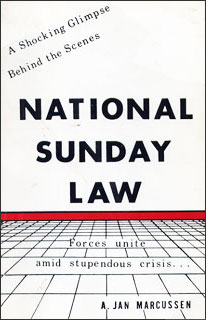
It was a hardcover first edition of 'The Long Home' by William Gay. I was shocked that I could pick up a first edition of this fine near-Lovecraftian novel for a song. But I noticed something out of place on the stack of books next to it. Amid all the pristine hardcovers, there was a ratty weird-format paperback with an ominously familiar title: "National Sunday Law." Could this be? I wondered, picking up the book.
It could be. It was.
From 1991, a relatively recent vintage, "The Sunday Law" was a Seventh-Day Adventist book about the coming Apocalypse. It was the very sort of book that had given Ray Garton nightmares for 46 years. As I paged through it, I saw chapters spelling out the warning signs; "The Two Horned Beast," "The Beast Identified," "The Beast Described STOP! If you have not read Chapter 2, "The Beast Identified," donét read this chapter," and so on up to the point where they had to get fancy with the type, "The Global Conflict." I had to have it, and Janet Leimeister, one of the many fine folks at CBC, allowed me to walk away with it at no cost. Lucky me! As I read it, I could only wonder what the author would have to say about the world some 20 years on. We've only gotten closer to hell, I would guess. (And I might agree!) The weird resonance between having heard Garton's tales of growing up in terror of the Sunday Laws and finding a book about them is still working its way through my mind and perceptions.
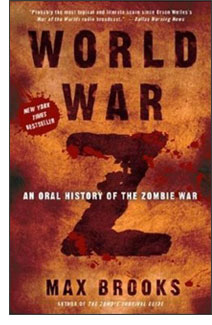
I arrived home to a considerably different book experience. Readers will remember that I recently spoke with David Sedaris, who afterwards sent me a very nice postcard suggesting Iéd enjoy 'World War Z' by Max Brooks. Now to be fair, he wasn't the first to suggest this, but he did manage to tip the scales. I'd actually looked for a copy at Borderlands Books when I'd interviewed Garton, but being fussy, I decided I wanted to get a first edition, first printing. It turned out to be harder than I expected, but last Monday, I decided to indulge myself and bought one via Bookfinder.com from Powell's Books.
When I arrived home that last Thursday, it was waiting for me on the table. I eagerly opened the package, which was very well packed, noting it came in a BroDart cover, a good sign. As I paged through it looked pristine, until I noticed that a page just before the novel begins had a big old inscription, from a father to a son. It really threw me. I didn't want to have someone else's life inserted in my book. It felt weird, and kind of creepy. Also, on a practical level, it annihilated the value of the book. Even if I did just want to read it, I could have bought the HC at Borderlands; trying to read this copy I knew I'd be eternally distracted by the inscription. It would be like reading a book held by a corpse. Dreading the inevitable painful process, but frankly, not willing to spend money I clearly didn't have, I called up the 800 number for Powell's and grit my teeth.
Imagine my very pleasant surprise when it proved to be almost absurdly easy. I read the order number from the enclosed paperwork, called, and got through a single voice menu and was quickly connected to a clerk. I explained that the book was not a pristine first, allowing that the inscription might easily have been missed. The clerk totally understood what I was talking about, to the point that she wondered whether hers at home was a first / first. The follow-up was easy. She emailed me a PDF file for the return. I printed four copies, put the book back in the box with some newspapers, and had it ready for the postman in a total of less than fifteen minutes. The upshot is that I'd buy again from Powell's with no hesitation. (And that I was able to find another copy ten dollars cheaper, unread.) Still, the sad story of the father to son gift that ended up at Powell's, the tie-in with Garton, the interviews I'd done and to come ... it all seemed to weave together in some kind of fabric of surreal strangeness .... the reading life.
|
|
|
|
|
|
|