|
 |
 11-06-09: Helen Merrick Reveals 'The Secret Feminist Cabal' : 'A Cultural History of Science Fiction Feminisms'
The word "secret" can cut two ways. On one hand, there are the secrets we keep because we are deliberately hiding something from someone; for example a small group of women plotting to overthrow the male hegemony that has ruled since time immemorial might well not wish that their plans be revealed before they've made their move. They want their plans kept deliberately secret.
There are few literary backwaters as teeming with life as those in the science fiction genre. Born of the writings of noble Englishmen (H. G. Wells) and French men (Jules Verne) and even, arguably, the work of a woman (Mary Shelley), and a down-and-out American (Edgar Allen Poe) the science fiction, fantasy and horror genres all coalesced in the gutter literature that was the world pulp fiction. There, in a sewer of their own design, a rich primordial soup formed, bursting with literary and sub-literate life. Most of of written, edited and published by men.
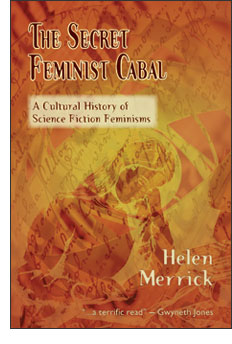
But as the work of Mary Shelley indicated, genre fiction was not to be the sole domain of men. And the women who wrote, edited and published had to be tougher, smarter and better than their male counterparts. Where there's a history, there's a story, and the story of women in science fiction spills out in Helen Merrick's 'The Secret Feminist Cabal: A Cultural History of Science Fiction Feminisms' (Aqueduct Press ; December 2009 ; $19). Merrick boldly goes where no ... academician has gone before and brings back an entertaining tale of women writers, editors, publishers and fans. It's SF convention girl-gossip channeled by a university scholar. The results are bracing, well-informed, and sort of shocking. Literature and feminism entwined in an unusual manner in that primordial soup. What emerged was, not surprisingly, sort of magical.
Merrick sticks with the recent past, and her work is thoroughly academic. That said, you'll find the history of Femizine, a British fanzine for women. You'll also find lots of literary theory and criticism as Merrick tries to deconstruct just what feminism is and then to understand its intersection with and incarnation in genre fiction. It's a troubled and complex history that will draw readers who might think of themselves as troubled and complex. Here's a quote from Justine Larbalestier found early on that I think gets to a very interesting point: "While not all of the women who have been part of the field of science fiction would identify as feminists, the fact of their participation has become a feminist issue."
What's interesting to more general readers is the existence of an intensely active, intensely intelligent literary, cultural and sexual discussion taking place in the back waters of a genre that many think begins and ends with, as U2 calls them, "Stories for Boys." You'll meet a lot of wonderfully outspoken women in this book, writers, critics and, critically, fans. The very idea of "fans" when it comes to literature is somehow abhorrent to the literary world. Particularly as regards the stereotypical "Syfy," shall we say, fan. But in our own little backwater, the stereotypical fan does not fit the stereotype. You go to a decent convention where the focus is on literature as opposed to media (World Fantasy Convention is a great example of this), and you'll find a lot of smart women who are not interested in costumes, but are interested in literature and literary theory. If you can'[t make the conventions but still crave the literary theory, you might as well join 'The Secret Feminist Cabal.'
|
|
 11-05-09: Dean Koontz is 'Breathless' : At This 'Relentless' Pace, Who Can Blame Him?
In some ways, I feel sorry for Dean Koontz. Yes, he's a regular occupant of the bestseller list. He's got more projects in the hopper than our over-worked President. He pops out hardcover thrillers at a torrid pace. If his investment advisor is any good, he's got to be richer than Croesus. And yet ...
For all his written success, Koontz has never had a decent movie made from one of his books. True, the incredibly bad movies made from some his books have given him an opportunity to exercise his sense of humor. And there's one book in particular that has been made and remade into a series of movies that would try the patience of a saint. That would be 'Watchers,' his 1987 novel that many readers consider his best — or if not his best, then at least their favorite.
For me, 'Watchers' is a superb example of Koontz's talent for creating sympathetic monsters that are truly terrifying and yet, heartbreakingly sympathetic. There's a moment of discovery in that book that still brings me to the edge of tears. And moments of terror that still resonate more than twenty years after I've read the book.
Koontz has been trying on and off again to duplicate the vibe of that book. I rather liked 'Fear Nothing,' and the sequel 'Seize the Night.' Those novels always make my drives down to southern California, past Camp Roberts, a treat, since there's a scene in one of them that transpires in those abandoned clapboard buildings that's nearly the equal of the new-development scene in 'Watchers.' There was a Dark Harvest 'Night Visions' novella that also tried to duplicate the sensibility of 'Watchers,' not quite successfully, but still, it had some good juju. What do all these Koontz books have in common?
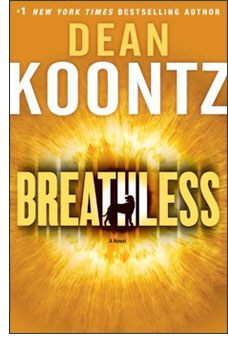
Monsters. Intelligent monsters. So when I opened up 'Breathless' (Bantam / Random House ; November 24, 2009 ; $28) and found a rather graceful opening which culminates with the appearance of two large white — somethings — I was hooked before I knew what was good for me. What follows on pretty much lives up to the title, as Koontz pulls on all the cables in his career, the supernatural and the science-fictional, to once again create characters who are not human.
And this is the interesting aspect of this book. Koontz loves all his characters here, though they’re not all admirable folks. Nor are they all human. Given that there are about a bazillion readers who will never forget Einstein, the doggie at the heart of 'Watchers,' it should come as no surprise that there are a lot of doggies in this one. Koontz goes beyond multi-cultural here; this is a cast with a variety of species. That said, you'll like them all, and he holds back from offering the reader a pack of 'Old Yellers.' To mind, this novel points the way for collaboration between Koontz and Jonathan Carroll, both ardent dog lovers. I don’t know that 'Breathless' will replace 'Watchers' in readers' hearts; even 'Watchers' itself probably couldn’t do that. When we remember books with fondness, it's more than content.
|
|
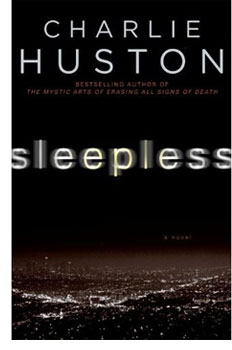 11-04-09: Charlie Huston is 'Sleepless' : Dreamers, Dealers and Pharma
We like out authors to be predictable. We like consistency, no matter how much we say we value originality. When we find something we like, we want more. When Charlie Huston started with his Hank Thompson novels, if he'd have asked me, I'd have said, keep at 'em. Then he went out and started the Joe Pitt novels, and again, I'd have suggested, don’t limit this — until I read 'The Mystic Arts of Erasing All Signs of Death.'
It wasn't so long ago that Huston told me he was working on a science fiction novel,or at least it didn't seem like so long ago until I looked it up. That said, just like very time before, there was a little devil sitting on my left shoulder telling me that we'd like it better if Huston just wrote more of those snappy vampire novels, or followed up on his new serial character, Web Goodhue. I somehow had the idea that a science fiction novel would lack the things I liked about Huston — the snarky attitude, the savage action, the kick-ass plotting.
Of course, 'Sleepless' (Ballantine / Random House ; January 13, 2010 ; $25) proves me wrong, and happily so. That said, this is rather different than Huston;s other work. Sure, all the elements we like are there, but they're combined in a different recipe so that the overall effect is a bit different even if the individual pieces are the same. And motivating the entire proceeding is the same raging anger that makes Huston's work so enjoyable.
The setup here is pretty inventive; the world's slide towards the shitter has not abated, and Parker Hass is one of those who is supposed to stem the tide. Insomnia has become a plague, and in answer, there's a drug that is supposed to help. There's more than enough violence to go around, what with RPG-armed gangs duking it out and human bombs cratering the streets. Of course, there's a secret that drives the guns, gangs, bombs and drugs, and Hass is going to be unlucky enough to come within the general vicinity of said secret.
Setup, shmetup — the secret here is in the execution and Huston is more than up to the challenge. His near-future LA seems like a CNN special report beamed from the future. It's chaotic but clearly underpinned by a smartly-defined set of suspicious extrapolations. He's got a great storytelling surprise in terms of how he lays out the perceptions, going back and forth from third-person to first-person in a manner that enhances the mystery at the core of the novel. His sense of humor is here, but it's grown very much bleaker. Yes, the dialogue is sharp as a razor, but you won't find it so prominently featured as in the Joe Pitt novels. The plot is alas, believably, depressingly ruthless and gripping. It makes you sort of regret the CNN feel. You really don’t want to live in this future, event though you do want to read about it. 'Sleepless' is good enough that you'll probably want to read another novel set in this unpleasant future. But you'll also hope that your own future holds more surprises from Huston.
|
|
11-03-09: A Quick Look at the 2009 World Fantasy Convention : Slick, Smart and Entertaining

I've come round full circle on these conventions, it's true. From a geeky gee-whiz to a ... well, as far as the 2009 World Fantasy Convention is concerned, a deep appreciation of a job well done. Superbly organized, well-attended, and chock full of smart stuff for readers, writers and anyone interested in reading and writing, this was for me, the best convention I've attended.
I'll focus on the three main elements that made the convention so enjoyable and rewarding. First, the all aspects of the WFC's organization, from the site selection, to the panels, to the scheduling, were just perfect. The Fairmont Hotel was big enough to accommodate everyone. All the panels, the dealers' room and whatnots (press office and interview site) were on one floor. You just had to walk around a big ol' circle on one floor in one building to get to any event. There was no rushing fro one site to the next, running around the streets, or any of that. You could stroll from one panel to the next. There was plenty of seating in all the rooms, there was great sound and amplification so you could hear everyone.
The panels were all extremely interesting and well-thought out so that the participants were thinking deeply, expressing themselves well, and generally didn't need a lot of prep to do so. There was a large downstairs lobby/restaurant/lounge where participants could gather informally — a perfect place to meet and mingle, if you’re good at that. (Alas, I'm not.) The Fairmont isn’t cheap, but if you pay a bit more you get, to my mind, a lot more. All in all, the whole infrastructure was just superb. Kudos to the organizers for bringing this off so smoothly. I hope nobody who is on the board has the temerity to do anything except offer hearty congratulations on a job well done.
The content and focus of this convention also made it a winner so far as I was concerned. Now mind you, I'm a reader and reviewer and author interviewer, so I totally loved the fact that there was no media content whatsoever. No panels devoted to a TV series, or movies, or games, or anything other than books and literature and art. It's so refreshing to attend an event that doesn't seem like it's crammed full of thinly-disguised promotions for games, TV and movies — I just loved this aspect of the World Fantasy Convention; this is a convention for readers of all genres.
And finally, of course, attendees were the main reason to enjoy this year's World Fantasy Convention. The writers, publishers and other guests were all quite literate, well-spoken and covered a wide range of interest; from the science fiction writers like David Drake, to the experimental literature writers like Brian Evenson. On panels and in interviews, these writers were all superbly interesting, and often really surprising in terms of what they'd say. Over the following weeks, be prepared for a deluge of interviews with the top writers in the field. Some of these interviews became quite intense, really, as we sorted out just why these writers what they do the way they do.
Now, all this said, I will have to add that for reasons that escape me, I always feel like an outrider at these conventions. I'm sure this is a largely self-imposed perception, but there it is. To a degree, I'm glad that I do. I feel more like a reporter examining a sub-culture than a member of that sub-culture. And a feeling of belonging is certainly neither necessary nor necessarily advantageous when it comes to enjoying what the WFC has to offer — which is an unparalleled literary experience, an opportunity to immerse one's self in the literature of fantasy, science fiction and horror. There aren't many ways to enhance a reading experience. For me hearing (or conducting) a good interview is one of the few ways to do so; an effective, non-spoiler review can also be of help. The WFC offers the opportunity to engage in an appropriately weird combination of both.
|
|
11-02-09: Graham Joyce Knows 'How to Make Friends With Demons' : Personal and Infernal
William Heaney is the kind of guy who's worth a listen. He's the kind of guy you want to read.
It's easy to think about characters here, and plots there, about high concepts and low humor, each thing separate, part of a book. As a reader you're supposed to put them all together.
But that's not really the case. When you pick up a book, you're entering into a one-sided conversation, and you'd damn well better want hear what the other speaker has to say.
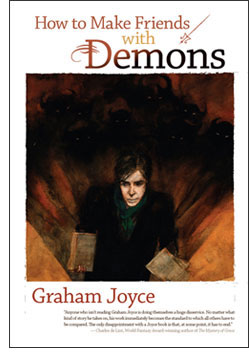
William Heaney, the narrator of Graham Joyce's new novel, 'How to Make Friends With Demons' (Night Shade Books ; November 15, 2009 ; $24.95) speaks with the kind of easy authority that makes the reader want to read what he has to say. There's a natural feel to his voice, so that whether he's talking about interminably boring meetings, or the 1,567 demons he's catalogued, you just want to keep reading. You want to keep listening, even when his story gets difficult — and I'm not talking about the demons. They're pretty easy and entertaining to read about. It's the real stuff that's scary.
Graham Joyce is a particularly brilliant writer who knows how to create characters so compelling that we'll believe them no matter what they say. Or at least, we'll believe that they believe and that's what matters. 'How to Make Friends With Demons' is the novel-length version of Joyce's O. Henry Award-winning story, "An Ordinary Soldier for the Queen" and it more than lives up to the original. Joyce has crafted a narrative that explores demons everyone acknowledges with a mordant sense of humor, one that accepts the existence of demons very few of us would allow into our lives. Using the second to unwrap the first lets Joyce and his engaging narrator, William Heaney get a perspective on the damages we do to one another and ourselves that unique, entertaining and addictive. Credit that last to a demon. It doesn't hurt that Heaney is a book addict, Readers who love books will find a kindred soul here. And that will be troubling.
Giving credit where credit is due also involves Night Shade Books, a publisher that is quickly overtaking most of the so-called major publishers with regards to original, genre-ish fiction. Along with Paolo Bacigalpi's 'The Windup Girl,' 'How to Make Friends With Demons' is quite likely to be one of the best novels published this year, damn the genre. Or rather, be glad. The fact that major publishers weren't falling over themselves to get this book is itself evidence of the kind of demons you don’t want to believe in. That fact that it got published is probably also evidence of their existence. They couldn't find a better man to represent them than Graham Joyce via William Heaney. I only hope that they paid the price — and not he. I'm suggesting that readers pay the price and order directly from Night Shade, or at the very least, from your local independent bookseller. Lest you attract demons of your own making.
|
|
|
|
|
|
|