02-10-13 UPDATE:Podcast Update:Time to Read Episode 84: Cory Doctorow 'Homeland'
Click image for audio link.
Here's the eighty-fourth episode of my new series of podcasts, which I'm calling Time to Read. The podcasts/radio broadcasts will be of books worth your valuable reading time. I'll try to keep the reports under four minutes, for a radio-friendly format. If you want to run them on your show or podcast, let me know.
My hope is that in under four minutes I can offer readers a concise review and an opportunity to hear the author read from or speak about the work. I'm hoping to offer a new one every week.
The eighty-fourth episode is a look at Cory Doctorow, 'Homeland'.
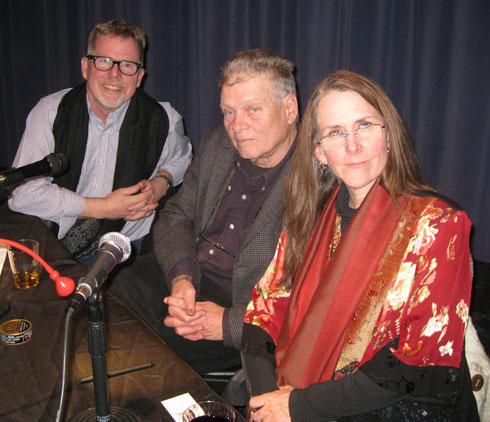
02-06-13: Panel Discussion with Steven Gould and Laura J. Mixon Moderated by Terry Bisson from SF in SF January 19, 2013
Click image for audio link.
"...the very difficult choices women still have to make between their career and their kids..."
—Laura J. Mixon
As first, Laura Mixon, then Steven Gould read from their respective works, you could probably see where this panel discussion was going. Here were two engaging married authors, whose science fiction readings both addressed family issues in a very clear manner. Obviously, for this family, science fiction is a means of telling stories about families.
This not only makes a lot of sense, but it makes for a very lively discussion about how and why the literature of the fantastic is created. One might at first think that the conjunction of the domestic and the fantastic might be rather limited, but that is clearly not the case. Both writers, a they extrapolated from a very clear premise, found themselves blending the imaginary with the familiar — and family.
Steven Gould was quick to note that the elements in his novels that reflect portions of his personal life emerge from his story. He writes from his premise (a young man finds out he can teleport) and the story he tells turns out to involve experiences from his life. In fact, the three novels in the "Jumper" series have each proved to be quite personal for Gould.
Mixon talked about how her work explores the themes of the opportunities that women have in our world. By virtue of taking us into the solar system, she can shine a much clearer light on the problems that a woman faces when she must choose between going to work and staying home with the children.
}
And yes, of course, the movie questions were asked and answered. That in itself is an interesting story. One hopes that both authors will address it in future works; it just seems so ripe for exploration. The omnipresence of media in our lives is an undeniable fact, and as all of us get closer to having the sort of tech it takes to make a movie, it seems inevitable that we will rocket past the point where our lives resemble a Steve Gould or Laura Mixon novel. Until then, you can hear the authors talk about their work by following this link to the MP3 audio file.
02-04-13:A 2013 Interview with Ian Rankin
Click image for audio link.
"Everything I know about writing I've learned from reading books."
— Ian Rankin
Ian Rankin looks impossibly young to have written as many books as he has, from his first Rebus novel to the latest, 'Standing in Another Man's Grave.' I learned during the interview just what that is, but when he arrived at KQED, I had to re-adjust my expectations.
To be honest, I was indeed expecting a gentleman a bit more Rebus-like than the one who stepped out of the elevator. But one learns to annihilate expectations in the face of reality when one does interviews, simply because they tend to derail better questions. Of course, the other derailer-of-questions is a big long talk before the interview. Alas, we were both early, so we headed up to the fabled "green room" while the studio techs prepared.
Fortunately, there was one thing we could talk about that was tangential to the books but not a derailer; that being music, as there's certainly plenty of it in the books! It turns out that Rankin is younger not just in fact, but also in musical taste than his protagonist, so there was a good deal to be said about the glory days of 1970's and 1980's music.
Once we sat down to talk about the books, the answers with regards to Rankin's youth were answered; he is young, with such a large catalogue, because he started young. Once you get that factored it, it all becomes clear. Rankin is very straightforward about his writing process; there's a bit of planning and a bit of instinct and very much writing.
One of the fascinating aspects of 'Standing in Another Man's Grave' is the presence of Malcolm Fox. In fact, Malcolm Fox himself is an interesting story. He's in the unit they call "the Complaints," which is the title of the first Malcom Fox novel. That's the UK equivalent of what we in the States call "Internal Affairs," that is, the cops who ferret out bad cops. As Rankin points out, they're hated by everyone.
Fox started out as a clear — and very different from Rebus — protagonist in his own novels. Of course, when he shows up in the return of Rebus, it's a very different matter. Rankin found that the hero of one novel would be the antagonist of another. Rankin and I talked about turning the tables on Fox. I have to day that I was barely into 'Standing in Another Man's Grave,' when I sussed that the stuffy Fox was the protagonist in two of Rankin's novels.
08-21-15: Agony Column Podcast News Report : Senator Claire McCaskill is 'Plenty Ladylike' : Internalizing Determination to Overcome Sexism [Incudes Time to Read EP 211: Claire McCaskill, Plenty Ladylike, plus A 2015 Interview with Senator Claire McCaskill]
Agony Column Podcast News Report : Emily Schultz Unleashes 'The Blondes' : A Cure by Color [Incudes Time to Read EP 210: Emily Schultz, The Blondes, plus A 2015 Interview with Emily Schultz]
07-05-15: Commentary : Dr. Michael Gazzaniga Tells Tales from Both Sides of the Brain : A Life in Neuroscience Reveals the Life of Science
Agony Column Podcast News Report : A 2015 Interview with Michael Gazzaniga : "We made the first observation and BAM there was the disconnection effect..."
04-21-15: Commentary : Kazuo Ishiguro Unearths 'The Buried Giant' : The Mist of Myth and Memory
Agony Column Podcast News Report : A 2015 Interview with Kazuo Ishiguro : ".... by the time I was writing this novel, the lines between what was fantasy and what was real had blurred for me..."
Agony Column Podcast News Report : A 2015 Interview with Marc Goodman : "...every physical object around us is being transformed, one way or another, into an information technology..."
Agony Column Podcast News Report UPDATE: Time to Read Episode 199: Marc Goodman : Future Crimes: Everything Is Connected, Everyone Is Vulnerable and What We Can Do About It